The Question of Placement
The geometry of the pyramids and Earth scaling is not simply a topic of architectural curiosity, but a gateway into a deeper understanding of how ancient civilizations may have perceived the planet itself. When we examine the Great Pyramid of Giza through this lens, we are no longer looking at a monument in isolation, but at a structure that appears to encode relationships between Earth, mathematics, and cosmic order. Could it be that the builders were not merely constructing in stone, but translating planetary knowledge into form? And if so, what does this reveal about their understanding of the world—and our own? Why was the Giza Plateau chosen, and why does it appear so persistently in analyses as a near-center of the Earth’s landmass when viewed through certain geodetic models that attempt to balance continental distribution?
The conventional narrative suggests convenience—proximity to the Nile, availability of stone, and political centrality—yet this explanation feels incomplete when one considers the broader geographic implications of such placement across a spherical Earth. To identify a point that balances landmasses requires not only travel, but synthesis, a form of planetary awareness that challenges the idea of a localized and technologically limited civilization. Alternative researchers have long argued that this positioning reflects an inherited or rediscovered understanding of Earth as a measurable sphere, a concept that mainstream timelines place much later in human intellectual history. If this were true, then Giza would not simply be a construction site, but a deliberate anchor point in a global system, perhaps even a reference origin for mapping or measurement. The implication deepens when we consider that multiple ancient civilizations appear to cluster around meaningful latitudes and longitudes, suggesting intention rather than accident. So we are left with a question that cannot be easily dismissed: was Giza chosen because it was convenient, or because it was mathematically and geographically essential?
Key Takeaways
- Giza lies near a calculated center of Earth’s landmass (depending on projection models)
- Latitude allows optimal visibility of both northern and southern skies
- Requires knowledge of Earth as a sphere and large-scale measurement
- Suggests potential use as a global reference or calibration point
- Challenges the idea of a localized, primitive civilization
Coordinates and Constants
The latitude of the Great Pyramid, approximately 29.9792 degrees north, continues to provoke both fascination and skepticism because of its striking resemblance to the numerical value of the speed of light, 299,792,458 meters per second. Mainstream scholars quickly dismiss this as coincidence, pointing out that degrees and meters are modern constructs, and therefore any correlation must be accidental rather than intentional. Yet this dismissal assumes that the relationship must be literal rather than proportional, ignoring the possibility that ancient builders encoded dimensionless constants that only later align with our systems of measurement. The geometry of the pyramids and Earth scaling becomes especially evident when we examine their placement on the planet. Alternative interpretations suggest that what we are seeing is not the direct encoding of a number, but the preservation of a ratio or harmonic relationship tied to fundamental properties of reality itself. If so, then the pyramid becomes less a monument and more a translation device, converting universal constants into geometric form that can survive the erosion of language and culture. The deeper issue here is not whether the numbers match perfectly, but whether the builders possessed an awareness of constants that transcend human systems of units. If they did, then the pyramid is not merely located on Earth—it is synchronized with the laws that govern the universe. So the question becomes unavoidable: are we projecting meaning onto numbers, or rediscovering meaning that was always intended?
Key Takeaways
- Latitude: 29.9792° N
- Speed of light: 299,792,458 m/s
- Numerical similarity suggests possible encoding or coincidence
- Raises idea of dimensionless constants vs human units
- Pyramid may encode ratios rather than fixed numbers
- Key concept: Geometry as a carrier of universal constants
Orientation to True North
The Great Pyramid’s alignment to true north, deviating by only about 3/60 of a degree, represents a level of precision that remains astonishing even by modern engineering standards. Traditional explanations propose that ancient Egyptians used stellar alignments, particularly circumpolar stars, to achieve this orientation, yet such methods would require prolonged observation, stable instrumentation, and a deep understanding of celestial motion over time. Mainstream archaeology acknowledges the accuracy but often underplays its implications, framing it as an impressive yet isolated achievement rather than evidence of a refined and repeatable system. Alternative researchers argue that such precision suggests not only observational skill but also a methodology that may have involved tools or techniques not preserved in the archaeological record. The distinction between true north and magnetic north alone implies an awareness of Earth’s axial behavior, something that cannot be casually inferred without consistent observation. Through the lens of the geometry of the pyramids and Earth scaling, even their coordinates begin to feel intentional. When we consider that the entire structure maintains this alignment across millions of blocks, the achievement becomes even more difficult to attribute to simple trial and error. Precision at this scale is not decorative—it implies function, calibration, and intent. So we must ask: what purpose demands that a structure be aligned so perfectly with the axis of the Earth?
Key Takeaways
- Alignment error: ~0.05° (3/60 of a degree)
- Distinguishes true north vs magnetic north
- Requires astronomical observation and long-term tracking
- Consistent precision across entire structure
- Suggests surveying system or advanced methodology
- Implies purpose beyond symbolism
Geometry as Language
The geometry of the Great Pyramid reveals relationships that seem to transcend practical construction, suggesting instead a deliberate encoding of mathematical principles within its proportions and spatial logic. The ratio of the perimeter to twice the height closely approximates 2π, effectively embedding the properties of a circle within a square-based structure in a way that is both elegant and persistent. Mainstream interpretations often attribute this to coincidence or structural convenience, yet this perspective struggles to explain the consistency and clarity of the relationship when measured precisely. Alternative thinkers propose that the pyramid functions as a geometric statement, expressing constants such as π and possibly the golden ratio through its carefully chosen dimensions. If geometry is a universal language, then the pyramid may be a form of communication, one that conveys knowledge without relying on symbols that can be lost or misinterpreted. The slope angle, approximately 51.84 degrees, creates a harmonic relationship between height and base that can be expressed mathematically in multiple ways, reinforcing the idea of intentional design. The precision of alignment reinforces the idea that the geometry of the pyramids and Earth scaling was central to their design. Such precision suggests encoding rather than approximation, intention rather than accident. So we must consider whether the pyramid is merely shaped by geometry, or whether it is itself a deliberate expression of it.
Key Takeaways
- Perimeter / height ≈ 2π relationship
- Slope angle: ~51.84°
- Possible presence of golden ratio (≈1.618)
- Geometry appears intentional, not incidental
- Pyramid acts as a mathematical structure in 3D
- Key idea: Geometry as universal language
Materials and Inner Design
The selection and placement of materials within the Great Pyramid suggest a level of intentionality that goes far beyond simple availability or structural necessity, pointing instead toward a deeper understanding of physical properties and potential functionality. Limestone forms the bulk of the structure, yet the outer casing once consisted of highly polished Tura limestone capable of reflecting sunlight with remarkable brilliance, possibly making the pyramid visible from vast distances. Granite, rich in quartz and transported from Aswan over hundreds of kilometers, is concentrated in key internal chambers, particularly the so-called King’s Chamber, where its density and composition stand out. Mainstream explanations emphasize durability and symbolic importance, yet alternative perspectives explore the possibility that these materials were selected for their mechanical and energetic properties, including resonance and piezoelectric effects. Quartz-bearing granite under pressure can generate electrical charge, raising questions about whether the pyramid was designed to interact with stress, vibration, or frequency. The presence of basalt in flooring and other structural elements adds further complexity, suggesting a deliberate combination of materials with distinct physical characteristics. If the pyramid were intended to function in ways we do not yet fully understand, then material choice would be central rather than incidental. When we explore materials and structure, the geometry of the pyramids and Earth scaling reveals deeper layers of purpose. So we must ask: were these stones chosen simply because they were available, or because they were essential to a purpose we have yet to rediscover?
Key Takeaways
- Total blocks: ~2.3 million
- Block weights: 2 to 80+ tons
- Granite transport distance: ~800 km (Aswan to Giza)
- Materials: limestone, Tura limestone, granite, basalt
- Quartz in granite → potential piezoelectric properties
- Suggests functional material selection
Scale and Earth Relationships
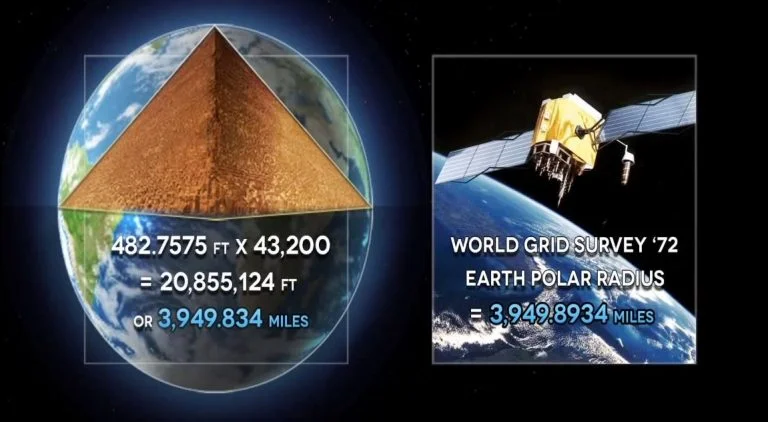
The dimensions of the Great Pyramid appear to invite comparison with the Earth itself, leading some researchers to propose that it functions as a scaled representation of planetary properties rather than a purely local construction. Mainstream academia often rejects such interpretations as numerological, arguing that correlations can be found in any sufficiently complex structure, yet this skepticism does not fully address the consistency of certain proportional relationships. The original height of approximately 146.6 meters, when scaled appropriately, aligns intriguingly with larger geophysical measures such as Earth’s radius or even the Earth–Moon distance, though not always with perfect precision. Alternative approaches suggest that ancient builders may have prioritized ratios and proportions over exact units, allowing their knowledge to be encoded in a flexible and enduring way. The concept of scaling implies intention, as it reflects an effort to represent something vast within a manageable form, much like a map or model. If the pyramid encodes planetary relationships, then it may have served as a teaching tool, a calibration device, or a symbolic bridge between Earth and cosmos. The concept of the geometry of the pyramids and Earth scaling suggests a civilization thinking in planetary terms. The recurrence of such relationships across different measurements invites further investigation rather than dismissal. So we must ask: are these echoes of planetary scale accidental, or are they deliberate reflections of a deeper understanding?
Key Takeaways
- Original height: ~146.6 meters
- Estimated mass: ~6 million tons
- Possible scaling to Earth radius and circumference
- Suggested links to Earth–Moon distance ratios
- Emphasis on proportion over exact units
- Pyramid as potential planetary model
Sacred Geometry and Sacred Numbers
When we turn our attention to the systems of measurement embedded within the Great Pyramid and other constructions of ancient Egypt, we begin to encounter a deeper layer of intentionality that challenges the notion of isolated or primitive standards. Mainstream Egyptology maintains that the primary unit was the royal cubit, estimated at approximately 52.36 centimeters, derived from the length of the forearm, yet this explanation alone does not fully account for the remarkable coherence between pyramid dimensions and other systems of measurement that emerged much later. Alternative researchers have demonstrated that the pyramid’s base length, roughly 230.4 meters per side, can be expressed not only in royal cubits (440 cubits), but also in values that closely approximate fractions of a mile, as well as subdivisions that align with what we now call the meter. This raises a profound question: how can a structure built thousands of years before the formal definition of the meter still conform so elegantly to it? One possible explanation is that the meter itself, defined in modern times as a fraction of Earth’s meridian, may unintentionally echo a much older geodetic understanding that was already encoded in ancient constructions. If this is the case, then the pyramid does not conform to our systems—we have rediscovered systems that conform to it. The presence of consistent ratios across different units suggests that the builders were not bound to a single measurement system, but were instead working within a framework of universal proportions that could be translated across scales. So we must ask: were these units invented independently across time, or are they fragments of a unified, ancient standard that once described the Earth itself?
The numerical relationships become increasingly compelling when examined closely, as the height of the pyramid at approximately 280 royal cubits corresponds to about 146.6 meters, while the perimeter of the base (1760 cubits) equates to roughly 0.55 miles, creating a bridge between cubits and miles through simple proportional scaling. Furthermore, when the base is measured in meters, its length aligns closely with values that reflect subdivisions of Earth’s circumference, suggesting that the meter may not be as modern as we assume, but rather a rediscovered fraction of planetary geometry. Even more intriguing is the observation that the pyramid’s dimensions maintain coherence when converted into different systems, meaning that whether one uses cubits, meters, or even feet, the underlying ratios remain consistent. This kind of cross-system harmony implies that the builders were working with relationships rather than fixed units, prioritizing proportion over arbitrary standards. Such an approach would allow their knowledge to survive shifts in measurement systems, ensuring that the encoded information could be rediscovered regardless of the units used by future civilizations. Sacred measurements further support the theory of the geometry of the pyramids and Earth scaling across multiple systems. The implication is profound, as it suggests that ancient Egyptian constructions were designed not only to endure physically, but to remain mathematically intelligible across time. So we are left with a final question that echoes through every dimension of the pyramid: were these measurements chosen for convenience, or were they deliberately crafted to unify Earth, mathematics, and human understanding into a single, enduring form?
Key Takeaways
- Royal cubit ≈ 52.36 cm
- Base: 440 cubits ≈ 230.4 meters
- Height: 280 cubits ≈ 146.6 meters
- Perimeter: 1760 cubits ≈ 921.6 meters ≈ 0.55 miles
- 1760 = yards in a mile
- Cross-system consistency: cubits, meters, feet, miles
- Meter linked to Earth’s meridian
- Key calculation: Perimeter / Height ≈ 2π
- Emphasis on ratios and universal scaling
Purpose Beyond the Tomb
The dominant narrative that the Great Pyramid served as a tomb for a pharaoh has long been accepted, yet it struggles to account for the full scope of the structure’s precision, complexity, and apparent knowledge encoding. There is a notable absence of definitive burial evidence within the pyramid, and its internal design does not conform neatly to other known tombs of the same period, raising questions that remain unresolved. Mainstream explanations often rely on tradition and historical continuity, yet they do not fully address why such extraordinary effort would be invested in a structure whose function could have been achieved far more simply. Alternative researchers propose that the pyramid’s purpose may have been multifaceted, encompassing roles related to knowledge preservation, initiation, or even interaction with natural forces. Ultimately, the geometry of the pyramids and Earth scaling leads us back to the fundamental question of purpose The convergence of geometry, astronomy, material science, and geodesy suggests a synthesis of disciplines that goes beyond funerary practice and enters the realm of applied knowledge. If the pyramid were intended as a repository of knowledge, then its durability and precision would ensure that this knowledge could survive across millennia. If it functioned as a device, whether symbolic or practical, then its design would reflect operational requirements rather than ceremonial ones. So we must ask, without assumption: was the pyramid built to honor the dead, or to communicate something essential to the living—and perhaps to the future?
Key Takeaways
- No confirmed burial evidence found
- Precision exceeds typical tomb requirements
- Combines astronomy, geometry, engineering
- Suggests multi-functional purpose
- Possible roles: knowledge repository, device, initiatory structure
- Central question: Why build at this level of precision?
Final Reflection
The Great Pyramid stands not only as a monument of stone, but as a convergence of questions that continue to challenge our understanding of history, knowledge, and human capability. It invites us to reconsider what ancient civilizations knew, how they knew it, and why they chose to encode that knowledge in such enduring forms. Whether we interpret its dimensions as coincidence or intention, its precision as skill or inheritance, the structure refuses to be reduced to a single explanation. Perhaps its greatest function is not what it does, but what it provokes—a continuous inquiry into the nature of knowledge itself. And so the final question remains, as enduring as the pyramid itself: are we uncovering a lost science, or remembering one?
Additional Reading and Sources
Sacred Numbers Series (link)
Ancient Measurement Systems and the Royal Cubit (link)
Ley Lines and the Global Energy Grid (link)
Archaeoastronomy and Ancient Civilizations (link)
The Language of Sacred Geometry
Great Pyramid of Giza overview and measurements (Britannica)
Papers on archaeoastronomy and pyramid star alignments
The Orion Mystery – explores star alignments and Giza correlations (link)
Fingerprints of the Gods – alternative history and lost civilizations (link)
The Giza Power Plant – engineering and functional theories (link)
Secrets of the Great Pyramid – classic work on pyramid measurements and mysteries
Serpent in the Sky – symbolic and esoteric Egypt (link)
Geodesy and Earth measurement studies
Structural engineering analysis of pyramid construction (link)
Astronomical alignment research (circumpolar stars, Orion correlation)
Materials science studies on granite and quartz properties