Mnajdra is a megalithic temple complex found on the southern coast of the Mediterranean island of Malta and recognized as a UNESCO World Heritage Sites. The complex is composed by three temples that, according to the mainstream archaeology, was erected at around 5,500 years-ago. A general study of the orientations of the prehistoric temples of Malta showed that the main axis of the Mnajdra temple had the same orientation as the equinox sunrise. But was this a coincidence or a deliberate choice of the temple builders?
What does Mnajdra’s architecture tell us about its cosmology?
 Respected scholars offer diverse perspectives. Caroline Malone and Simon Stoddart (2011) suggest that there are “clear underlying structuring principles” behind the layout of the temples with human representation that is “potentially suggestive of cosmological beliefs” in “regeneration and celebration of the cycle of life” (p. 768). Tore Lomsdalen (2010) theorizes that the temple design represents “an image of the world” in the context of cosmological time and space. The Neolithic builders viewed stone as a manifestation of power and as sacred for its timeless and predictable attributes; thus, the megalithic proportions of the temples symbolize the immensity of the temple builders’ cosmos. In Lomsdalen’s cosmological interpretation of ancient beliefs, the rhythmical moon phases gave the reassurance of survival by linking time to birth, becoming, death, plants, and fecundity. The temple structure of Mnajdra was built as an observatory of solar time cycles; it marked the passage of the sun to symbolize the assurance of never changing time or immortality. Lomsdalen’s insightful interpretation of cosmology engages with cosmic time and space; he acknowledges the relationship with landscape, ancestors and spirit worlds that are typical of indigenous spiritual traditions. Tore Lomsdalen looks to the east and south for the origins of megalithic architecture with astronomical features (Lomsdalen, 2010, p. 3).
And for many years it was assumed that Mnajdra South was the only temple with astronomical features. However, recent research by John Cox and Tore Lomsdalen (2010) found astronomical orientations and alignments at twenty-five temples on Malta and Gozo (pp. 2217-2231); thus, the evidence for intentionality continues to mount, pointing to a culture with astronomical knowledge. A quarter century of archaeo-astronomical research at Mnajdra produced the following findings:
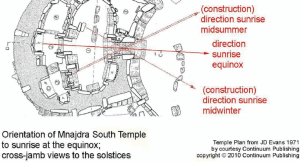
– Paul Micallef, in 1976, publishes articles on orientations and in 1990, he discovers the significance of two vertical orthostats inside Mnajdra South, based on his observations of winter and summer solstice sunrises. The entrance to Mnajdra South is aligned with sunrise on the solstice and equinox. The first rays of the rising sun at the summer solstice illuminate the vertical orthostat in the left front apse. The first rays of the rising sun at the winter solstice light up the vertical orthostat in the right front apse. At the spring and autumn equinoxes, the rays of the rising sun illuminate the central passage and inner niche (Lomesdalen, 2014, pp. 72, 86).
– In 1992, Serio, Hoskin and Ventura suggest that the orientations could be intentional (Serio, Hoskin & Ventura, 1992, p. 117).
– The small trefoil temple has two orthostats with neat rows of drilled holes, which are interpreted as tally marks, indicating that Mnajdra sky-watchers worked with “great precision” in their observations of the sky, possibly of the rising point of Pleiades (Ventura, Serio & Hoskin, 1993, p. 35).
– In 2010, Tore Lomsdalen argues intentionality by providing detailed descriptions of multiple solar events and interprets the astronomical significance of the cut-out windows that were formerly called oracle holes (Lomsdalen, 2010, p. 9). Mnajdra North is designed to frame a winter solstice sunrise (Lomsdalen, 2013, p. 192).
Two incised stones provide further evidence of astronomical knowledge. The fan-shaped Tal-Qadi stone has radiating lines and symbols that represent stars and the crescent moon; it may have been an instrument for stellar observations. Ħaġar Qim temple, only 600 meters from Mnajdra, was where a stone solar wheel was found.
Architecture is an aesthetic expression of a culture’s cosmology. Perceptions of cosmic order are translated into architectural design and art. Mnajdra was made sacred because it was a symbol of the cosmic order; thus, the modern word ‘temple’ is fitting. Mnajdra was a place to re-enact the cosmic drama of time, space, origins, and regeneration. In Mnajdra’s architectural design, we experience a cosmology in which mariculture and astronomy intersect.
References
______________________________________________________________________________
- Frank J. Ventura (University of Malta), George Agius (Independent Scolar), 2017. An Investigation of the possible Equinox Alignment at Mnajdra, Malta.
- Tore Lomsdalen (University of Malta), 2018. Can Archeoastronomy Inform Archaeology on the Building Chronology of the Mnajdra Neolithic Temple in Malta?
- Research Gate, Tore Lomsdalen
- Serio, G. F., Hoskin, M. & Ventura, F. (1992). The orientations of the temples of Malta. Journal for the History of Astronomy, 23, 107-119.
- Ventura, F., Foderá Serio, G., & Hoskin, M. (1993). Possible tally stones at Mnajdra, Malta. Journal for the History of Astronomy, 24, 171
- Lomsdalen, T. (2010). Astronomy and Intentionality in the Temples of Mnajdra. Sophia Centre for the Study of Cosmology in Culture, University of Wales. Retrieved from http://astrolom.no/dokumenter/1443_H33VR4JJWAZ9.pdf.
- Wendorf, F. & Malville, J.M. (2001). The megalith alignments. In Holocene settlement of the Egyptian Sahara, Volume I (pp. 489-502). New York: Springer.
- Cox, J. & Lomsdalen, T. (2010). Prehistoric cosmology: Observations of moonrise and sunrise from ancient temples in Malta and Gozo. Journal of Cosmology, 9, 2217-2231.
- Cutajar, D. (1986). Two relief-carvings of Chalcolithic Malta. In Archaeology and fertility cult in the ancient Mediterranean: Papers presented at the First International Conference on Archaeology of the Ancient Mediterranean, University of Malta, 2-5 September 1985, Volume 1 (pp. 163-168). University of Malta Press.