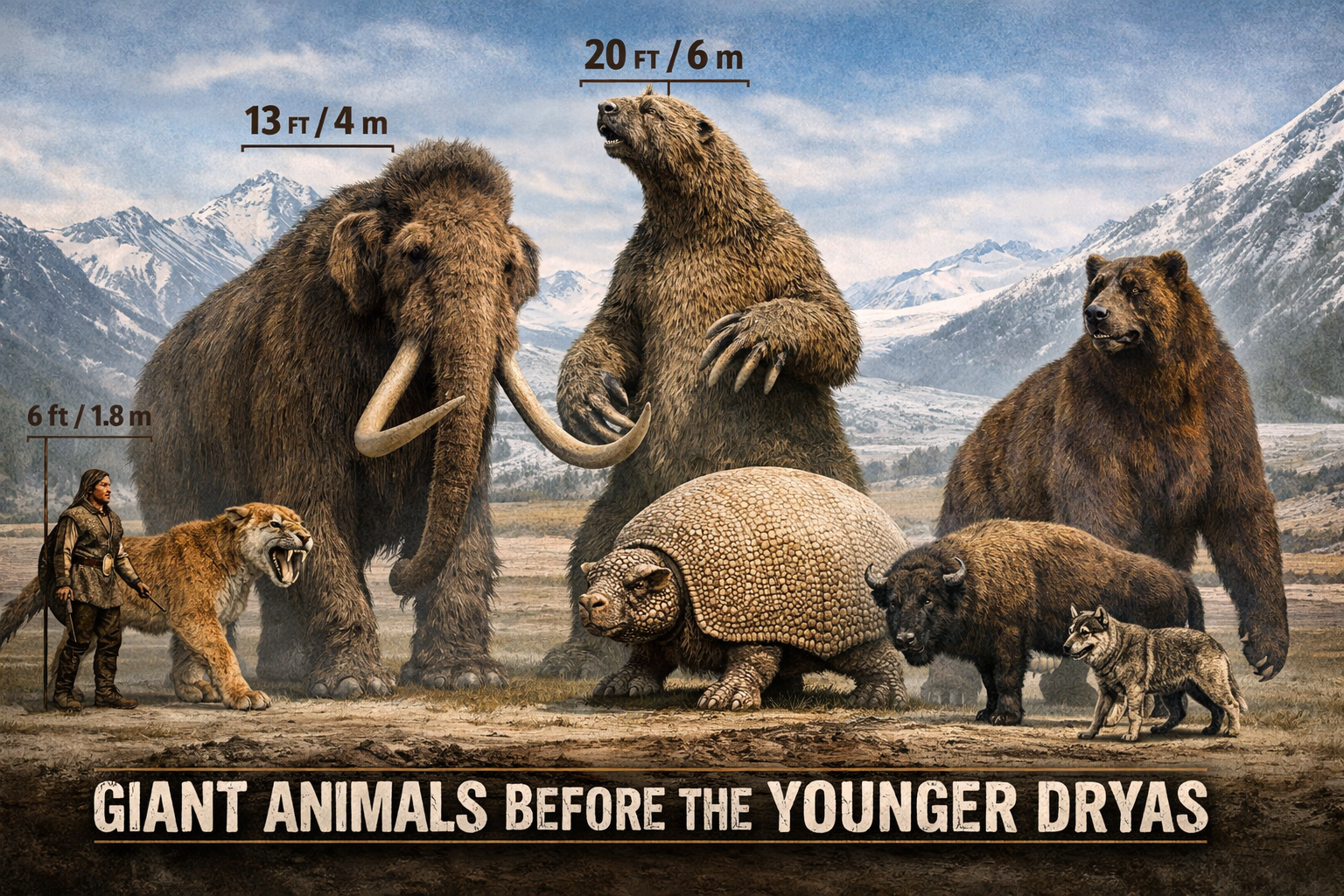
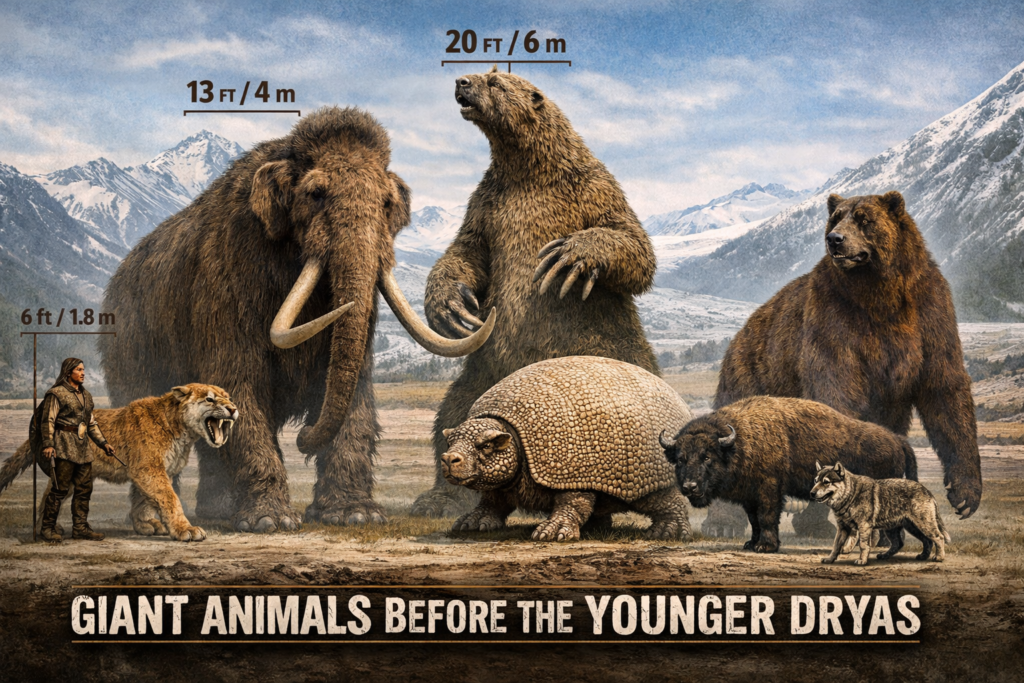
Giant Animals Before the Younger Dryas
The existence of giant animals before the Younger Dryas is not speculative, mythical, or fringe—it is established fact. Mammoths, saber-toothed cats, giant armadillos, massive ground sloths, short-faced bears, and oversized birds dominated ecosystems across multiple continents until roughly 12,900 years ago. What remains unresolved is why these animals reached such extraordinary sizes and why they disappeared so abruptly.
The conventional explanation—slow climate change combined with human overhunting—appears increasingly insufficient when confronted with the scale, biology, and sudden extinction of this megafauna. The reality of giant animals before the Younger Dryas forces a deeper examination of ancient environments that may have been fundamentally different from those of today.
The Measured Reality of Ice Age Giants
The first step in dismantling dismissive narratives is to establish scale using physical data.
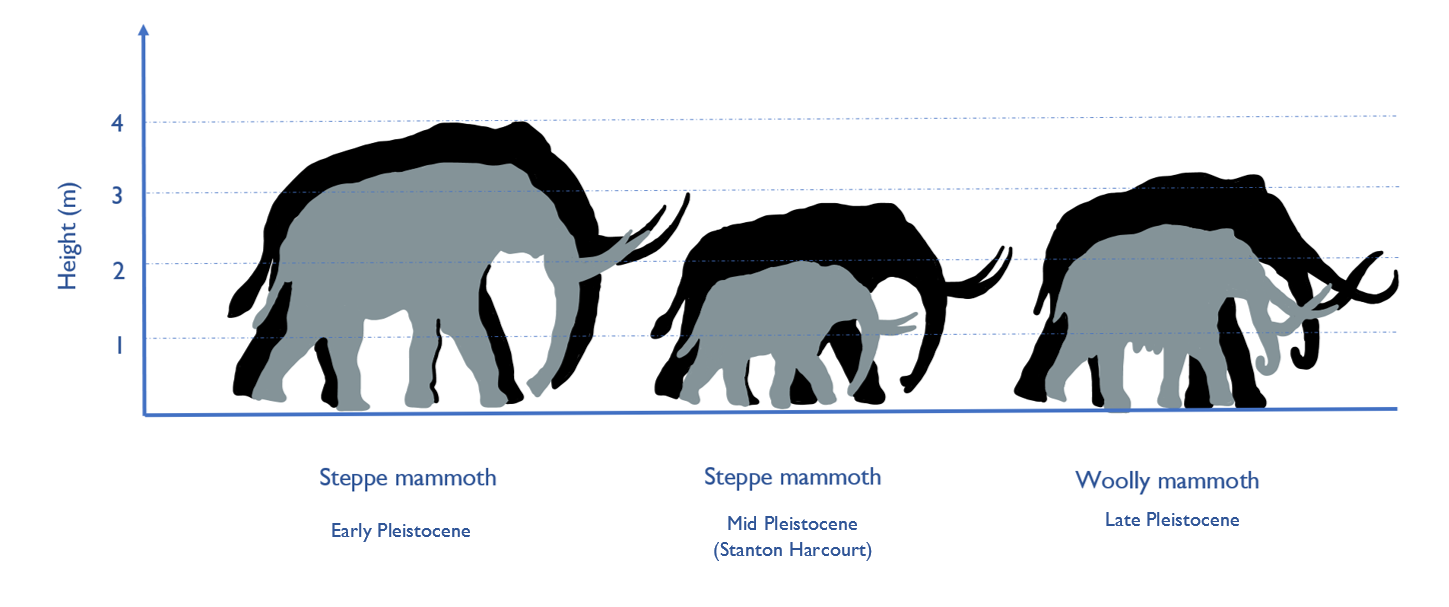
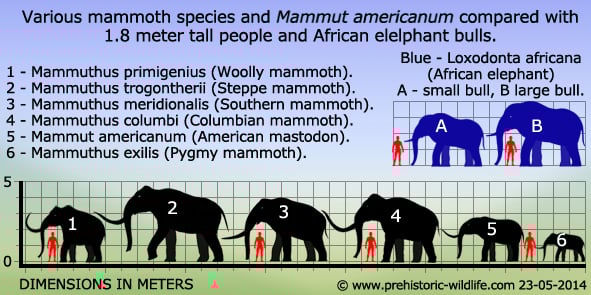
Mammoths (Mammuthus primigenius, M. columbi)
-
Shoulder height: up to 4.2 meters (13.8 ft)
-
Weight: 6–10 metric tons
-
Tusks exceeding 4.5 meters (15 ft) in length
Saber-toothed Cats (Smilodon populator)
-
Body mass: 300–400 kg (660–880 lbs)
-
Forelimbs massively overbuilt for prey restraint
-
Bite mechanics adapted for large megafauna
Giant Ground Sloths (Megatherium)
-
Length: 6 meters (20 ft)
-
Weight: 4–5 metric tons
-
Could stand upright taller than modern elephants
Giant Armadillos (Glyptodon)
-
Length: 3.5 meters (11.5 ft)
-
Weight: 2 metric tons
-
Bone armor thickness exceeding modern armored mammals
These are not evolutionary curiosities. They represent entire ecosystems structured around extreme size.
Global Distribution, Same Pattern
One of the most problematic aspects of the conventional narrative is geography. Giant animals before the Younger Dryas were not isolated to one region or climate zone.
They existed simultaneously in:
-
North America
-
South America
-
Eurasia
-
Africa
-
Australia
This global distribution strongly suggests that the underlying cause of gigantism was planetary in scale, not local adaptation. Independent evolution alone struggles to explain why so many lineages converged toward massive body sizes at the same time.
Functional Biology, Not Abnormal Growth
A common misconception is that Ice Age giants were biologically inefficient or on the edge of collapse. Skeletal evidence contradicts this.
-
Bone density scales appropriately with mass
-
Joint articulation shows long-term load adaptation
-
Muscle attachment points indicate sustained, powerful locomotion
-
Dental wear patterns show long-lived individuals
These animals were not stressed anomalies. They were optimized for their environments. This directly challenges the assumption that such sizes were barely sustainable.
The Ecosystem Question No One Wants to Ask
Large animals require:
-
Massive food availability
-
High nutrient density
-
Stable climates
-
Efficient oxygen and energy metabolism
The presence of giant animals before the Younger Dryas implies ecosystems far more productive than those of today. Yet mainstream reconstructions often depict Ice Age environments as harsh, resource-poor, and marginal.
This contradiction is rarely addressed directly.
If landscapes could sustain multi-ton herbivores and the predators that hunted them, then:
-
Plant biomass must have been abundant
-
Growing seasons likely longer or more stable
-
Atmospheric and environmental conditions may have differed
Sudden Extinction, Not Gradual Decline
Another critical issue is timing. The extinction of megafauna clusters tightly around the Younger Dryas onset.
-
Mammoths disappear within centuries
-
Giant sloths vanish rapidly
-
Large predators collapse soon after
This pattern resembles systemic collapse, not slow ecological replacement. Climate alone does not usually eliminate entire size classes across continents in geological instants.
The sudden loss of giant animals before the Younger Dryas suggests a catastrophic environmental disruption rather than gradual decline.
Humans and Giants: An Uncomfortable Overlap
Archaeological evidence confirms that humans:
-
Coexisted with megafauna
-
Hunted some of them
-
Lived within the same ecosystems
Yet humans themselves were physically more robust during this period:
-
Higher average bone density
-
Greater muscle attachment development
-
Larger cranial capacity in some populations
This raises an uncomfortable but legitimate question:
If ecosystems supported giant animals, why is it assumed they could not support larger humans as well?
This question does not assert myths—it exposes a selective skepticism in conventional thinking.
What This Evidence Suggests (Without Overreach)
At this stage, the investigation does not claim a single cause. Instead, Part 1 establishes three unavoidable facts:
-
Giant animals before the Younger Dryas were real, global, and biologically optimized
-
Their ecosystems were far more productive than commonly portrayed
-
Their extinction was abrupt and systemic, not gradual
These facts alone justify questioning simplified explanations.
In Part 2, the investigation will examine one of the most debated variables: atmospheric composition, oxygen availability, and environmental productivity, and whether these factors made gigantism not just possible—but inevitable.
Additional Reading & Research References
Peer-Reviewed & Academic
-
Barnosky et al. (2004), Assessing the Causes of Late Pleistocene Extinctions – link
-
Stuart et al. (2004), Pleistocene to Holocene Extinction Dynamics – link
-
Faith & Surovell (2009), Human Hunting and Megafaunal Collapse – link
Paleontology & Biology
-
Kurtén, Pleistocene Mammals of North America – link
-
MacPhee, End of the Megafauna – link
-
Haynes, American Megafaunal Extinctions at the End of the Pleistocene – link
Climate & Catastrophe
-
Firestone et al. (2007), Evidence for an Extraterrestrial Impact at the Younger Dryas Boundary – link
-
Kennett et al. (2015), Bayesian Analysis of Younger Dryas Onset – link