Giants Before the Younger Dryas. Environment, Oxygen, and the Forgotten Scale of Humanity
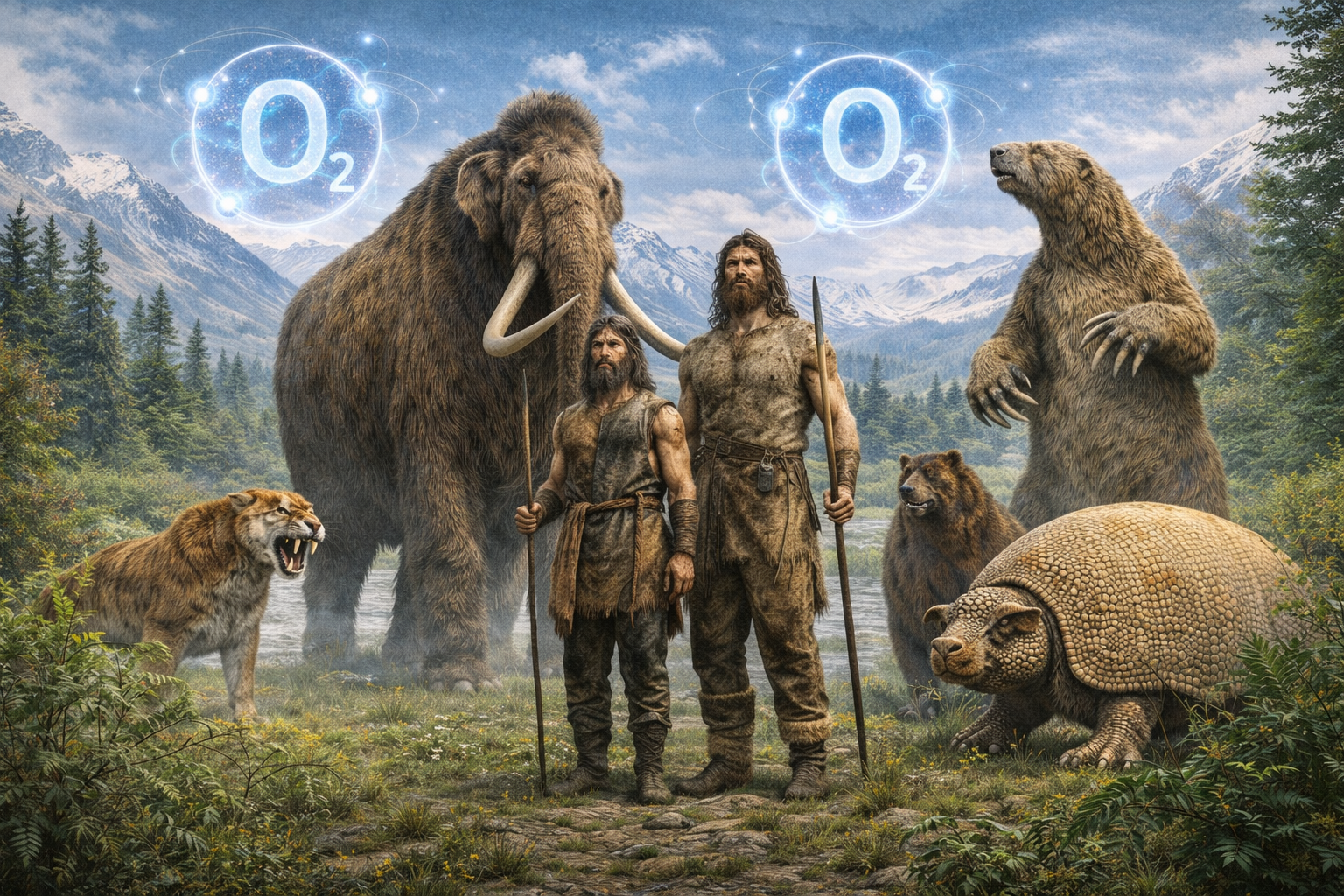
The existence of giant animals before the Younger Dryas forces an uncomfortable reassessment of Earth’s late Ice Age environment. Mammoths, giant sloths, armored glyptodons, and oversized predators did not merely survive—they thrived. Their size was not marginal or pathological; it was systemic.
If environmental conditions were sufficient to sustain multi-ton mammals across continents, a parallel question inevitably follows: could the same conditions have supported larger humans as well? This article explores the growing body of evidence suggesting that pre–Younger Dryas Earth was optimized for gigantism—not just in animals, but potentially in humanity itself.
A World Engineered for Size
Modern ecosystems struggle to support large-bodied species. By contrast, giant animals before the Younger Dryas existed in extraordinary abundance. This implies an environment characterized by:
-
Exceptional plant biomass
-
High nutrient density
-
Stable climate regimes
-
Efficient oxygen and energy exchange
These conditions are not theoretical. Fossil pollen records, megafaunal grazing patterns, and isotopic analysis all indicate vast grasslands and forests capable of sustaining enormous caloric demand. Size is expensive. Biology does not “overshoot” without systemic support.
Oxygen, Density, and Growth Efficiency
While oxygen alone does not create giants, it is a critical amplifier.
Even slight increases in:
-
Oxygen percentage
-
Atmospheric pressure
-
Carbon dioxide (plant growth)
can result in:
-
Higher aerobic efficiency
-
Faster growth rates
-
Improved tissue repair
-
Greater maximum body mass
Insects demonstrate this principle clearly in the fossil record. Mammals, with more complex respiratory systems, would benefit even more from marginal atmospheric enhancements.
This suggests that giant animals before the Younger Dryas were not evolutionary accidents, but expressions of an optimized biosphere.
Humans in a World of Giants
Mainstream archaeology maintains that Ice Age humans were biologically similar to modern populations. However, the skeletal record complicates this assumption.
Documented Findings Include:
-
Robust human skeletons with exceptional bone density
-
Individuals exceeding 2 meters (6.5 ft) in multiple regions
-
Oversized femurs and joint surfaces inconsistent with modern averages
Such remains have been reported across:
-
North America (early excavation records, burial mounds)
-
Europe (Upper Paleolithic and Mesolithic contexts)
-
Asia (Central Asian and Himalayan regions)
While many finds are dismissed as mismeasurement or pathology, the frequency and geographic spread raise legitimate questions.
If ecosystems could sustain mammoths and giant predators, dismissing larger human body plans outright is biologically inconsistent.
Myth as Environmental Memory
Nearly every ancient culture preserves accounts of giants:
-
The Nephilim of the Near East
-
The Titans of Greece
-
The Jötnar of Scandinavia
-
Giant builder-kings in the Americas
Rather than literal interpretations, these traditions may represent compressed cultural memory of a world where humans and animals were simply larger.
Myth does not need to be taken at face value to be informative—it often preserves scale, not detail.
The Younger Dryas: A Hard Reset
The Younger Dryas event marks a sharp boundary in the archaeological and biological record.
-
Megafauna vanish
-
Forests retreat
-
Human populations fragment
-
Average human stature declines
This is exactly what one would expect after:
-
Atmospheric disruption
-
Ecological collapse
-
Reduced food density
Small bodies survive better in stressed environments. The post–Younger Dryas world favored efficiency over scale.

Why This Matters
The refusal to question environmental assumptions has consequences.
By isolating megafauna, humans, and ancient myths into separate academic silos, the larger picture is lost. Giant animals before the Younger Dryas may not be anomalies—they may be evidence of a fundamentally different Earth system. This does not require fantasy. It requires consistency.

Conclusion
The presence of giant animals, robust humans, and global traditions of giants all converge on one possibility: pre–Younger Dryas Earth supported life at a scale no longer possible today.
Oxygen levels, atmospheric density, plant productivity, and planetary energy systems may have aligned to produce a world optimized for size. When that system collapsed, so did its giants.
This series closes with a critical realization: the past may not be primitive—but lost.
Additional Reading & Research & Sources
-
Kurtén, Pleistocene Mammals of North America – link
-
MacPhee, End of the Megafauna – link
-
Berner, R.A., Atmospheric Oxygen Over Phanerozoic Time – link
Human Anthropology
-
Trinkaus & Villotte, External Auditory Exostoses and Ice Age Humans
-
Ruff et al., Body Size and Robusticity in Paleolithic Humans – link
Climate & Catastrophe
-
Firestone et al., Younger Dryas Boundary Event – link
-
Kennett et al., Bayesian Chronology of the Younger Dryas – link
Comparative Mythology