Giant Animals and the Oxygen Hypothesis – Rethinking Biology Before the Younger Dryas
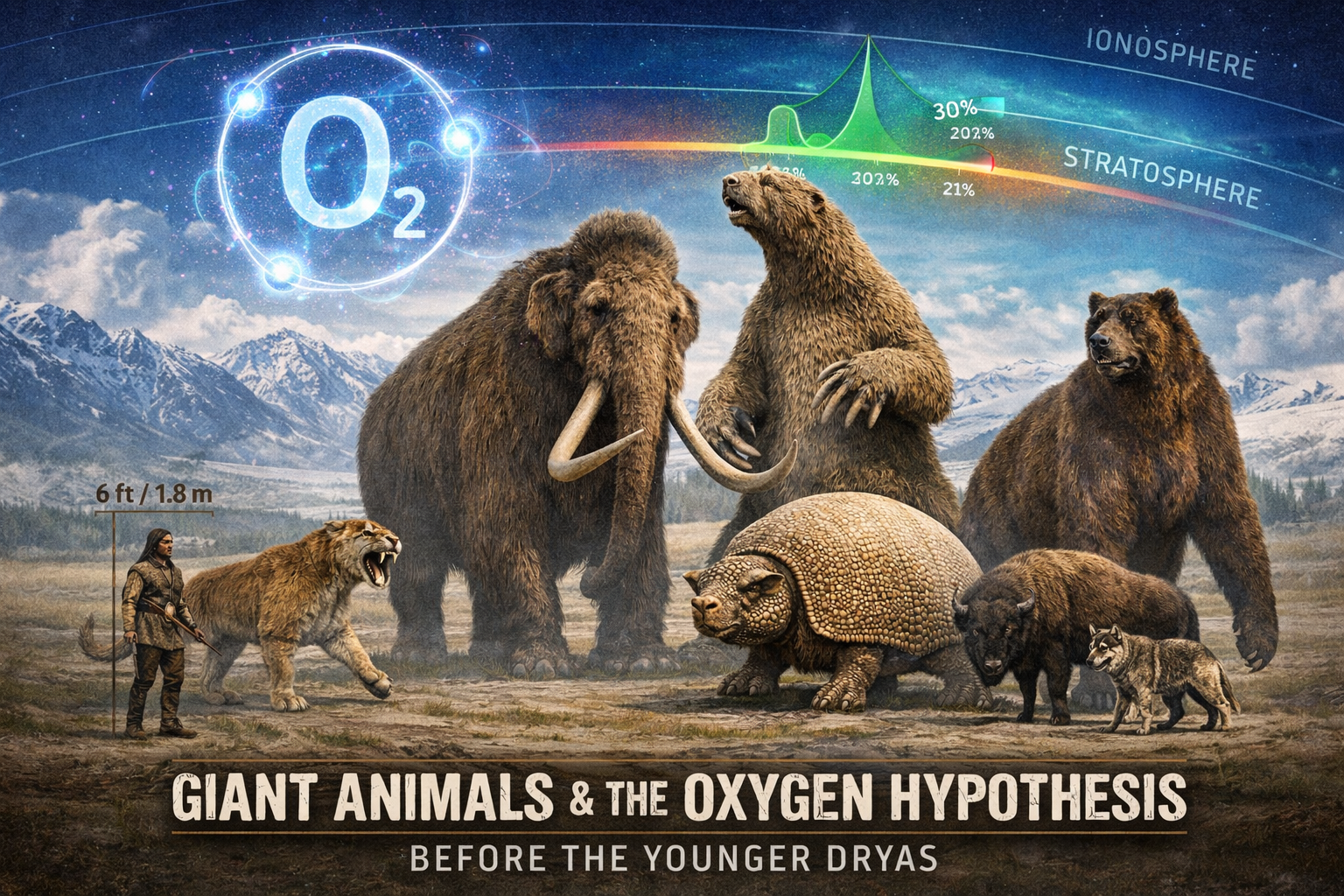
The existence of giant animals before the Younger Dryas presents one of the most persistent challenges to mainstream explanations of Earth’s recent past. Mammoths towering over modern elephants, saber-toothed cats larger than today’s lions, giant ground sloths exceeding the mass of rhinoceroses, and armored glyptodons comparable in size to small cars force a fundamental question: were environmental conditions radically different before the Younger Dryas event?
The dominant narrative attributes megafauna gigantism to isolated evolutionary pathways and extinction to climate change and human overhunting. Yet this explanation struggles to account for the global consistency of oversized species, their sudden disappearance, and the biological limits of modern ecosystems. Increasingly, researchers and independent scientists are revisiting an alternative framework—one centered on atmospheric composition, planetary energy systems, and systemic environmental amplification.
Giant Animals Before the Younger Dryas: A Global Pattern
The record of giant animals before the Younger Dryas is not localized. It is global.
-
North America: Woolly mammoths, mastodons, short-faced bears, dire wolves
-
South America: Megatherium (giant ground sloths), glyptodons
-
Eurasia: Cave lions, woolly rhinoceroses
-
Australia: Diprotodon, giant marsupials
-
Africa: Oversized bovids and megaherbivores
These species did not evolve in isolation. Their overlapping timelines suggest a shared environmental driver, not random evolutionary coincidence.
The Oxygen Hypothesis: Biology at Scale
One hypothesis increasingly discussed—but rarely emphasized in mainstream channels—is the role of elevated atmospheric oxygen prior to the Younger Dryas.
In biological systems, oxygen availability directly affects:
-
Cellular energy production
-
Growth efficiency
-
Recovery and regeneration
-
Maximum sustainable body mass
The fossil record already confirms that higher oxygen concentrations in the deep past supported giant insects and amphibians. The question becomes unavoidable: why is this logic rarely extended to Ice Age megafauna?
Even modest increases in oxygen concentration—combined with higher atmospheric pressure—could allow mammals to grow larger while maintaining metabolic efficiency. This framework offers a coherent explanation for why gigantism appears across continents and species, rather than in isolated evolutionary niches.
Humans, Giants, and the Suppressed Question
If animals were larger under different atmospheric conditions, the implications for early humans are unavoidable.
-
Skeletal anomalies reported throughout the 19th and early 20th centuries
-
Oversized tools incompatible with modern human ergonomics
-
Global myths describing giants, titans, and ancestral builders
Mainstream archaeology dismisses these as myth or misinterpretation. Yet the same discipline accepts environmental explanations for megafauna size. This inconsistency raises an uncomfortable question: were humans also biologically different before the Younger Dryas?
The possibility does not require fantasy—only consistency in applying biological principles.
Energy, Atmosphere, and Planetary Feedback Systems
Another dimension often overlooked is the role of Earth’s energy systems in shaping pre-Younger Dryas life.
Independent research suggests that ancient environments may have featured:
-
Higher atmospheric density
-
Stronger geomagnetic stability
-
Enhanced electrical interaction between Earth and ionosphere
Such conditions would not only support larger organisms but also accelerate growth rates, enhance plant biomass, and stabilize megafauna food chains.
This may explain the parallel rise of:
-
Massive animals
-
Massive trees
-
Massive stone architecture
All appear abruptly in the record—and vanish or degrade just as abruptly.
The Younger Dryas as a Biological Reset
The Younger Dryas event represents a planetary interruption, not a gradual transition.
Evidence points to:
-
Sudden climate instability
-
Atmospheric disruption
-
Massive extinctions across trophic levels
In this context, megafauna extinction is not an anomaly—it is an expected outcome of a collapsed environmental system. Smaller animals survived not because they were superior, but because they required fewer resources in a destabilized world.
Why the Conventional Narrative Falls Short
The standard explanation—climate stress plus human hunting—fails on several fronts:
-
It does not explain global synchronicity
-
It ignores atmospheric variables
-
It avoids biological scaling laws
-
It cannot account for persistent giant-human traditions
By contrast, the oxygen and energy-system hypothesis integrates biology, geology, climatology, and mythology into a single explanatory framework.
Conclusion
The existence of giant animals before the Younger Dryas is not controversial—the fossils are real. What remains unresolved is why they existed at such scale and why that scale disappeared so suddenly.
As with ancient monuments and advanced stonework, the problem may not be a lack of evidence—but a reluctance to reconsider first assumptions. In the final article of this series, we will examine how megafauna, ancient humans, and early civilizations may all be expressions of a lost environmental equilibrium, not isolated mysteries.
Sources & Research Foundations (External)
-
Giant Animals Before the Younger Dryas – link
-
National Museum of Natural History – Megafauna Records – link
-
Pleistocene Megafauna Databases – link
- Rapid Range shift and Megafauna Extinction associated with rapid Climate Change – link
-
Berner, R.A. — Atmospheric Oxygen Over Geological Time – link
-
Younger Dryas Impact Hypothesis (Science Direct link)
- New Evidence Suggesting the Younger Dryas Impact Hypotesis (link)
-
Comparative physiology and oxygen saturation studies – link