
Göbekli Tepe celestial connections
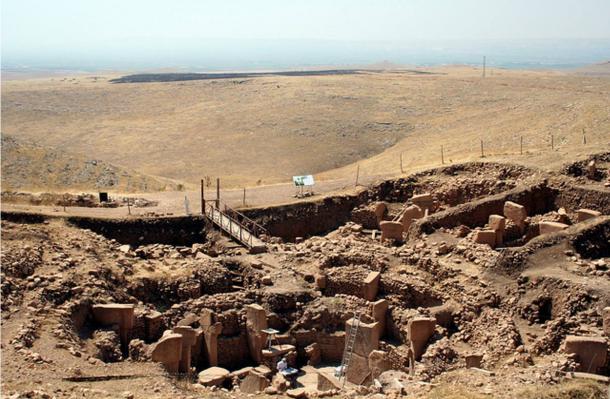
There are two major claims that Göbekli Tepe had celestial connections point to. One suggests that the site was aligned with the night sky, particularly the star Sirius, because the local people worshiped the star like other cultures in the region did thousands of years later. Another claims that carvings at Göbekli Tepe record a […]
Göbekli Tepe evidence of ancient cataclysm

A team of researchers with the University of Edinburgh has found what they describe as evidence of a comet striking the Earth at approximately the same time as the onset of the Younger Dryas in carvings on an ancient stone pillar of Göbekli Tepe. The findings were published in the journal Mediterranean Archaeology and Archaeometry. […]
Göbekli Tepe astronomical events and symbolism

Researchers are matching low-relief carvings on some of the pillars at Göbekli Tepe to find compelling evidence that the ‘Vulture Stone’ is a date stamp for 10950 BC which closely corresponds to the proposed Younger Dryas event, estimated at 10890 BC. Researchers also found evidence that a key function of Göbekli Tepe was to observe […]
Göbekli Tepe and Karahan Tepe

Göbekli Tepe and Karahan Tepe challenging conventional timelines of early human civilization The prehistoric sites of Göbekli Tepe and Karahan Tepe have become focal points in discussions about the origins of complex human society. Dated to approximately 11,000–13,000 years ago, these monumental complexes predate agriculture, pottery, and metalworking, challenging long-standing assumptions about what early hunter-gatherer […]