
Researchers are matching low-relief carvings on some of the pillars at Göbekli Tepe to find compelling evidence that the ‘Vulture Stone’ is a date stamp for 10950 BC which closely corresponds to the proposed Younger Dryas event, estimated at 10890 BC. Researchers also found evidence that a key function of Göbekli Tepe was to observe meteor showers and record cometary encounters. Indeed, the people of Göbekli Tepe appear to have had a special interest in the Taurid meteor stream, the same meteor stream that is proposed as responsible for the Younger-Dryas event.
ASTRONOMY, GEOLOGY AND ARCHAEOLOGY
Is Göbekli Tepe the ‘smoking gun’ for the Younger-Dryas cometary encounter, and hence for coherent catastrophism?
It is theorized that a swarm of comet fragments hit Earth approximately 10,950 BC. The symbols etched into stone pillars at Göbekli Tepe in Turkey might confirm the theory. The comet incident may have killed out animal species and caused a 1,000-year mini-ice age. This mini-ice age, known as the Younger Dryas, lasted around 1,000 years, and it’s considered as a crucial period for humanity because it was around that time agriculture and the first Neolithic civilizations arose – potentially in response to the new colder climates. The period has also been linked to the extinction of the mega-fauna.
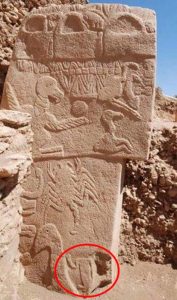
“One of its pillars seems to have served as a memorial to this devastating event – probably the worst day in history since the end of the Ice Age.” An image of a headless man on the stone is also thought to symbolize human disaster and extensive loss of life following the impact. The carvings show signs of being cared for by the people of Göbekli Tepe for millennia, which indicates that the event they describe might have had long-lasting impacts on civilization.
The Göbekli Tepe is thought to have been built around 9,000 BCE – roughly 6,000 years before Stonehenge – but the symbols on the pillar date the event to around 2,000 years before that. The carvings were found on a pillar known as the Vulture Stone and show different animals in specific positions around the stone. The symbols had long puzzled scientists and Martin Sweatman and Dimitrios Tsikritsis –from the University of Edinburgh’s School of Engineering– discovered that the symbols corresponded to astronomical constellations and showed a swarm of comet fragments hitting the Earth.
To try to accurately calculate whether that comet strike happened or not, the researchers used computer models to match the patterns of the stars detailed on the Vulture Stone to a specific date – and they found evidence that the event in question would have occurred about 10,950 BCE, give or take 250 years. The dating of these carvings also matches an ice core taken from Greenland, which pinpoints the Younger Dryas period as beginning around 10,890 BCE. According to Martin Sweatman, this isn’t the first-time ancient archaeology has provided insight into civilization’s past. Many paleolithic cave paintings and artifacts with similar animal symbols and other repeated symbols suggest astronomy could be very ancient indeed. As this giant comet probably arrived in the inner solar system some 20 to 30 thousand years ago, and it would have been a very visible and dominant feature of the night sky, it is hard to see how ancient people could have ignored this given the likely consequences.
The carvings appear to have remained important to the people of Gobekli Tepe for millennia, indicating an event that had a very serious and long-lasting impact, say the scientists. Several of the pillar symbols suggest that long-term changes in the Earth’s rotational axis were recorded by the early astronomers using an early form of writing. The discovery also supports the theory that Earth experiences times when comet strikes are more likely, due to the planet’s orbit intersecting with rings of cometary fragments.






3 Responses