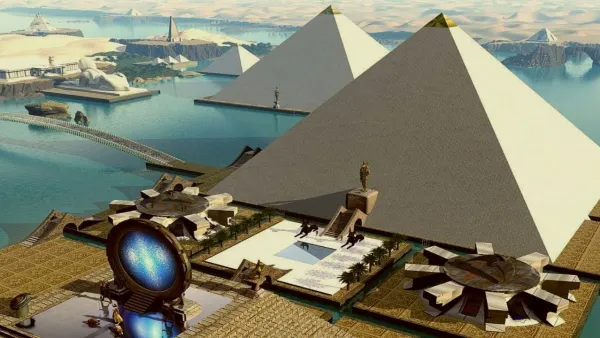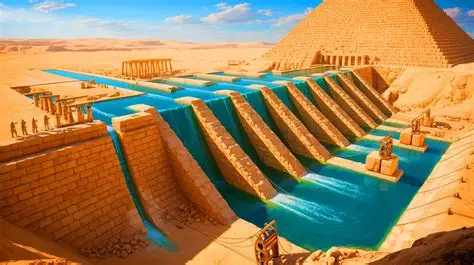
The Megalithic Civilization hypothesis proposes that megaliths such as the Pyramids of Giza, Stonehenge, and other megalithic structures throughout the World, were built by a common group of people, or civilizations during the Neolithic period. Alexander Thom (1950) has referred to these builders as Megalithic man. The hypothesis bases itself on the accurate measurements found in megalithic metrology, that are observed for virtually all known megaliths discovered. The hypothesis challenges mainstream theories, thus many scientific communities consider research for a megalithic civilization as pseudoscientific.
Research in support of this hypothesis is often considered pseudoscientific by mainstream scientific and archaeological circles because it challenges the current and accepted human evolutionary paradigm. The hypothesis supposes that Megalithic Man was smarter than what modern science gives credit for (due to the complex mathematics proposed in the placement of blocks), as it contradicts mainstream’s time-frame of how humans evolved from hunter/gather types to forming civilization. The dating and precision of Göbekli Tepe is an example of how archaeologists and the mainstream scientific community have no other option, but to reconsider how early man really developed. Modern-day branches of the megalithic civilization hypothesis also challenges when and who the builders were for the Giza Pyramid Complex, proposing that Megalithic Man (that lived and developed during the Neolithic period) built them before 3500 BCE, rather than the Egyptians themselves.
What knowledge was applied to build the megalithic structures?
Professor Alexander Thom believed that stone circles were astronomical observatories and in 1951 he published an article in the Journal of the British Astronomical Association entitled ‘The Solar Observations of Megalithic Man’. The survey carried out by Prof. Alexander Thom of over 300 European megalithic sites led him to conclude that the builders had used standard units of measurement which, along with a highly developed knowledge of geometry, (including Pythagorean principles), were used in the design of many of western Europe’s most significant pre-historic constructions.
( 1 MY = 2.72 ft or 82.96 cm )
The Megalithic Yard (MY) is a unit of measurement of about 2.72 ft, that some researchers hypothesize was used in the construction of megalithic structures. The proposal was made by Alexander Thom as a result of his surveys of 600 megalithic sites in England, Scotland, Wales and Brittany. Thom also proposed the Megalithic Rod of 2.5 MY. As sub-units of these, he further proposed the Megalithic Inch of 2.073 cm, one hundred of which are included in a Megalithic Rod, and forty of which composed a Megalithic Yard. But Thom’s proposals were initially ignored or regarded as unbelievable by mainstream archaeologists. Thom applied the statistical lumped variance test of J.R. Broadbent on this quantum and found the results significant, yet others challenge his statistical analysis and suggest that Thom’s evidence for the supposed megalithic yard could be explained as an average length of a pace unit. Douglas Heggie’s analysis of the MY claims “little evidence for a highly accurate unit” and “little justification for the claim that a highly accurate unit was in use“. Thus, Thom’s findings were and are continued to today, considered pseudoscientific by major scientific and archaeological circles. However, there is enough evidence to support megalithic standards that the Megalithic Yard has caught the attention of smaller communities of researchers to continue to make comparative studies.
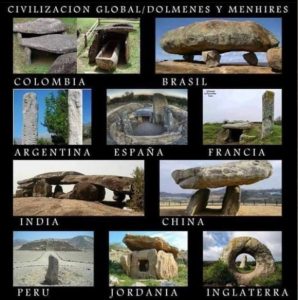
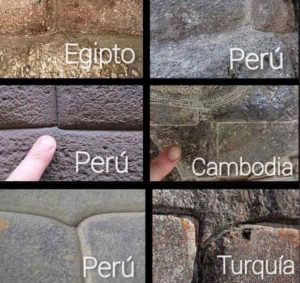
Alexander Thom made a comparison of his Megalithic Yard with the Spanish vara, the pre-metric measurement of Iberia, whose length was 2.7425 ft. Thom has suggested that “There must have been a headquarters from which standard rods were sent out but whether this was in these islands or on the Continent (British Isles) the present investigation cannot determine.” Many researchers have concluded that there is marginal evidence for a standardized measuring unit, but that it was not as uniform as Thom believed. Yet, many commentators and researchers of the MY unit have found equal, or close to equal measures of units, throughout the World.
References
_____________________________________________________________________________________________
- Thom, Alexander., The megalithic unit of length, Journal of the Royal Statistical Society, A 125, 243-251, 1962.
- ↑Alexander Thom (12 March 1964). New Scientist. Reed Business Information. pp. 690–. https://books.google.com/books?id=c2iCzjpnd4EC&pg=PA690. Retrieved 19 April 2011.
- ↑Barbara Ann Kipfer (2000). Encyclopedic dictionary of archaeology. Springer. pp. 344–. ISBN 978-0-306-46158-3. https://books.google.com/books?id=XneTstDbcC0C&pg=PA344. Retrieved 23 April 2011.
- ↑Archibald Stevenson Thom (1995). Walking in all of the squares: a biography of Alexander Thom : engineer, archaeoastronomer, discoverer of a prehistoric calendar, the geometry of stone rings and megalithic measurement. Argyll Pub.. ISBN 978-1-874640-66-0. https://books.google.com/books?id=o0HbAAAAMAAJ. Retrieved 19 April 2011.
- ↑Thom, Alexander., The larger units of length of megalithic man, Journal for the Royal Statistical Society, A 127, 527-533, 1964.
- Andrzej Wiercinski, MEGALITHIC YARD IN TEOTIHUACAN? https://mdc.ulpgc.es/utils/getfile/collection/almog/id/179/filename/345.pdf
- avid H. Kelley; Eugene F. Milone; Anthony F. (FRW) Aveni (28 February 2011). Exploring Ancient Skies: A Survey of Ancient and Cultural Astronomy. Springer. pp. 163–. ISBN978-1-4419-7623-9. https://books.google.com/books?id=ILBuYcGASxcC&pg=PA163. Retrieved 22 April 2011.
- Heggie, Douglas C. (1981). Megalithic Science: Ancient Mathematics and Astronomy in North-west Europe. Thames and Hudson. p. 58. ISBN 0-500-05036-8.
- ↑ Thom (1976). Megalithic sites in Britain, p. 43. Clarendon. https://books.google.com/books?id=Y6p-DwEACAAJ. Retrieved 6 April 2011.
- Keith Critchlow (1979). Time stands still: new light on megalithic science, p. 37. Gordon Fraser. https://books.google.com/books?id=jK3aAAAAMAAJ. Retrieved 23 April 2011.
- ↑ Euan Wallace MacKie (1977). The megalith builders, p. 192. Phaidon. https://books.google.com/books?id=7gOBAAAAMAAJ. Retrieved 22 April 2011.