Celestial Navigation Before Science
The concept of celestial navigation ancient systems represents one of the most profound yet often underestimated aspects of human development, as it suggests that long before the emergence of formal astronomy, mathematical models, or written star charts, early humans were already engaging in systematic observation of the night sky, using recurring celestial patterns as reliable frameworks for orientation, movement, and timekeeping. Rather than viewing the sky as a distant or purely symbolic realm, prehistoric societies appear to have treated it as a functional map—one that was stable, predictable, and universally accessible, offering a consistent reference point in environments where terrestrial markers could shift, disappear, or remain unknown (Prehistoric Navigation Systems Before Maps link).
This perspective challenges the traditional linear narrative of scientific progress, where knowledge is assumed to evolve gradually from primitive observation to structured understanding, because in the case of celestial navigation, the distinction between observation and system may be less clear than previously thought (Ice Age Civilizations Before the Floods link). When patterns are tracked over generations, memorized, and applied consistently to real-world navigation, they begin to function not merely as observations but as components of an operational system, raising the question of whether early humans developed forms of proto-astronomy that were sophisticated in practice even if they were not formalized in written or mathematical terms (Mapping the Sky Before Civilizations link).
The Sky as a Navigational Framework
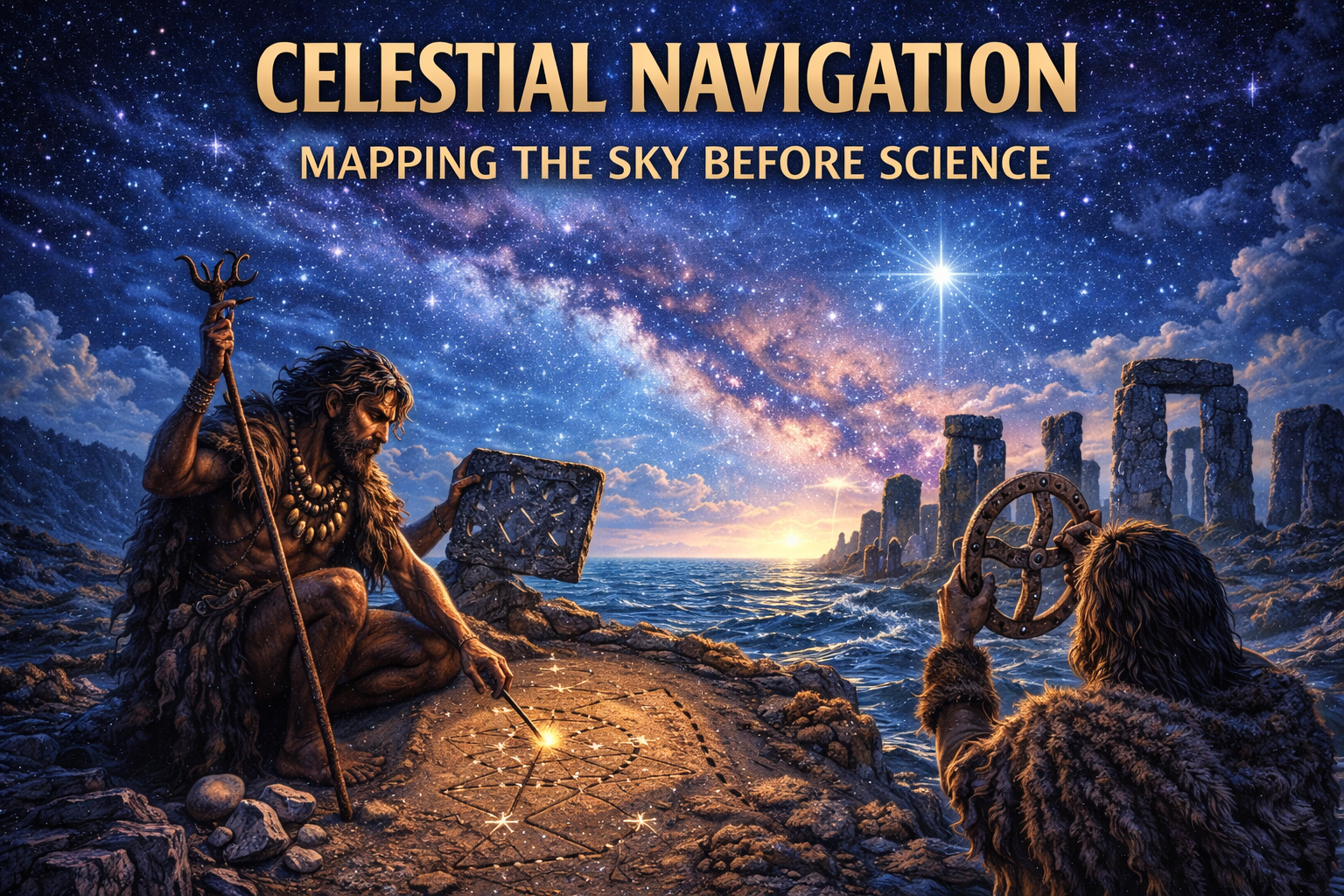
At the core of celestial navigation ancient practices lies the recognition that the night sky behaves with remarkable regularity, as stars rise and set along predictable paths, constellations shift with the seasons, and certain celestial bodies maintain fixed relationships relative to the horizon, creating a natural coordinate system that can be used for orientation (Lost Know;edge Before Written History link). Unlike landscapes, which can vary dramatically across regions, the sky provides a shared reference that remains consistent across vast distances, making it particularly valuable for long-range navigation, especially in open environments such as oceans, deserts, or ice-covered terrain (Science Before the Younger Dryas link).
The ability to use this system effectively would have required more than casual observation, as navigators needed to identify specific stars, understand their movement patterns, and associate them with directional cues, effectively translating visual information into spatial orientation. Over time, these observations could be structured into sequences or “routes” in the sky, where the rising or setting of particular stars corresponded to specific directions of travel, allowing navigators to maintain a steady course even in the absence of visible landmarks (Lost Knowledge of the Ice Age link).
Star Paths and Directional Memory
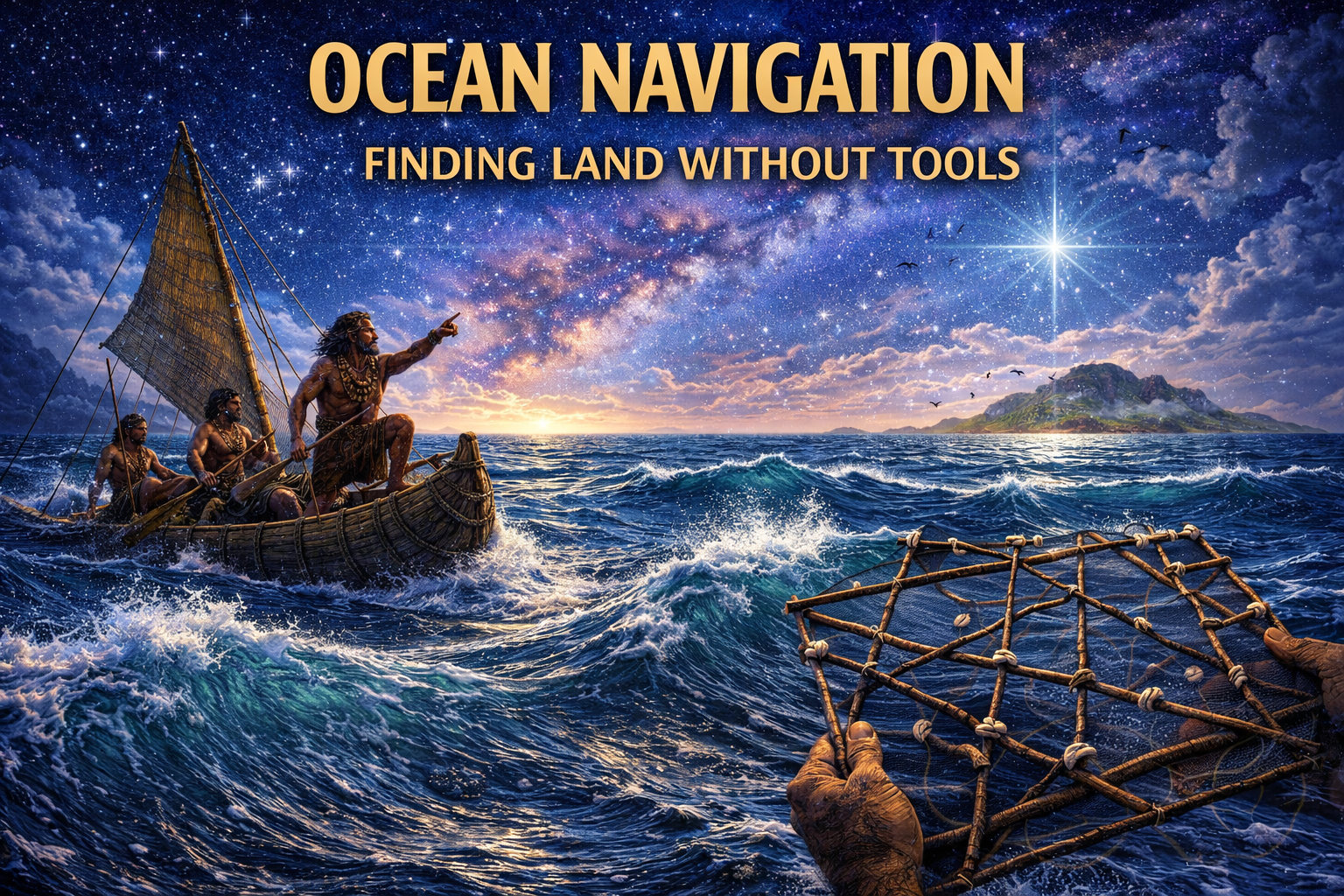
One of the most compelling elements of celestial navigation ancient systems is the concept of star paths, where navigators memorize sequences of stars that guide movement across long distances, effectively turning the night sky into a dynamic map that unfolds over time. In later documented traditions, such as those of Polynesian wayfinders, each star corresponds to a specific direction on the horizon, and as the Earth rotates, navigators transition from one star to another, maintaining a consistent heading throughout the night (Cycles of Time link).
This method does not rely on instruments but on precise memory and continuous observation, suggesting that navigators developed highly refined cognitive systems capable of tracking multiple variables simultaneously, including star positions, timing, and environmental conditions. While direct evidence of such systems in deep prehistory is limited, the existence of highly sophisticated oral navigation traditions in more recent cultures strongly implies that these techniques are the result of long-term development rather than sudden innovation, potentially extending back into the late Ice Age or earlier.
Solar and Lunar Cycles in Early Navigation
In addition to stars, the sun and moon played a critical role in ancient navigation systems, offering reliable and repeatable patterns that could be used to establish both direction and time. The rising and setting points of the sun provide a consistent east-west axis, while its changing height and path across the sky throughout the year allow for seasonal calibration (Hidden Codes of Ancient Civilizations link). This means that navigators were not simply observing the sun in isolation, but understanding its cyclical behavior in relation to the Earth—an insight that implies careful, long-term observation.
The moon adds another layer of complexity, with its phases, brightness, and shifting position relative to the stars offering cues for both nighttime travel and timekeeping. Navigators could use the moon’s cycle to estimate the passage of days, while its alignment with certain stars might serve as an additional directional reference. Could this integration of solar and lunar knowledge point to an early form of astronomical system-building, one that predates formal science but operates with similar principles?
Ancient structures such as Stonehenge and Chankillo demonstrate a clear awareness of solar cycles, with alignments marking solstices and equinoxes. These sites raise important questions: were they purely ceremonial, or did they also function as teaching tools for navigation and timekeeping? If so, they may represent physical anchors for knowledge systems that were otherwise transmitted orally.
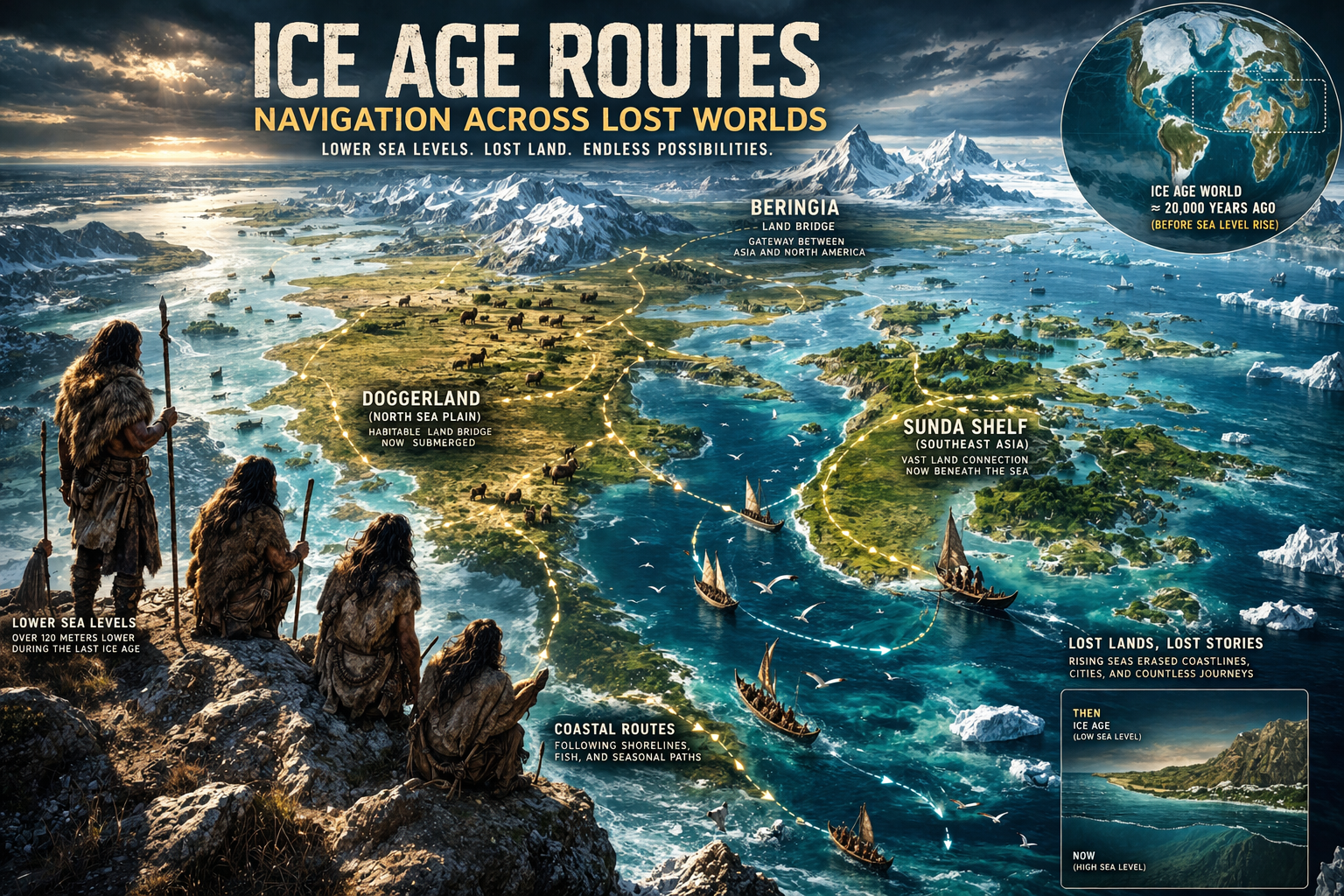
Considering the possibility of lost coastal civilizations, one must wonder how many similar observatories once existed in regions now submerged. If entire landscapes were erased by rising seas at the end of the last Ice Age, then the material evidence of early astronomical knowledge may be severely incomplete. Could it be that what we see today are only the remnants of a once far more extensive network of observational sites?
The integration of solar and lunar cycles into navigation suggests a holistic understanding of the sky, where multiple celestial patterns were combined into a unified system. This level of synthesis hints at intellectual traditions that may have been far more advanced than typically assumed, raising the possibility that entire chapters of early scientific thought have been lost to time.

Precession and Long-Term Sky Changes
A more subtle but profoundly significant aspect of ancient celestial knowledge is the phenomenon of axial precession, in which the orientation of Earth’s axis slowly changes over thousands of years, altering the apparent positions of stars in the sky (Mapping the Sky Before Civilizations link). While this shift is imperceptible within a single lifetime, it becomes noticeable across generations, particularly in cultures that maintain continuous traditions of sky observation. This introduces a fascinating possibility: could ancient societies, through careful record-keeping and oral transmission, have detected these gradual changes?
Recognizing precession would require not only long-term observation but also a framework for comparing past and present sky configurations. This implies a continuity of knowledge across many generations, as well as a cultural emphasis on preserving and interpreting astronomical data. If such awareness existed, it would suggest a level of temporal depth in human thinking that is rarely attributed to prehistoric societies (Precession and the Great Cycle link).
Some researchers have pointed to alignments in sites like Great Pyramid of Giza and symbolic motifs in ancient mythologies as potential indicators of precessional knowledge (Cosmic Measurement Code link). While these interpretations remain debated, they raise an important question: are we underestimating the observational capabilities of ancient peoples simply because the evidence is fragmented? And if so, how much knowledge might have been lost when the cultures that sustained it were disrupted?
Cataclysmic events—whether rapid sea-level rise, climatic shifts, or regional disasters—could have broken the continuity required to track such long-term changes. If entire knowledge systems depended on uninterrupted transmission, even a single major disruption could erase centuries or millennia of accumulated understanding (Geometry of teh Earth link). Could this explain why hints of advanced knowledge appear sporadically in the archaeological record, rather than as a continuous, well-documented progression?
Ultimately, the question of precession in ancient navigation opens the door to a broader reconsideration of human history. If early cultures were capable of detecting and encoding such slow cosmic changes, then their intellectual world may have been far more sophisticated than we currently recognize. And if that is the case, then what we see today may be only scattered fragments of a much older and more complex relationship between humanity and the sky.
Archaeological Hints of Early Sky Knowledge
Material evidence for celestial navigation ancient systems is inherently indirect, yet certain archaeological sites provide intriguing hints that early societies were engaging in structured observation of the sky, particularly where architectural alignments correspond to solar or stellar events. Sites such as Göbekli Tepe, with its circular enclosures and carved pillars, and later megalithic structures like Stonehenge, demonstrate clear alignments with solstices and other celestial phenomena, suggesting that the sky held both practical and symbolic significance.
Similarly, cave art, including that found at Lascaux, has been interpreted by some researchers as containing representations of constellations, although such interpretations remain debated within the academic community. A balanced approach recognizes that while not all symbolic representations are necessarily astronomical, the repeated association between early structures and celestial events indicates that observation of the sky was an important and potentially systematic aspect of prehistoric life.
Polynesian Navigation as a Living System
One of the strongest pieces of evidence for the sophistication of celestial navigation ancient systems comes not from deep prehistory but from historically documented traditions such as Polynesian navigation, which preserved complex wayfinding techniques into the modern era. Polynesian navigators were able to travel thousands of kilometers across open ocean using a combination of star paths, ocean patterns, and environmental cues, demonstrating that highly effective navigation systems can exist without written maps or instruments.
These traditions are often described as “living laboratories” for understanding prehistoric navigation, as they provide insight into how knowledge can be structured, transmitted, and applied in the absence of formal scientific frameworks. The existence of such systems reinforces the argument that early humans were capable of developing and maintaining complex knowledge systems over long periods, even in the absence of written records.
Conclusion: The Sky as Humanity’s First Map
The study of celestial navigation ancient systems reveals a form of knowledge that blurs the boundary between observation and science, where early humans transformed the night sky into a reliable and structured framework for navigation, orientation, and timekeeping long before the emergence of formal astronomy. Rather than representing a primitive precursor to modern science, these systems may be better understood as parallel forms of knowledge, optimized for their context and capable of supporting complex behaviors such as long-distance travel and environmental adaptation.
When viewed within the broader Ancient360 perspective, celestial navigation becomes part of a larger pattern, where early human societies demonstrate a capacity for structured knowledge that is often underestimated, suggesting that the foundations of science may lie deeper in prehistory than traditionally assumed, embedded not in written texts but in the enduring relationship between humans and the natural world.
References & Further Reading
Polynesian Voyaging Society — Traditional Wayfinding – link
Encyclopaedia Britannica — Celestial Navigation
Nature — Early Human Migration Studies
Journal of Archaeological Science — Archaeoastronomy
NOAA — Solar and Lunar Cycles – link
Journal of Anthropological Archaeology – link
Ancient360 — Submerged Civilizations & Ancient Maps – link