Sacred Number 108: The Cosmic Measurement Code
The sacred number 108 appears with striking consistency across ancient cultures, spiritual traditions, and architectural systems, raising a profound question that continues to challenge both historians and scientists: how did early civilizations arrive at a number that seems to encode precise relationships between the Earth, the Sun, and the Moon? The presence of the sacred number 108 in ritual practices, temple construction, and cosmological systems suggests that it may not be a symbolic coincidence, but rather the remnant of a deeper understanding of the universe—one that could point to a legacy of knowledge inherited from far older and perhaps forgotten civilizations (Infinity, Cycles, Cosmic Balance).
From prayer beads to planetary distances, from temple layouts to astronomical cycles, the sacred number 108 emerges not as an isolated curiosity, but as a recurring constant embedded within systems that appear to bridge mathematics, observation, and metaphysical interpretation. This raises the possibility that ancient knowledge systems were far more advanced, integrated, and precise than traditionally assumed, and that the sacred number 108 may have served as a key to understanding the structure of reality itself.
Sacred Number 108 in Cosmic Distances
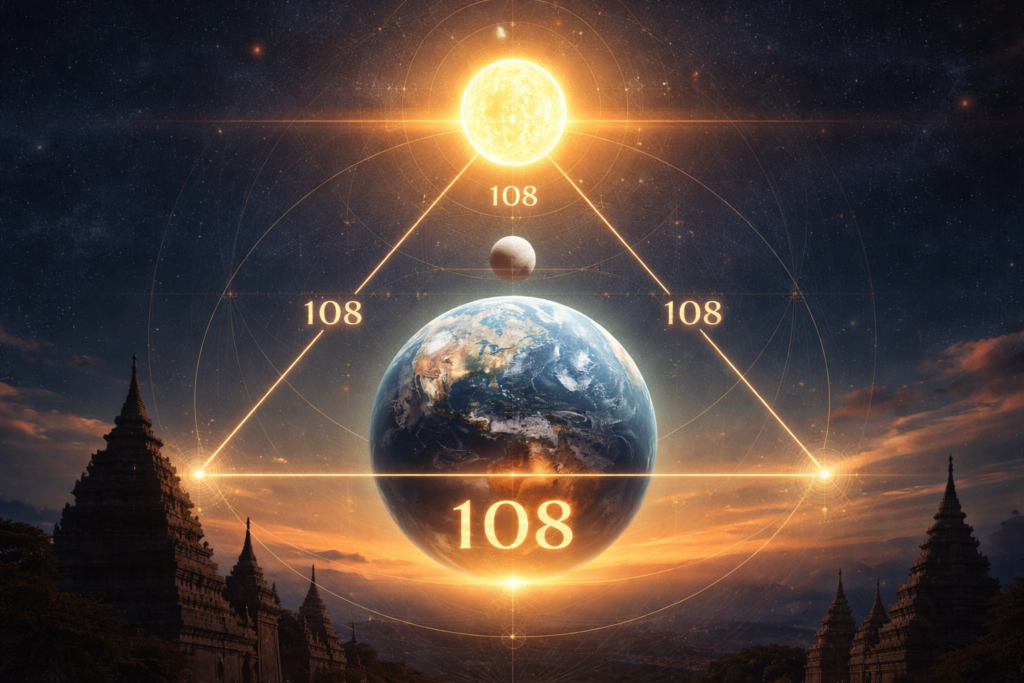
One of the most frequently cited and intriguing aspects of the sacred number 108 is its relationship to the distances between celestial bodies. When examining the scale of the solar system, a remarkable approximation appears:
-
The distance between the Earth and the Sun is approximately 108 times the Sun’s diameter
-
The distance between the Earth and the Moon is approximately 108 times the Moon’s diameter
While these values are not perfectly exact by modern measurements, the level of approximation is extraordinary when considered in the context of ancient observational capabilities. This raises a critical question: were ancient civilizations aware of these relationships through long-term observation, or did they inherit this knowledge from an earlier, more advanced source?
The recurrence of the sacred number 108 in these cosmic ratios suggests that it may have functioned as a scaling constant, allowing ancient astronomers to conceptualize the vastness of space using proportional relationships rather than absolute measurements.
Sacred Number 108 and Archeoastronomy
Within the field of archeoastronomy, the sacred number 108 offers a compelling lens through which to interpret ancient structures and alignments. Many temples and monuments appear to incorporate proportional systems that reflect astronomical cycles and distances.
Rather than relying solely on visual alignment with celestial events, some researchers have proposed that ancient builders encoded numerical relationships directly into architectural dimensions. If this is the case, the sacred number 108 may have served as a bridge between observation and construction, allowing cosmic principles to be translated into physical form.
This perspective challenges the conventional view that ancient architecture was primarily symbolic or ritualistic, suggesting instead that it may have functioned as a form of applied cosmology.
Sacred Number 108 in Sacred Architecture
The sacred number 108 is deeply embedded in the design and symbolism of temples across multiple cultures, particularly in South Asia. Many temples are constructed with 108 steps, 108 pillars, or spatial divisions that reflect this number (Builders Beynd Time).
In these contexts, the sacred number 108 is often associated with spiritual progression, representing a path from the material world to higher states of awareness. However, when viewed through the lens of sacred geometry and archeoastronomy, these architectural choices may also reflect an attempt to align human experience with cosmic structure.
The repetition of the sacred number 108 in physical spaces suggests that ancient builders may have been working with a unified system of knowledge in which:
• geometry
• astronomy
• spirituality
• measurement
were not separate disciplines, but interconnected aspects of a single framework.
Sacred Number 108 in Ancient Measurement Systems
The sacred number 108 may also be connected to ancient systems of measurement that appear to encode planetary relationships within terrestrial units. Some researchers have explored the possibility that units such as the meter, the foot, and other traditional measures may have origins linked to Earth-based geometry and astronomical proportions (Sacred Orientation and cosmic Alignments).
While these theories remain debated, the recurring presence of the sacred number 108 in both measurement systems and cosmological models raises the possibility that ancient civilizations were working with a standardized numerical language derived from observations of the natural world.
If such a system existed, it would imply a level of scientific coherence that challenges current assumptions about the development of early knowledge.
Sacred Number 108 in Spiritual Traditions
Beyond architecture and astronomy, the sacred number 108 holds a central place in spiritual practices across cultures. Prayer beads, meditation cycles, and ritual recitations often incorporate 108 repetitions, suggesting that the number carries symbolic significance related to completeness and cosmic order.
However, the persistence of the sacred number 108 across geographically and culturally distinct traditions raises an important question: is this convergence the result of independent discovery, or does it point to a shared origin?
The possibility that multiple civilizations inherited a common numerical framework aligns with broader theories of lost knowledge, in which fragments of an earlier, more advanced system were preserved through ritual and tradition even as their original context was forgotten.
Sacred Number 108 and the Encoding of Knowledge
The repeated appearance of the sacred number 108 across disciplines suggests that it may have functioned as more than a symbolic or practical number. It may have been part of a system designed to encode and transmit knowledge across generations.
In a world without written language as we understand it today, numbers and geometry could have served as durable carriers of information, capable of preserving complex ideas in forms that could be replicated and transmitted.
Temples, monuments, and ritual practices may therefore be understood not only as cultural expressions, but as repositories of encoded knowledge, with the sacred number 108 acting as a key component of this system.
Sacred Number 108 and the Possibility of Lost Civilizations
The precision and consistency with which the sacred number 108 appears in ancient systems inevitably lead to deeper questions about the origins of this knowledge. If early civilizations lacked the tools to measure planetary distances with such accuracy, how did they arrive at this number?
One possible explanation is that this knowledge was accumulated over long periods through careful observation and refinement. Another, more speculative possibility is that it was inherited from a prior civilization with more advanced capabilities.
This perspective does not require the assumption of mythical technologies, but rather invites a reconsideration of historical timelines and the possibility that knowledge may have been lost, fragmented, and later rediscovered.
The sacred number 108, in this context, becomes a trace—a numerical echo of a system that once connected humanity more directly to the structure of the cosmos.
Sacred Number 108 as a Universal Constant
When viewed across its various applications, the sacred number 108 appears to function as a unifying constant that links:
• celestial distances
• architectural design
• spiritual practice
• numerical systems
This convergence suggests that ancient knowledge systems may have been based on a holistic understanding of reality, in which physical, mathematical, and spiritual dimensions were integrated into a single framework.
Such a perspective contrasts sharply with modern specialization, in which disciplines are often treated as separate and unrelated.
Sacred Number 108 and the Geometry of the Cosmos
From a geometric perspective, the sacred number 108 also relates to angular measurements. The internal angle of a pentagon is 108 degrees, linking this number to pentagonal geometry and, by extension, to the golden ratio.
This connection further reinforces the idea that the sacred number 108 is not arbitrary, but deeply embedded in the mathematical structures that govern both natural forms and cosmic relationships.
Key Insights
• Sacred number 108 appears in Earth–Sun and Earth–Moon distance ratios
• It is widely used in temple architecture and spiritual practices
• The number may function as a cosmic scaling constant
• It connects geometry, astronomy, and measurement systems
• Its recurrence suggests a unified ancient knowledge system
• It raises questions about lost or inherited civilizations
Additional Reading and Sources
Aveni, Anthony — Ancient Astronomy in Practice (link)
Krupp, Edwin — Echoes of the Ancient Skies (link)
Kak, Subhash — The Astronomical Code of the Vedas (link)
Magli, Giulio — Architecture, Astronomy and Sacred Landscape (link)
Ancient360 — https://ancient360.eu/category/archeoastronomy/
Ancient360 — https://ancient360.eu/category/sacred-geometry/
Ancient360 — https://ancient360.eu/cycles-of-time-geometry-and-civilization/
Ancient360 — https://ancient360.eu/earth-geometric-system/