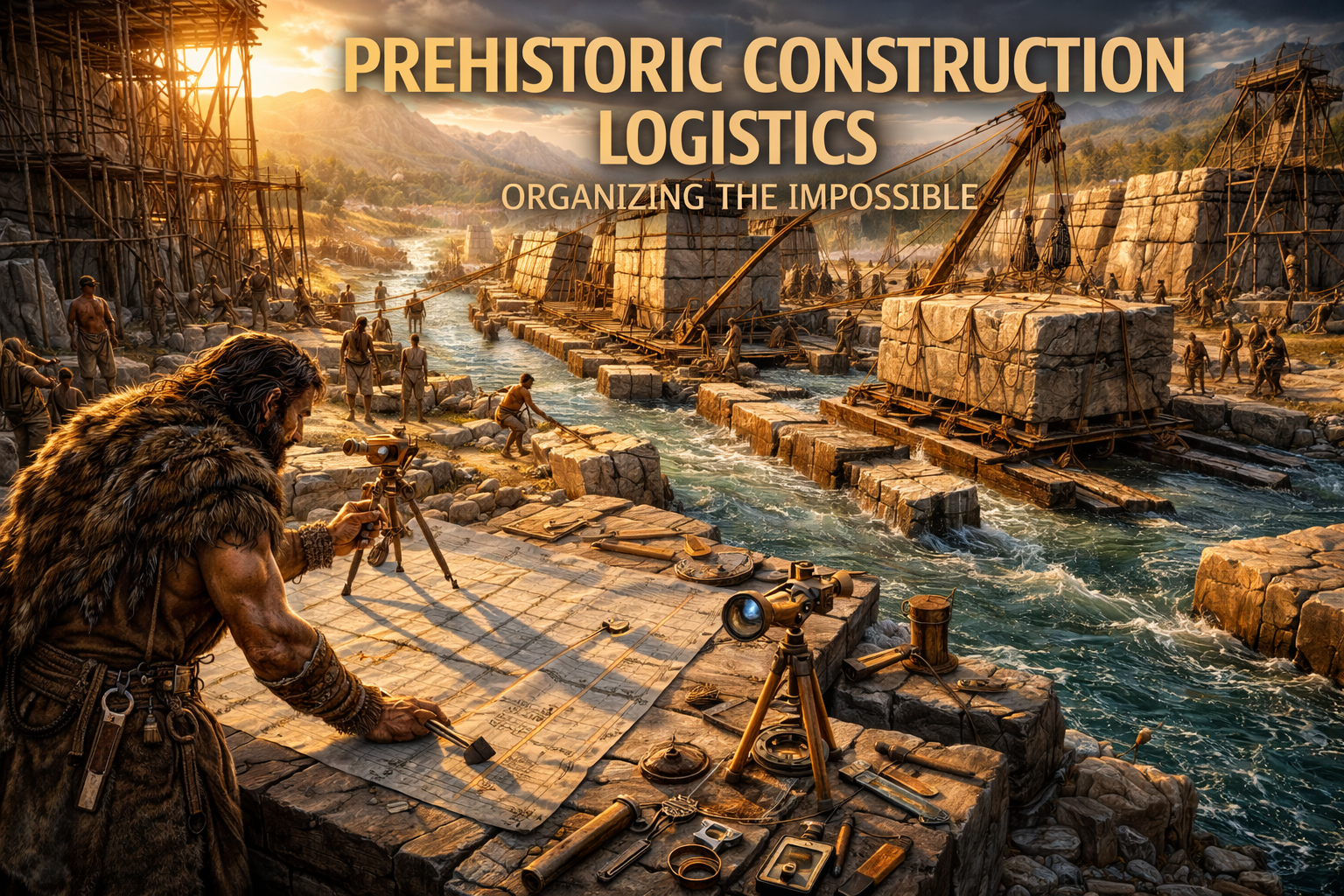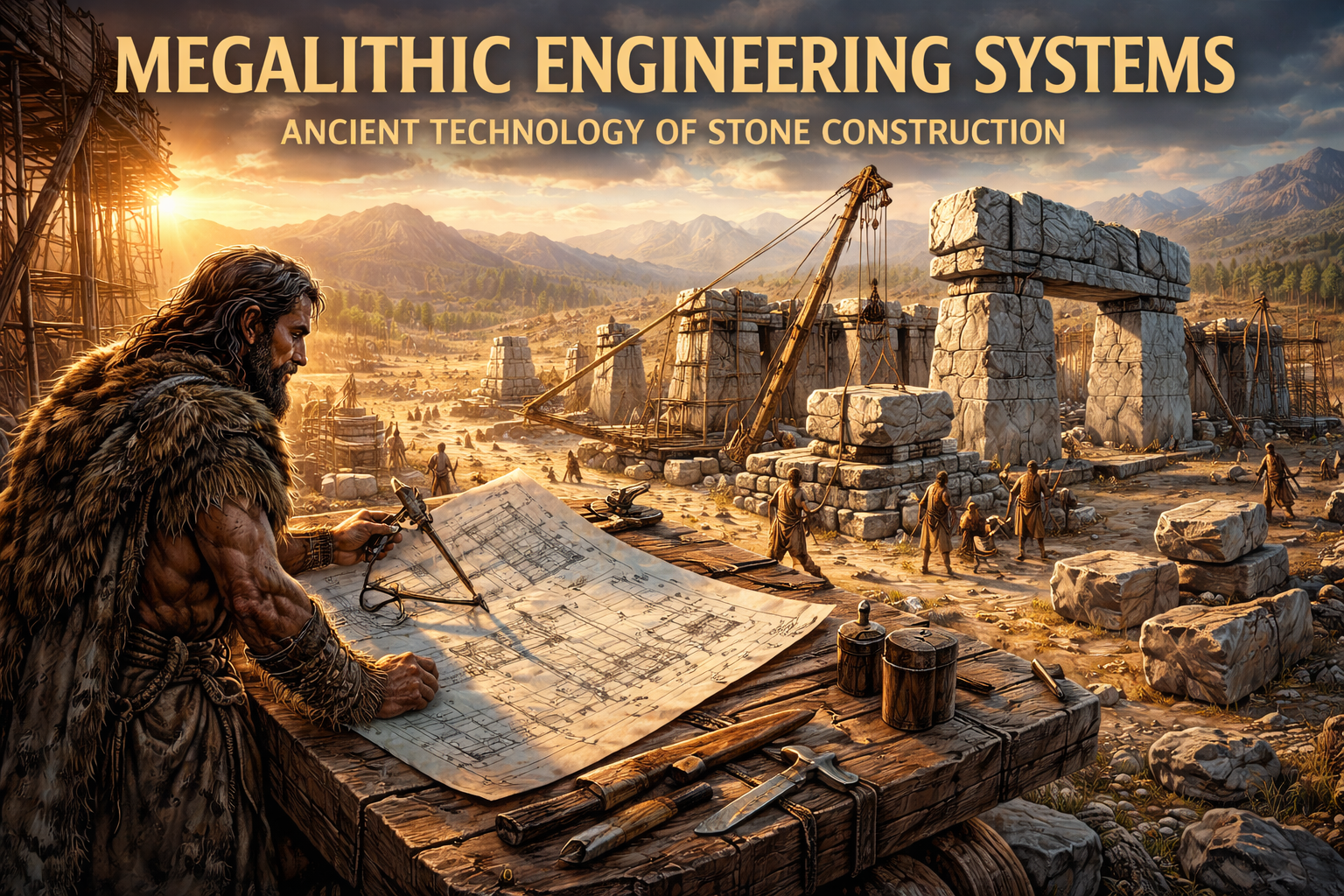
Bridging the Past and the Impossible
The story of the forgotten engineers begins where the stars meet the stones.
For millennia, temples, pyramids, and megalithic walls have whispered of technologies that modern science still struggles to explain.
These ancient builders were not primitive — they were masters of materials, geometry, and natural forces, guided by a unified understanding of the cosmos and the Earth itself.
As we transition from the Celestial Engineers — those who measured the heavens — to the Forgotten Engineers, we find that the same cultures that tracked solstices and stars also shaped granite and basalt with astonishing precision.
Precision That Defies Explanation
In Egypt, the casing stones of the Great Pyramid at Giza are fitted so tightly that a human hair cannot pass between them.
In Peru, the fortress of Sacsayhuamán rises in cyclopean curves, its stones carved with twenty or more faces, locked in perfect balance without mortar.
And in Puma Punku, high in Bolivia’s Andes, H-shaped blocks appear machine-cut — symmetrical, smooth, and uniform.
How were these feats achieved? Bronze chisels and wooden rollers cannot explain the results.
Were these ancient engineers applying forgotten technologies — possibly involving vibration, sound, magnetism, or geopolymers?
“It is easier to deny the evidence than to rethink our history.” — Anonymous field archaeologist, 1987
The Ancient Toolkit: Stone, Sound, and Science
Across cultures, legends hint that the ancients knew how to move stone with sound.
In Tibet, accounts describe monks using long horns and chants to lift rocks.
In Egypt, tales from the Coffin Texts speak of “voices that raised the stones.”
Recent acoustic experiments show that resonant frequencies can reduce the apparent weight of materials or create harmonic levitation in small-scale tests.
Could ancient builders have understood natural harmonics — not as myth, but as a working science?
Meanwhile, the concept of lost geopolymers — reconstituted stone mixtures — has gained traction through the work of Dr. Joseph Davidovits, suggesting that some pyramid stones might have been cast rather than quarried.
This wouldn’t diminish their achievement — it would elevate it, revealing early mastery of chemistry, materials, and environmental engineering.
A Global Pattern of Knowledge
The forgotten engineers were not confined to Egypt or the Andes.
Their fingerprints stretch across continents:
-
Stonehenge aligns with solstices and lunar cycles while demonstrating precise circular geometry.
-
Ba’albek, in Lebanon, holds some of the heaviest stones ever moved — weighing up to 1,200 tons each.
-
Nan Madol, in Micronesia, was built from columnar basalt transported over water.
The pattern suggests a shared principle — an understanding of earth energy, geometry, and vibration that transcended geography.
Some researchers, such as Christopher Dunn in The Giza Power Plant, even propose that ancient monuments functioned as energy devices — harmonizing the Earth’s natural resonances.
While controversial, the precision and intent in these works cannot be denied.
Cataclysms and the Great Forgetting
What if much of this knowledge vanished in the cataclysms of the Younger Dryas (~12,800 years ago)?
This turbulent period, possibly triggered by a cometary impact, brought sudden global cooling, floods, and the collapse of ecosystems.
Plato’s dialogues hint at civilizations erased by “fire and flood” — a repeating cycle of rise, destruction, and renewal.
Could the forgotten engineers belong to one of those lost epochs — a bridge between the mythical Atlantis and the first historical societies?
The erosion on the Sphinx, as noted by John Anthony West and Robert Schoch, suggests a wetter, older climate.
If true, then Egypt’s civilization — and its builders — could predate our accepted timeline by millennia.
Symbols of Knowledge, Machines of Stone
Look closer at ancient monuments and you’ll see that they are not random — they are designed to teach.
Every angle, ratio, and alignment encodes principles of mathematics and astronomy.
The Great Pyramid’s geometry corresponds to π and φ, and its orientation mirrors the Earth’s cardinal directions.
At Tiwanaku, the Gateway of the Sun tracks solar cycles with astonishing precision.
Were these structures temples, machines, or both?
Perhaps the forgotten engineers sought to harmonize human life with cosmic order — embedding their science in sacred architecture to survive the ravages of time.

Rediscovering Ancient Innovation
Modern engineers are now re-examining ancient methods:
-
3D scans of Andean walls reveal standardized tool marks — evidence of industrial-scale production.
-
Core samples from Giza show traces of reconstituted limestone.
-
Satellite mapping detects geometric site layouts along magnetic grid lines.
Each discovery strengthens the idea that ancient builders possessed technical intelligence equal — or superior — to ours in specific fields.
Echoes for the Future
We are only beginning to rediscover the lost continuum of ancient science — a worldview where physics, geometry, and spirituality were one.
To the forgotten engineers, a monument was more than stone: it was a message in form, an eternal bridge between heaven and earth.
Their work still stands, not merely as relics, but as teachers — inviting us to remember that knowledge, like stone, endures.
Additional readings
-
Article: Lost Science of the Ancients — From the Sky to the Stone
- Article: The Cosmic Code – Decoding the Sky Temples
-
Robert Schoch & John Anthony West — Sphinx Weathering Debate