Geometry of Ancient Structures: Earth Scaling and Cosmic Code
Geometry of Ancient Structures and the Hidden Order
The Geometry of Ancient Structures reveals a recurring pattern that challenges conventional interpretations of ancient architecture. Across continents and civilizations, monumental constructions display not only precision and durability, but also a consistent application of proportion, alignment, and numerical relationships that seem to extend beyond practical necessity.
From the Great Pyramid of Giza to the temples of Angkor Wat, from the stone circles of Europe to the engineered blocks of Puma Punku, ancient builders appear to have followed a geometric logic that was both repeatable and intentional with ancient units of measurements and hidden sacred ratios (link). There were sacred numbers in ancient civilizations with deeper esoteric meanings (link) Cycles of time, geometry and civilizations appear to all play important roles in shaping the mind of our ancient predecessors (link). So these structures are not isolated achievements. They form a global pattern. This raises a critical question:
Were ancient structures designed using a system of geometry that reflects the dimensions and cycles of the Earth itself?
The possibility introduces a profound shift in perspective. Instead of viewing ancient architecture as purely functional or symbolic, we begin to consider that it may also serve as a mathematical and planetary encoding system – a cosmic code (link), where geometry becomes the bridge between Earth, cosmos, and human construction.
Geometry of Ancient Structures in the Great Pyramid — Earth Scaling in Stone
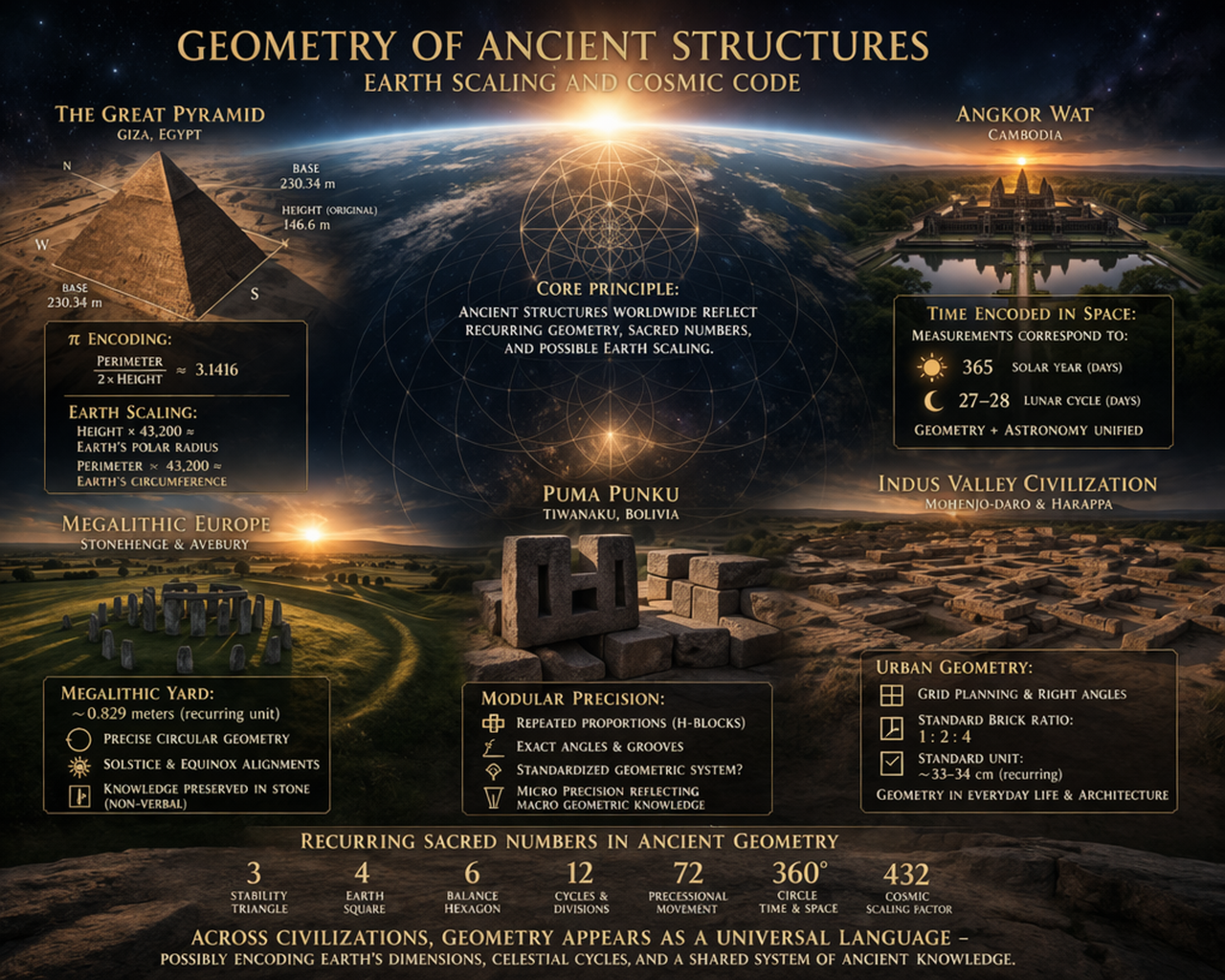
The Great Pyramid stands as one of the most compelling examples in the study of the Geometry of Ancient Structures. Its dimensions have been measured extensively, and the numerical relationships embedded within its form continue to generate debate. The base of the pyramid measures approximately 230.34 meters per side, while its original height reached about 146.6 meters. When these values are analyzed, a striking relationship emerges: the ratio between the perimeter of the base and twice the height closely approximates the value of π (pi).
This relationship can be expressed as: Perimeter ÷ (2 × Height) ≈ 3.1416
Such precision raises an important question. Was this relationship intentional, or is it a byproduct of construction methods? While definitive proof remains elusive, the consistency of the ratio suggests that geometry played a central role in the design process.
Beyond this, the concept of Earth scaling introduces an even more intriguing dimension. When the pyramid’s height is multiplied by 43,200, the result approaches the Earth’s polar radius. Similarly, the perimeter scaled by the same factor aligns closely with the Earth’s circumference. This numerical convergence invites speculation:
Could the Great Pyramid represent a scaled model of the Earth, encoded through geometry?
Whether symbolic or practical, the alignment between structure and planetary measurement remains one of the most fascinating aspects of ancient architecture.
Geometry of Ancient Structures in Angkor Wat — Time Encoded in Space

For example, certain measurements within the temple complex align with numbers such as 365, representing the solar year, and 27 or 28, reflecting lunar cycles. These relationships suggest that the builders were not only constructing a physical structure, but also embedding a representation of time itself.
This integration of geometry and astronomy raises a deeper question:
Did ancient civilizations perceive architecture as a way to materialize cosmic cycles on Earth?
In this context, geometry becomes more than a tool—it becomes a language through which time, space, and meaning are unified.
Geometry of Ancient Structures in Megalithic Europe — Circles, Ratios, and Repetition

The megalithic sites of Europe provide further evidence of the Geometry of Ancient Structures, particularly through their use of circular forms and consistent units. Stone circles such as Stonehenge and Avebury demonstrate precise geometric planning. Their diameters, radii, and alignments suggest the use of a standard unit, often referred to as the Megalithic Yard, estimated at approximately 0.829 meters.
What makes these sites particularly significant is not just the presence of a unit, but the way geometry is applied. Circles are divided into arcs, aligned with solar and lunar events, and constructed with a level of consistency that implies intentional design.
The absence of written records does not diminish the sophistication of these structures. On the contrary, it suggests that geometry itself may have functioned as a non-verbal system of knowledge transmission. This leads to a broader consideration:
Could geometry have served as a universal language, allowing knowledge to persist across generations without written documentation?
Geometry of Ancient Structures in Puma Punku — Modular Precision and Hidden Systems
Unlike the large-scale symbolic geometry seen in pyramids or temples, Puma Punku reflects a more technical application of geometric principles. Angles are precise, surfaces are flat, and interlocking features indicate careful planning. This precision raises a critical question:
What type of measurement system allowed for such repeatability in hard stone, and how was it maintained across multiple elements?
While there is no conclusive evidence that these measurements align with the modern meter, the consistency of the geometry suggests an underlying system—one that may connect to broader principles seen in other ancient sites.
Geometry of Ancient Structures in the Indus Valley — Urban Scaling and Ratio Systems
The Indus Valley Civilization provides a more grounded but equally important example of the Geometry of Ancient Structures. Cities such as Mohenjo-Daro were built using grid systems, standardized bricks, and consistent spatial organization. Bricks were often produced in a ratio of 1:2:4, a proportion that ensures both structural stability and modular flexibility. Streets were aligned in straight lines, intersecting at right angles, indicating a planned approach to urban design.
Measurement units appear to have been standardized, with a base unit around 33 to 34 centimeters repeated across construction elements.
This level of organization suggests that geometry was not limited to monumental architecture, but extended into everyday life.
Numerical Relationships in the Geometry of Ancient Structures
When the Geometry of Ancient Structures is examined across cultures, recurring numbers begin to emerge. These numbers appear in different contexts, yet maintain consistent meanings. Among them:
- 3 — associated with triangular stability
- 4 — linked to the square and the Earth
- 6 — representing balance and hexagonal symmetry
- 12 — used in divisions of time and space
- 72 — connected to precessional movement
- 360 — defining the circle and cycles
- 432 — appearing in cosmological scaling
These numbers are not confined to a single civilization. They appear in:
- Architecture
- Astronomy
- Calendrical systems
- Mythological frameworks
This repetition suggests that ancient builders were working within a shared numerical framework, even if expressed through different cultural lenses.
Earth Scaling and the Geometry of Ancient Structures
The concept of Earth scaling represents one of the most intriguing aspects of the Geometry of Ancient Structures. It proposes that certain monuments may encode the dimensions of the Earth through proportional relationships. The Great Pyramid provides the most discussed example, but similar ideas have been explored in relation to other sites.
The key principle is simple: A large system can be represented through a scaled model, using consistent ratios. If ancient builders understood the Earth as a measurable entity, they could express its dimensions through architecture. However, this remains a hypothesis. While numerical alignments exist, determining whether they are intentional requires careful consideration.
Geometry of Ancient Structures as a Universal System
Across all examined sites, one pattern remains consistent: geometry acts as the underlying framework. Units may vary. Materials may differ. Cultural expressions may change. But geometry remains constant.
This suggests that ancient knowledge systems may have been based not on fixed measurements, but on relationships and proportions. In this sense, geometry becomes a universal system—one that transcends language, culture, and time.
Final Thoughts — The Questions That Remain
The study of the Geometry of Ancient Structures does not lead to definitive answers, but it refines the questions that guide further exploration.
- Did ancient civilizations understand the dimensions of the Earth in ways that we are only beginning to recognize?
- Did they intentionally encode this knowledge into their structures, or are we observing patterns that emerge naturally from geometry?
- Was there a shared system of knowledge that connected distant cultures, or did similar solutions arise independently?
And perhaps most importantly:
Were ancient civilizations operating within a level of geometric and conceptual sophistication that we have yet to fully understand?
Additional Reading & Sources
Sacred Numbers and Ancient Measurement Systems (link)
Sacred Numbers 72 (link)
Sacred Number 360 (link)
Magli, Giulio — Architecture, Astronomy and Sacred Landscape (link)
Neugebauer, Otto — The Exact Sciences in Antiquity (link)
Aveni, Anthony — Ancient Astronomy in Practice
Magli, Giulio — Architecture, Astronomy and Sacred Landscape (link)
Santillana & von Dechend — Hamlet’s Mill (link)