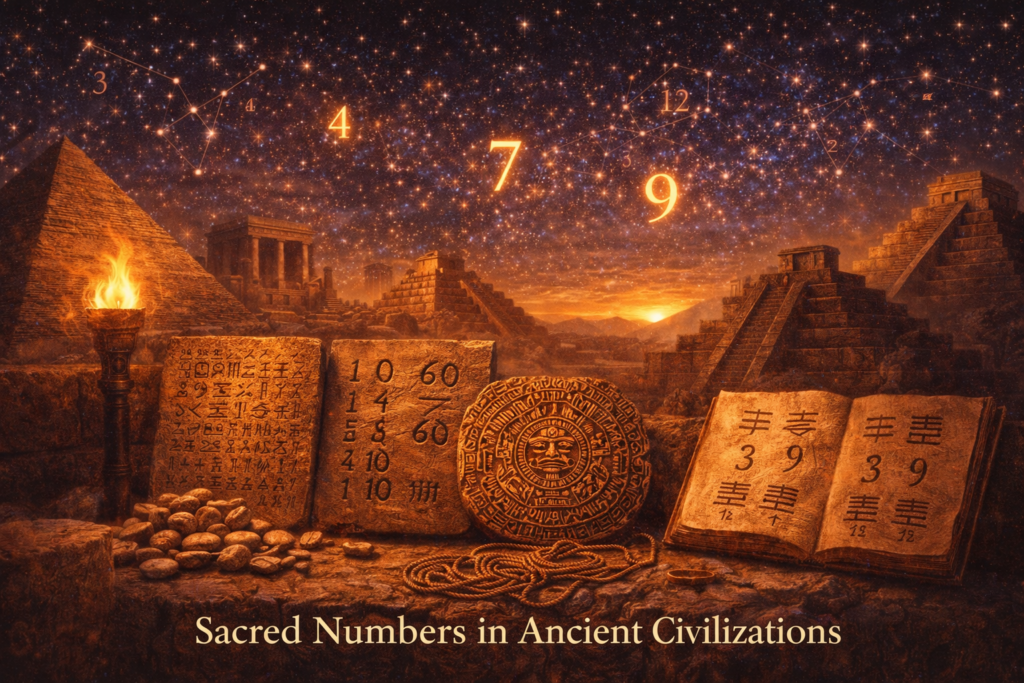
Sacred Numbers in Ancient Civilizations
Sacred numbers in ancient civilizations appear repeatedly across cultures separated by geography, language, and time. From temple architecture in Egypt to cosmological calendars in Mesoamerica, numerical symbolism shaped religious practices, astronomy, and philosophical traditions. These patterns raise an important question: how did societies across the world independently develop similar systems of numerical symbolism?
Some historians argue that these traditions emerged through parallel cultural development. Others propose that sacred numerical knowledge may have been transmitted from earlier civilizations, preserved through oral traditions, mythological narratives, ritual schools, and symbolic monuments.
Across antiquity, numbers were not merely mathematical tools. They were considered expressions of cosmic order and metaphysical structure, linking the human world to celestial cycles and universal harmony.
Numerical Symbolism in Egypt
In ancient Egypt, numbers carried profound religious meaning and appeared throughout temple design, funerary texts, and cosmological myths. Priestly scholars associated specific numbers with divine principles. The number three symbolized completeness and divine manifestation, while seven represented cosmic perfection. Temple complexes aligned with astronomical cycles, reflecting the belief that numerical harmony governed both earthly and celestial realms.
Egyptian initiatory traditions—sometimes described in classical accounts as temple schools—were said to preserve mathematical and astronomical knowledge passed from earlier generations of priests.
Mesopotamia and the Mathematics of the Cosmos
In Mesopotamia, early scholars developed one of the most influential numerical systems in history: the base-60 system. This system shaped astronomical observation, timekeeping, and geometry. The division of the circle into 360 degrees and the hour into 60 minutes can be traced to this ancient tradition.
Within Mesopotamian cosmology, numbers also carried symbolic meaning. The number seven appeared repeatedly in mythological texts, while twelve structured celestial cycles and zodiacal divisions.
Clay tablets discovered across the region reveal that scribal schools transmitted mathematical knowledge through structured education, suggesting the presence of organized intellectual traditions preserving earlier insights.
Sacred Numbers in India
Ancient Indian philosophy incorporated numerical symbolism into cosmology, ritual, and metaphysical speculation. Texts associated with the Vedic tradition describe numerical structures governing cosmic cycles, spiritual disciplines, and philosophical systems. Numbers such as three, seven, and twelve frequently appear in descriptions of cosmic order and ritual organization.
Later mathematical developments in India produced sophisticated numerical concepts, including positional notation and the concept of zero. These innovations demonstrate how numerical philosophy evolved into advanced mathematical theory while maintaining symbolic significance.
China and Numerical Cosmology
In ancient China, numbers played an important role in philosophical and cosmological frameworks. Systems such as the I Ching organized natural processes through symbolic numerical patterns representing transformation and balance.
Chinese cosmology frequently used numerical relationships to express the interaction of cosmic principles such as yin and yang and the five elements. Numerical symbolism also structured imperial architecture, ritual spaces, and calendar systems.
These traditions illustrate how numerical philosophy was integrated into governance, spiritual practice, and scientific observation.
Sacred Numbers in Mesoamerican Civilizations
Across Mesoamerica, civilizations such as the Maya and Aztec developed sophisticated numerical systems closely linked to astronomy and ritual calendars. The Maya created one of the most advanced calendar systems in the ancient world, based on complex cycles involving the numbers 13 and 20. Their Long Count calendar tracked vast periods of time and reflected a deep understanding of celestial cycles.
Similarly, Aztec cosmology incorporated sacred numbers into mythological narratives describing successive ages of the world. These traditions demonstrate how numerical symbolism shaped both cosmology and social organization within Mesoamerican cultures.
Numerical Traditions in the Andes
In the Andean region, the Inca civilization developed unique numerical recording systems using quipu, a network of knotted cords that encoded information through patterns and numerical structure.
While the quipu system functioned primarily as an administrative tool, many scholars believe it also encoded symbolic or ritual information related to cosmological concepts. This suggests that numerical systems served both practical and philosophical purposes across ancient societies.
Phoenician Transmission of Knowledge
The Phoenicians played an important role in the transmission of knowledge across the Mediterranean world. As skilled navigators and traders, they connected civilizations ranging from Egypt to Greece and beyond.
Through these networks, mathematical ideas, astronomical observations, and symbolic traditions may have circulated between cultures, contributing to the spread of numerical knowledge across the ancient world.
The Possibility of Older Sources of Knowledge
The recurrence of sacred numbers in ancient civilizations has inspired speculation that these systems may reflect knowledge inherited from earlier cultural traditions. Myths and legends from many cultures describe ancient teachers or primordial civilizations that transmitted knowledge of astronomy, mathematics, and cosmic order to later societies.
While such narratives cannot always be verified historically, they highlight an important cultural reality: ancient societies viewed knowledge as something preserved and transmitted through generations.
Temples, monuments, and oral traditions often served as repositories of this knowledge. Initiatory schools—whether priestly colleges, philosophical communities, or scribal academies—functioned as guardians of symbolic and mathematical traditions.
Sacred Numbers and the Transmission of Knowledge
In many ancient civilizations, knowledge was not written down in the same scientific way it is today. Instead, important ideas were preserved through symbolic systems and cultural traditions. These included:
-
myths and legends
-
sacred architecture
-
ritual practices
-
astronomical alignments
-
geometric symbolism
Through these forms, complex ideas about mathematics, cosmology, and the structure of the universe could be remembered and passed down for many generations.
Because of this, some scholars believe that the ideas found in Pythagorean numerology may be part of a much older tradition of human knowledge. Ancient accounts say that Pythagoras traveled to places such as Ancient Egypt and Mesopotamia, where advanced knowledge of mathematics and astronomy already existed. In these regions, temple schools and priestly groups often protected and taught important knowledge to new generations.
From this point of view, Greek philosophers may not have created all of these ideas from the beginning. Instead, they may have inherited older knowledge and developed it further through their own schools and philosophical systems.
This suggests that human understanding of numbers, geometry, and cosmic patterns could be much older than the surviving Greek texts. The Greeks helped organize and explain these ideas in a clearer philosophical way, but the roots of this knowledge may reach much deeper into the history of early civilizations.
Conclusion
Sacred numbers appear in many ancient civilizations, showing that numbers were more than simple tools for counting. In cultures such as Ancient Egypt, Mesopotamia, Ancient India, Ancient China, and the civilizations of Mesoamerica, numbers were connected to ideas about the universe, time, harmony, and natural order. They appeared in temple architecture, calendars, myths, and philosophical systems. These patterns suggest that many early societies believed the universe followed mathematical laws.
In the ancient world, knowledge was not always written in scientific books like today. Instead, important ideas were often preserved in myths, stories, rituals, and symbolic traditions. Through storytelling and cultural practices, complex ideas about astronomy, geometry, and cosmic cycles could survive for many generations. In this way, myths and sacred traditions may have helped protect and pass down knowledge long before formal scientific writing existed.
Some scholars believe that parts of this knowledge could be much older than the civilizations where we first see it written down. According to this view, certain myths and symbolic traditions may contain fragments of knowledge inherited from even earlier cultures. Ancient monuments, temples, and carefully aligned structures may also reflect advanced understanding of geometry and astronomy that later civilizations tried to study and interpret.
In many cultures, small groups of priests, scholars, or initiates were responsible for preserving and teaching this knowledge. These individuals studied mathematics, astronomy, and sacred traditions, and they often trained students in temple schools or philosophical communities. Figures such as Pythagoras are sometimes described as travelers who learned from older centers of knowledge, particularly in places like Egypt and the Near East, before bringing these ideas into Greek philosophical traditions.
Whether sacred numerical knowledge developed independently in different cultures or was passed down from older and possibly more advanced civilizations remains an open question. What is clear is that numbers played a central role in how ancient societies understood the world. For them, numbers were not just tools for calculation—they were a way to describe the hidden harmony and structure of the universe.
Additional Reading and Sources
Ifrah, Georges. The Universal History of Numbers. Wiley, 2000. (link)
Kline, Morris. Mathematical Thought from Ancient to Modern Times. Oxford University Press, 1972. (link)
Robson, Eleanor. Mathematics in Ancient Mesopotamia. Princeton University Press, 2008. (link)
Joseph, George G. The Crest of the Peacock: Non-European Roots of Mathematics. Princeton University Press, 2000.
Saliba, George. Islamic Science and the Making of the European Renaissance. MIT Press, 2007.
Krupp, Edwin – Echoes of the Ancient Skies (link)
Joseph Campbell – The Masks of God (link)
Ancient360 – Sacred Geometry in Architecture
Ancient360 – Aligning Earth and Sky (link)
Ancient360 – Cycles of Time (link)
Ancient360 – Lost Geometry Knowledge (link)