
Turkey is hailing the discovery of an 11,400-year-old monumental site as one of the world’s oldest villages, challenging the prevailing science on when and why humankind first settled down.
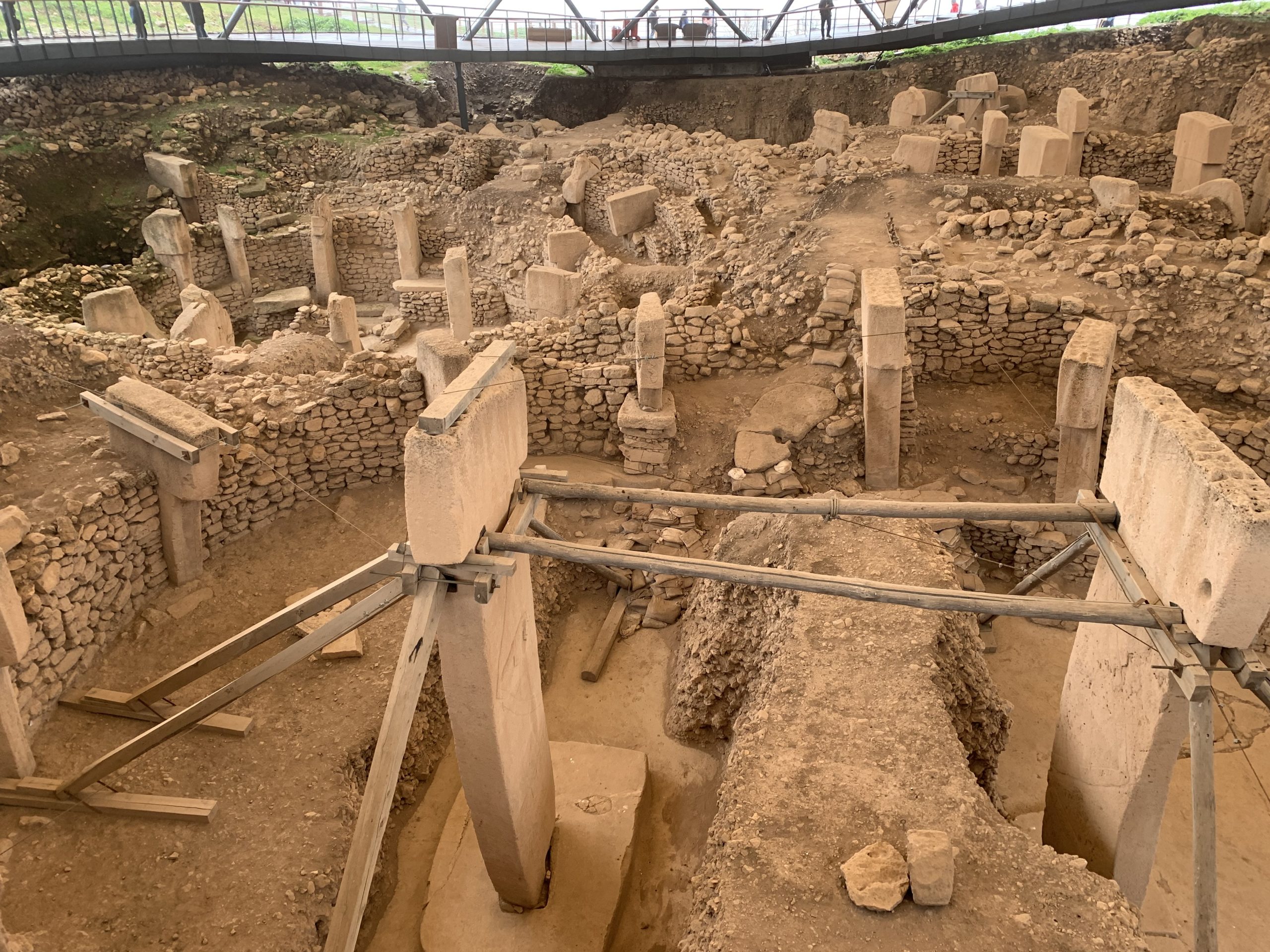
Potbelly Hill in Turkish, Göbekli Tepe is an artificial mound spread across eight hectares at the top end of the Fertile Crescent near the present-day city of Sanliurfa, Turkey. The oldest known temple complex is a Neolithic archaeological site located in the Southeastern Anatolia Region of Turkey. Dated to the Pre-Pottery Neolithic, between c. 9500 and 8000 BCE, the site comprises several large circular structures supported by massive stone pillars. The world’s oldest known megaliths.

At around 12,000 years old, Göbekli Tepe in south-east Turkey has been billed as the world’s oldest temple. It is many millennia older than Stonehenge or Egypt’s great pyramids, built in the pre-pottery Neolithic period before writing or the wheel. It features a series of circular sunken structures that had been occupied for a thousand years before they were back-filled and abandoned. Construction techniques vary but in the most elaborate there is a ring of T-shaped monolithic columns with a pair of larger, carved T-columns at the centre up to five metres tall. These not only supported a roof (for at least some of their life) but also represented abstract human figures that were part of a belief system that is not yet understood. They are sculptural as well as structural, with animal figures in relief.
According to Bianet.org, the 2022 was characterized by a large number of findings such as grinding stones and hammer-stones that indicated the daily use of these places. Necmi Karul, archeologist at İstanbul University and leader of the dig team, said that ancient grinding stones were often used to crush or pulp plants or animals for cooking. Analysis of these findings will give a more detailed idea of what these activities were. Necmi Karul said that according to the new findings from excavations, some of the generally accepted views on Göbekli Tepe are still valid, but some are likely incorrect. “One of the prominent possibilities is that although it has been suggested that there were only public buildings in Göbekli Tepe, called temples by some, it was known that there were places in the form of dwellings and shelters.” Necmi Karul went on to say, “More of these (dwellings and shelters) have been found. So, this has fueled debate over whether this was a gathering center or a settlement where people live at the same time.” Necmi Karul said that the fact that the team found residences in Karahantepe and other stone hills which existed around the same time as Göbekli Tepe increased the probability that these places were settlements containing public buildings.
Karul adds, “The existence of tools pointing to agricultural experiments shows that when the first settlements began to appear at the site, there was no agricultural activity, but wild grains were collected, and that this collection process evolved into the cultivation of plants over time.”
While the layers at nearby Çakmaktepe are “possibly older” than Göbekli Tepe and Karahantepe, architectural remains pointing to the presence of complex societies in Sayburc from the beginning of the Neolithic period were unearthed last year. While Karul described the period as the beginning of settled life and living together in larger groups for the first time, he stressed that this brought a new social order, new relationships, and a division of labor. The public buildings are among the best indicators of this and that the figures in these structures and the scenes depicted on the figures are the products of a communal memory based on a distant past. “When we put all this together, we see the construction of a new society that we have never encountered before.”
The team also found the remains of a rectangular-planned building from the end of Neolithic period, which would demonstrate a complex character at the Sefertepe site, adding that findings from the pre-Neolithic period were also unearthed in the Sogut field. “It is a fact that both Göbekli Tepe and other settlements are sites that were part of an interacting social organization in a wide region about 11,000 to 11,500 years ago.”
“The excavation work continues in nine different locations this year as part of the project Tas Tepeler,” Karul said, noting the project under the auspices of the Culture and Tourism Ministry started last year. The excavations are being carried out simultaneously by multinational teams at the sites.





4 Responses