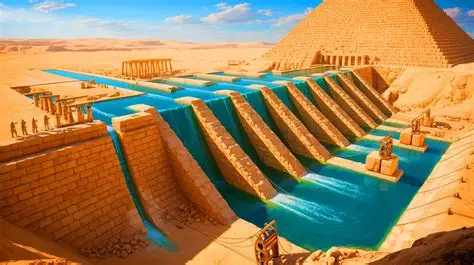
Great Pyramid True Purpose: New Evidence from Science, Engineering, and Chemistry
For over two centuries, mainstream archaeology has asserted that the Great Pyramid of Giza was built as a royal tomb. Yet this explanation collapses when confronted with measurable physical evidence, chemical residues, engineering design, and global technological parallels.
The Great Pyramid true purpose emerges not from mythology or symbolism, but from hard data—geology, chemistry, physics, and industrial logic. When evaluated as a functional system rather than a symbolic monument, the pyramid reveals itself as part of a planetary-scale technological network developed by a highly advanced pre-dynastic civilization.
This article is part of Ancient360’s ongoing investigation into non-funerary megalithic architecture and lost ancient technologies.
The Great Pyramid True Purpose Cannot Be Funerary
No verified burial evidence exists inside the Great Pyramid:
-
No mummy
-
No funerary texts
-
No grave goods
-
No sealing evidence
Instead, what we find are reaction chambers, pressure-resistant architecture, precision granite components, and materials chosen for specific physical properties, not ritual aesthetics.
The Great Pyramid true purpose must therefore be functional.
Material Intelligence: Stones Chosen for Physics, Not Symbolism
The Great Pyramid uses three primary stone types, each with known physical properties:
White Limestone (Casing & Core)
-
High dielectric constant
-
Stores electric fields efficiently
-
Acts as an electrical insulator
Red Granite (Internal Chambers)
-
Piezoelectric under pressure
-
Produces ultrasound and resonance
-
Precisely machined to extreme tolerances
Black Basalt (Associated Structures)
-
High thermal mass
-
Heat storage and dissipation
This intentional material triad mirrors modern industrial and electrical design logic—not funerary tradition.
Geometry as an Energy-Focusing Mechanism
The pyramid’s tetrahedral geometry is not decorative.
Peer-reviewed physics simulations demonstrate that the Great Pyramid geometry concentrates electromagnetic energy around:
-
The King’s Chamber
-
The antechamber
-
Internal granite structures
Small variations in slope angles between pyramids alter field concentration zones, indicating engineering calibration, not architectural trial-and-error.
This geometry reinforces the Great Pyramid true purpose as an energy-driven system.
The Power Source: Earth and Sky Working Together
From Below: Telluric Currents
-
Natural electric currents flowing through Earth’s crust
-
Concentrated by:
-
Subterranean water
-
Metal ore veins (iron, copper, gold, platinum)
-
From Above: Lightning
-
Fulgarites (fossilized lightning) found across Giza
-
Melted and vitrified iron veins embedded with silica microspheres
-
Lightning strike density correlates with pyramid placement
The pyramid did not generate electricity—it harvested and focused natural planetary energy.
Chemical Function: Industrial-Scale Synthesis
According to Geoffrey Drumm’s hypothesis, the pyramids formed a linked chemical manufacturing complex:
| Pyramid | Chemical Output | Purpose |
|---|---|---|
| Step Pyramid | Methane | Fuel, synthesis gas |
| Red Pyramid | Ammonia | Fertilizer, metallurgy |
| Bent Pyramid | Urea | Solid fertilizer |
| Great Pyramid | Sulfuric Acid | Metal extraction |
| Central Pyramid | Hydrochloric Acid | Ore processing |
The Great Pyramid true purpose aligns precisely with sulfuric acid production, using:
-
Hydrogen sulfide from subterranean caves
-
Air intake shafts
-
Controlled pressure and heat

Engineering Requirements That Eliminate Tomb Theory
Pressure & Temperature
-
Internal chambers capable of:
-
~500°C
-
40+ atmospheres
-
Structural Necessity
The massive stone body:
-
Prevents catastrophic explosion
-
Contains toxic gases
-
Stabilizes internal reactions
-
Shields environment from contamination
A tomb requires none of this.
Global Parallels: One Technology, Many Locations
The same mechanisms appear worldwide:
Egypt
-
Giza Plateau
-
Saqqara
-
Dashur
Europe
-
Stonehenge
-
Avebury
-
Newgrange
Asia
-
Japanese stone circles
-
Pyramid-like structures over geothermal vents
Americas
-
Teotihuacan
-
Andean precision masonry
All share:
-
Lightning attraction
-
Subterranean water
-
Metal-rich geology
-
Astronomical timing
This points to shared knowledge or a single point of technological origin.
Timeline: Before Dynastic Egypt
Evidence places pyramid operation between:
-
8,500–5,300 BCE (Saharan Humid Period)
This predates:
-
Pharaohs
-
Writing
-
Dynastic religion
The dynastic Egyptians inherited these structures—they did not originate the technology New Evidence CONFIRMS the Great…
Synthesis: The Great Pyramid True Purpose Reconsidered
When stripped of modern assumptions, the evidence converges:
-
The Great Pyramid was not a tomb
-
It was not symbolic
-
It was not primitive
It was:
-
An industrial-scale chemical reactor
-
An energy-harvesting structure
-
Part of a global technological system
-
Built by a civilization approaching Type I planetary capability
The Great Pyramid true purpose represents not a mystery—but a suppressed chapter of human technological history. This article is part of Ancient360’s ongoing investigation into non-funerary megalithic architecture and lost ancient technologies.
Additional Resources and Readings
-
Pyramids Not Tombs — Investigative Series (Parts 1–3)
Foundational framework challenging the funerary narrative: Part 1 – Part 2 – Part 3 -
Precision Stonework in Ancient Egypt
Quantitative analysis of tolerances, materials, and machining (link) -
The Serapeum of Saqqara: Engineering Without Burial
Comparative case study of non-funerary granite structures (link) -
Global Megalithic Energy Sites
Mapping stone structures, geology, and electromagnetic anomalies (link) -
Ancient Engineering and Over-Design
Why excessive precision implies function, not ritual Part 1 – Part 2
Engineering & Technology
-
Christopher Dunn — The Giza Power Plant
Engineering-based functional analysis of the Great Pyramid (link) -
Christopher Dunn — Lost Technologies of Ancient Egypt
Manufacturing precision and machine-tool evidence (link)
Scientific & Academic
-
N. Tesla — Selected Works on Earth–Atmosphere Electricity
Foundational concepts relevant to planetary energy interaction (link) -
Research Gate
Electromagnetic field concentration studies inside the Great Pyramid (link) -
Hemiunu Project (Czech Institute of Egyptology)
Subsurface voids, water channels, and structural mapping at Giza (link)
Archaeology (for contrast and critique)
-
Mark Lehner — The Complete Pyramids
Mainstream reference for comparative analysis (link)