Introduction: A Scientific World Before History Began
The concept of ice age knowledge challenges one of the most deeply ingrained assumptions in modern historical thinking, namely that scientific understanding emerged only after the development of agriculture and urban civilization, because mounting archaeological and interdisciplinary evidence suggests that prehistoric humans may have developed structured systems of observation, measurement, and environmental prediction long before the Younger Dryas climatic disruption reshaped the planet approximately 12,800 years ago (Younger Dryas Impact – The Impact that Reset Civilization link). While mainstream narratives continue to frame Paleolithic societies as primarily focused on survival, new interpretations of symbolic artifacts, megalithic alignments, and early astronomical awareness increasingly point toward the existence of intellectual traditions that were both systematic and cumulative, indicating that knowledge itself may have been one of humanity’s earliest and most important tools (Pre Flood Civilization and Environmental Collapse link).
This emerging perspective is not based on a single discovery but rather on a convergence of evidence drawn from archaeology, archaeoastronomy, climatology, and cognitive science, all of which suggest that early humans possessed the capacity to observe long-term natural cycles, encode that information into symbolic or structural forms, and transmit it across generations through both visual and oral systems (Exploring Ancient Civilizations After Ancient Cataclysms link). When viewed through this lens, the Ice Age is no longer simply a period of harsh environmental conditions but becomes instead a vast and largely undocumented era of intellectual experimentation, during which human beings may have begun to understand the rhythms of the Earth and sky with a level of sophistication that has yet to be fully acknowledged (Prehistoric Lost Knowledge Before Written History link).
Crucially, this reinterpretation intersects with the Younger Dryas Impact Hypothesis, which proposes that abrupt climatic changes caused by extraterrestrial or environmental factors may have triggered widespread ecological collapse and cultural disruption, raising the possibility that early knowledge systems were not simply primitive precursors to later science but fully developed traditions that were partially lost, fragmented, or transformed in the aftermath of global catastrophe. In this context, the study of ice age knowledge becomes not only an investigation into prehistoric intelligence but also an inquiry into the resilience and vulnerability of human understanding across deep time (Giant Humans Before Younger Dryas link).
Environmental Pressures and the Birth of Scientific Thinking
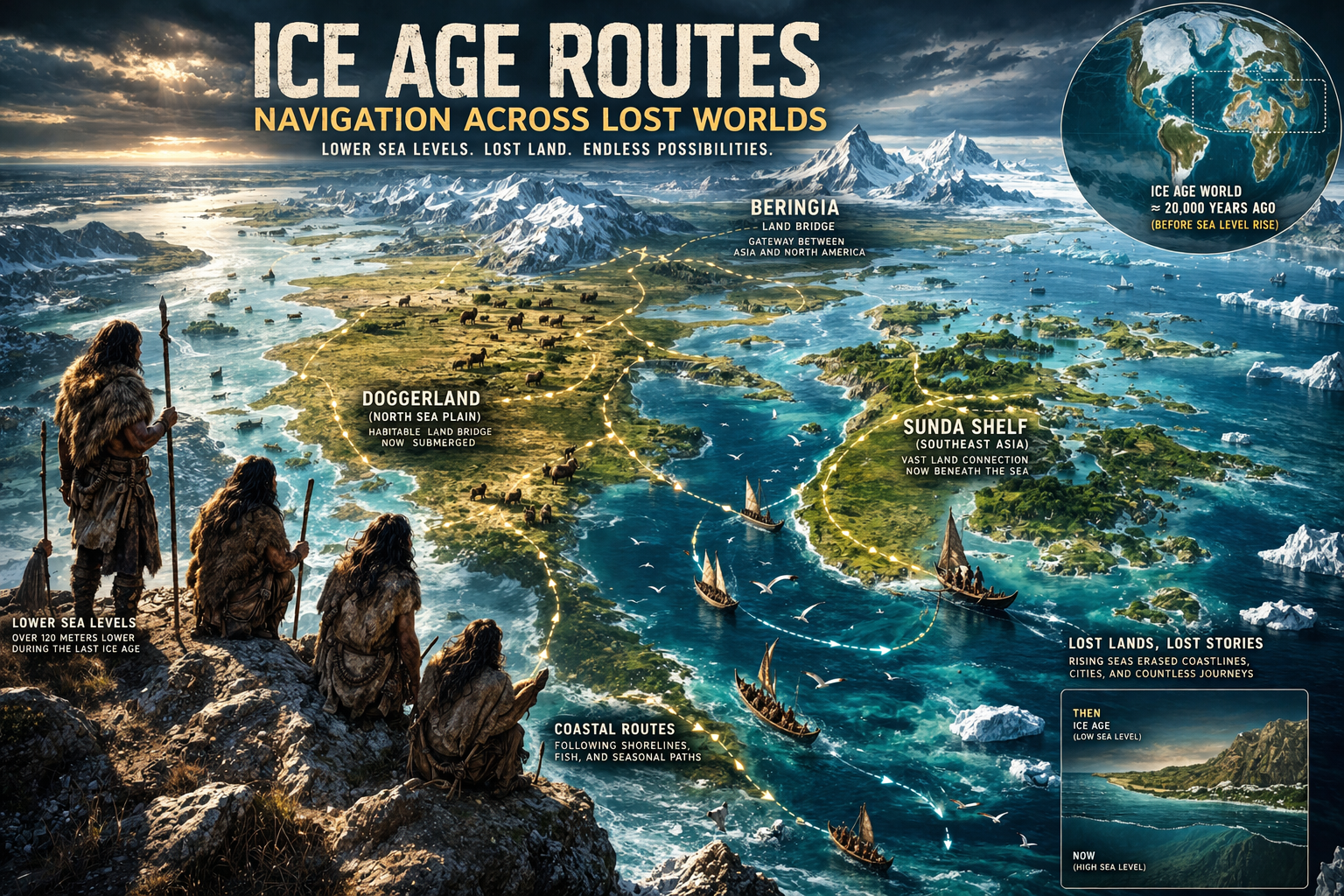
The Ice Age environment imposed extreme challenges on human populations, including fluctuating temperatures, shifting ecosystems, and unpredictable resource availability, all of which required a level of adaptability that likely drove the development of advanced observational skills and pattern recognition. Survival under such conditions would have depended not merely on immediate responses to environmental stimuli but on the ability to anticipate change, recognize cyclical patterns, and make decisions based on accumulated knowledge rather than instinct alone.
This necessity may have acted as a catalyst for the emergence of proto-scientific thinking, because early humans who could accurately track seasonal cycles, animal migrations, and climatic variations would have enjoyed a significant survival advantage over those who relied solely on short-term perception (Pre Flood Civilization and Environmental Collapse link). Over time, these observational practices could evolve into structured systems of knowledge, incorporating elements of measurement, prediction, and classification that resemble the foundational principles of scientific inquiry.
For example, the tracking of lunar phases would allow prehistoric communities to anticipate tides, nocturnal visibility, and seasonal transitions, while the observation of stellar positions could provide reliable indicators of time and direction. These practices, repeated over generations, would gradually accumulate into a body of knowledge that, although not formally written, functioned as a practical and conceptual framework for understanding the natural world.
Astronomical Awareness in the Paleolithic Era
One of the most compelling lines of evidence supporting the existence of ice age knowledge lies in the study of prehistoric astronomy, which reveals that early humans were not only aware of celestial phenomena but actively incorporated them into their cultural and possibly scientific systems. Cave art sites such as Lascaux and Chauvet, while often interpreted as purely symbolic or ritualistic, contain patterns and arrangements that some researchers believe correspond to star clusters or seasonal constellations.
These interpretations remain debated, yet they are supported by the broader observation that many ancient cultures, including those separated by vast distances and time periods, developed remarkably similar methods for tracking celestial cycles. This convergence suggests that the human capacity for astronomical observation is both ancient and deeply rooted in our cognitive architecture, potentially extending back to the earliest phases of cultural development.
If Paleolithic communities were indeed mapping the sky or encoding celestial information into symbolic forms, then their understanding of the cosmos may have been far more sophisticated than traditionally assumed, encompassing not only practical navigation but also abstract concepts related to time, space, and cyclical change.
Megalithic Precursors — Were There Ice Age Origins?
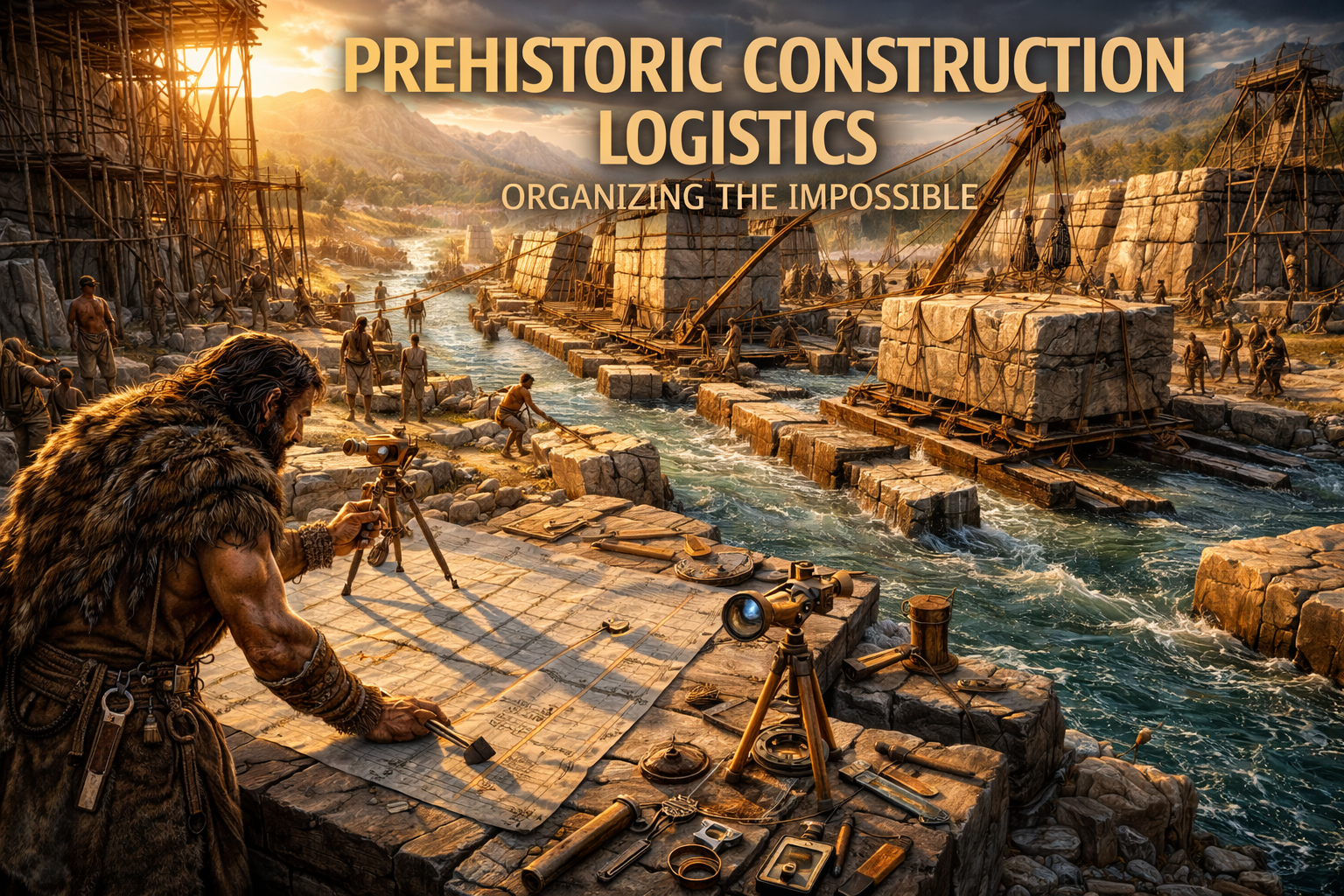
Although most megalithic structures date to the post-Ice Age period, some researchers have proposed that their underlying principles may originate in much earlier traditions of environmental observation and spatial measurement. Sites such as Göbekli Tepe, which dates to approximately 11,600 years ago, already exhibit a level of architectural complexity and symbolic sophistication that appears fully developed rather than experimental, raising questions about the knowledge systems that preceded its construction. It represents lost knowledge of the ancients… (link)
The precise alignment of megalithic structures with solstices, equinoxes, and other astronomical events suggests that their builders possessed a deep understanding of celestial mechanics, an understanding that may have been inherited from earlier Ice Age traditions. If this is the case, then megalithic architecture represents not the beginning of scientific knowledge but its continuation, built upon foundations that extend far deeper into prehistory.
The Younger Dryas Disruption
The Younger Dryas period represents one of the most abrupt climatic events in Earth’s recent history, characterized by a rapid return to near-glacial conditions that disrupted ecosystems across multiple continents. This sudden environmental shift would have had profound effects on human populations, potentially forcing migrations, altering resource availability, and destabilizing existing social structures. And studies uncover new evidence supporting this impact hyphotesis… Research Gate (link) – Impact Evidence from the University of Edinburgh (link) – YDIH.ORG (link)
If complex knowledge systems existed prior to this event, they may have been severely impacted by these changes, leading to the loss or fragmentation of accumulated information. In such a scenario, the transition from the Ice Age to the Holocene would not represent a simple progression toward civilization but rather a period of recovery and reconstruction, during which surviving fragments of knowledge were reorganized into new cultural frameworks.
Symbolic Systems as Scientific Tools
Returning to the evidence of symbolic engravings discussed in the previous article, it becomes increasingly plausible that these markings functioned as tools for recording and transmitting scientific observations. Sequences of lines, dots, and geometric shapes could represent counts, cycles, or relationships between environmental variables, effectively serving as early data recording systems (Sacred Geometry link).
Such systems would allow knowledge to be externalized and shared, enabling collective learning and long-term accumulation of information. Over generations, these symbolic tools could evolve in complexity, forming the basis for more advanced systems of notation and eventually written language.
Knowledge Transmission and Cultural Continuity
One of the central difficulties in studying Ice Age knowledge is explaining how complex information could be passed down without written language. Anthropologists often point to oral traditions, which use storytelling, repetition, and rhythm to encode important knowledge in memorable ways. These traditions were likely reinforced through ritual practices and symbolic markers, enabling communities to preserve critical survival information across many generations.
Although such systems leave limited direct archaeological traces, evidence from later oral cultures shows that they can maintain remarkable accuracy over long periods. Techniques like mnemonic devices, performance, and symbolic imagery would have strengthened memory and reduced the risk of knowledge loss. When combined, these approaches could form resilient systems capable of surviving environmental crises, migrations, and social changes..
Implications for the History of Science
If Ice Age societies engaged in systematic observation of nature, then the origins of science must be reconsidered as much older than traditionally believed. Early humans closely monitored seasonal cycles, animal behavior, and celestial patterns, suggesting a form of proto-scientific thinking grounded in empirical experience. This implies that science did not suddenly appear in ancient civilizations but gradually evolved over tens of thousands of years.
This interpretation is supported by research indicating that human cognitive abilities have remained largely unchanged for millennia. The capacity for reasoning, pattern recognition, and abstraction was already present in prehistoric populations. As a result, the foundations of scientific thinking may have existed long before they were formalized in written records..
Conclusion: Rediscovering the Depth of Human Knowledge
The study of Ice Age knowledge challenges older assumptions that prehistoric humans possessed only limited intellectual capabilities. Instead, growing evidence suggests that they developed sophisticated systems of understanding related to their environment, astronomy, and symbolic communication. These insights point to the possibility that early forms of scientific knowledge existed but were later transformed or lost due to changing conditions.
Recognizing this deeper history does not diminish the accomplishments of later civilizations but places them within a broader continuum of human intellectual development. It highlights that curiosity, observation, and learning have been central traits of our species for tens of thousands of years. Continued research may further reshape our understanding of human history, revealing that the pursuit of knowledge is one of the oldest and most enduring aspects of humanity.