A Sudden Winter in Prehistory
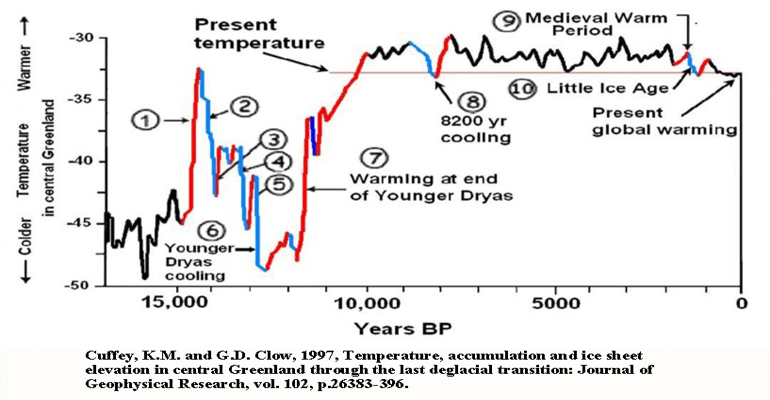
Around 12,800 years ago, Earth entered an abrupt and catastrophic cooling period known as the Younger Dryas. This event marked the end of the Pleistocene epoch and delayed the planet’s warming after the last Ice Age. What should have been a steady thaw turned, within decades, into an arctic freeze.
Ice sheets re-advanced. Megafauna vanished. And human populations — from North America to the Fertile Crescent — faced a planetary collapse. But what caused it? That question lies at the heart of one of the most debated episodes in geological and archaeological history.
The Dryas Periods — A Timeline of Climate Whiplash
The Dryas periods are named after Dryas octopetala, a tundra wildflower whose pollen marks cold phases in ice-core samples.
-
Older Dryas (~14,000–13,700 BCE)
-
A brief return to glacial conditions after an initial warming trend.
-
Evidence from Greenland ice cores shows a sharp drop in temperatures, possibly due to melt-water disrupting oceanic currents.
-
-
Younger Dryas (~10,800–9,600 BCE)
-
A dramatic and longer-lasting freeze — up to 1,200 years of climatic instability.
-
Temperatures in the North Atlantic fell by as much as 10°C within decades.
-
The period ended suddenly, leading to the onset of the Holocene, our current inter-glacial age.
-
These shifts are recorded in Greenland ice cores (GISP2 and GRIP), lake sediments, and oceanic isotopes, providing one of the clearest records of abrupt climate change in Earth’s history.

The Younger Dryas Impact Hypothesis
In 2007, a group of geologists and researchers proposed the Younger Dryas Impact Hypothesis, suggesting that the event was triggered by the airburst or fragmentation of a massive comet or asteroid over the North American ice sheet.
Key evidence includes:
-
Microspherules and nanodiamonds found at the so-called Younger Dryas Boundary (YDB) layer across multiple continents.
-
High levels of platinum-group metals, often associated with cosmic impacts.
-
Melted glass-like materials (impactites) discovered in North America, the Middle East, and even South America.
-
Charcoal and soot layers, indicating massive wildfires — possibly continental in scale.
These clues suggest that one or more fragments from a disintegrating comet may have impacted the Northern Hemisphere, causing:
-
Rapid meltwater floods from destabilized ice sheets,
-
A massive freshwater influx into the North Atlantic, disrupting the Atlantic Meridional Overturning Circulation (AMOC),
-
And a global cooling effect within years.
“It was a reset button for civilization.” — Graham Hancock, Magicians of the Gods (2015)
Effects on Climate, Ecosystems, and Civilizations
The Younger Dryas coincides with the extinction of the Pleistocene megafauna, including mammoths, mastodons, saber-toothed cats, and giant sloths. Human cultures across the globe were transformed — or wiped out.
-
In North America, the Clovis culture vanished abruptly.
-
In the Middle East, the Natufian culture, which had begun early agriculture, regressed to hunter-gatherer patterns.
-
In South America, rising waters and torrential rains may have erased coastal settlements.
In geological terms, this was more than climate change — it was a global cataclysm that reset the trajectory of civilization.
From Myth to Memory — Cataclysms in Ancient Records
Ancient stories echo what geology reveals. The Epic of Gilgamesh, Plato’s dialogues on Atlantis, Hindu flood myths, and the Mesoamerican Popol Vuh all recount an age-ending deluge or firestorm from the heavens.
-
Plato describes “fire from the sky” and “a great flood that swallowed the island of Atlantis.”
-
The Maya spoke of “the world of the first sun destroyed by fire.”
-
The Norse Ragnarok and Hindu Mahapralaya speak of cycles of destruction and rebirth — strikingly similar to post-cataclysmic recoveries in geology.
These myths, scattered yet convergent, may represent cultural memories of the Younger Dryas impact — events passed down through oral traditions for millennia.

Scientific Debate and Controversy
The Younger Dryas Impact Hypothesis remains contentious. Critics argue that:
-
Some claimed impact markers could result from terrestrial processes like volcanism or wildfires.
-
The timing and distribution of materials do not always align perfectly across sites.
-
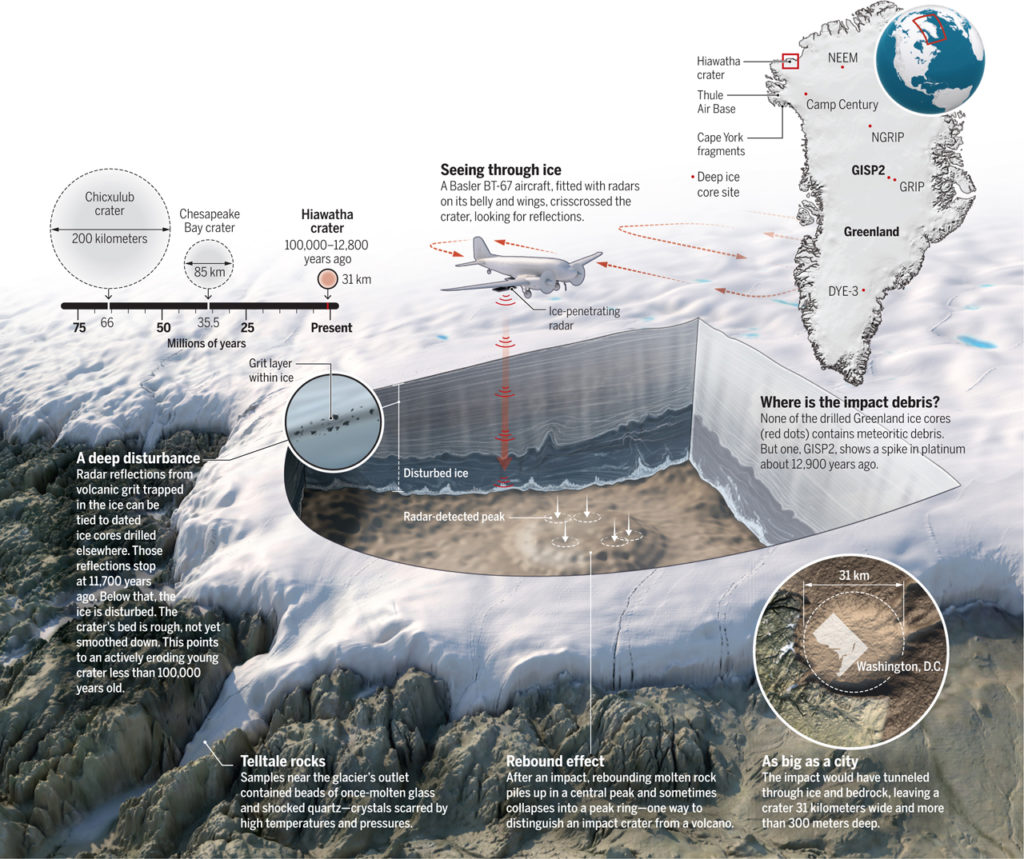
No single crater has been definitively linked to the event (though Greenland’s Hiawatha Crater, discovered in 2018 beneath the ice, remains a candidate).
Supporters counter that the scale of geochemical and geomagnetic anomalies across continents is too consistent to dismiss.
Recent studies (e.g., Scientific Reports, 2021) continue to strengthen the case for cosmic involvement.
The Legacy of the Dryas Cataclysms
The end of the Younger Dryas marks the dawn of the Holocene — and, almost immediately, the rise of agriculture and civilization.
Within centuries of the ice retreating, sites like Göbekli Tepe appeared — an astronomical and architectural enigma built around 9,500 BCE. Coincidence or continuity?
Many now suspect that survivors of pre-cataclysmic cultures carried fragments of knowledge — astronomy, geometry, and engineering — that reemerged in early Neolithic construction.
Thus, the Younger Dryas may not only mark a geological boundary, but a civilizational amnesia: a global reset that erased the world’s first great cultures, leaving behind legends of the “gods” who came after the flood.
Links and References
-
Firestone et al., PNAS (2007): Evidence for an Extraterrestrial Impact 12,900 Years Ago
- COMET Research Group and Younger Dryas Publications
- Article: The Younger Dryas Impact Hypothesis Explained