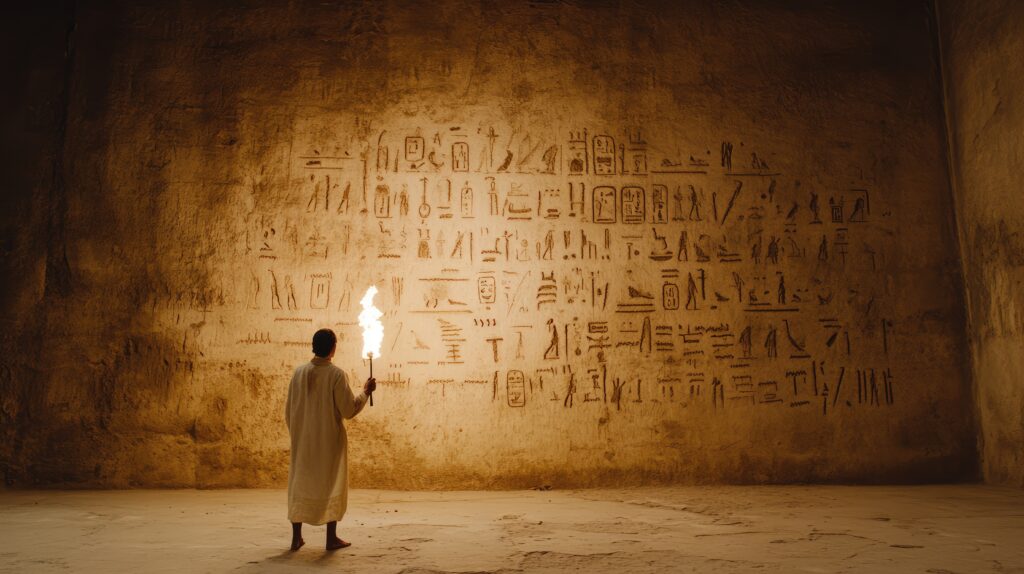
Before Writing, There Were Symbols
Long before the appearance of formal writing systems in ancient Mesopotamia or Egypt, human societies across multiple continents were already producing structured symbolic marks that appear to encode meaning beyond simple decoration or artistic expression. These early notations, found engraved on bone, stone, and cave walls, may represent the earliest forms of organized knowledge transmission in human history. Increasingly, researchers studying prehistoric symbol systems are beginning to question whether these markings were merely artistic expressions or whether they formed part of a much older intellectual tradition through which early humans recorded time, environmental observations, and collective knowledge.
Traditional archaeological narratives have long held that writing emerged suddenly around 5,000 years ago with the administrative needs of early urban civilizations… Some proof are the Discovery of Submerged 6,000 Year Old Underwater City (link) and Göbekli Tepe: World’s Oldest Megalithic Temple (link). Yet the discovery of consistent symbolic patterns tens of thousands of years older suggests that humanity may have been experimenting with information encoding far earlier than once believed. These discoveries raise a profound possibility: that prehistoric societies developed sophisticated symbolic communication systems capable of preserving knowledge across generations long before the rise of cities or states.
The implications of this possibility extend well beyond linguistics. If prehistoric symbol systems represent structured information networks, then early human societies may have possessed intellectual frameworks capable of sustaining scientific observation, environmental record keeping, and cosmological interpretation. Such capabilities would challenge the conventional assumption that prehistoric humans were intellectually limited hunter-gatherers, instead suggesting that deep-time knowledge traditions may have existed long before recorded history.
Moreover, when considered alongside evidence of abrupt climatic disruptions such as the Younger Dryas Impact Hypothesis (link) with its impact evidence (link), these symbolic traditions may represent fragments of cultural systems that were partially erased by environmental catastrophe and later rediscovered by emerging civilizations.
The Archaeological Record of Early Symbol Systems
Across Europe, Africa, and parts of Asia, archaeologists have uncovered artifacts engraved with repeated geometric symbols that appear in structured sequences rather than random arrangements. Some markings consist of groups of parallel lines arranged in patterns that suggest counting or numerical notation. Others include branching shapes, intersecting lines, and dot clusters whose arrangement indicates a deliberate symbolic language rather than abstract decoration.
One of the most intriguing aspects of these discoveries is the recurrence of similar symbols across geographically distant regions separated by thousands of kilometers and many thousands of years. Such repetition suggests that certain symbolic conventions may have been widely shared among prehistoric populations, either through cultural diffusion or through inherited traditions that originated much earlier in human history.
In some cases, archaeologists have identified symbolic sequences that appear to track lunar cycles or seasonal changes. By comparing the number and spacing of engraved marks with astronomical patterns, researchers have proposed that prehistoric communities may have used symbolic systems to record time, predict seasonal events, and coordinate social activities such as migrations or ritual gatherings.
These interpretations remain controversial, yet the growing body of evidence supporting structured symbolic behavior is forcing scholars to reconsider the intellectual landscape of deep prehistory.
Symbols as Information Technology
From a modern perspective, it is easy to underestimate the significance of simple marks engraved on bone or stone. Yet in information theory, the creation of a repeatable symbol capable of representing a concept marks the birth of information technology. Once a community develops shared symbols whose meanings are collectively understood, those symbols become tools for storing and transmitting knowledge.
In prehistoric societies, such systems may have functioned as early data storage devices. Marks could represent quantities of hunted animals, counts of lunar cycles, or reminders of seasonal events such as migrations or plant harvesting periods. Over time, symbolic traditions could become increasingly complex, evolving from simple counting marks into more elaborate conceptual diagrams.
The development of symbolic information systems would have dramatically expanded the cognitive capabilities of early societies by allowing knowledge to be preserved outside the human brain. Instead of relying solely on memory, communities could externalize information through engraved symbols, enabling more complex social coordination and long-term planning.
This transformation represents one of the most important technological revolutions in human history, because it laid the conceptual foundation for later writing systems and scientific notation.
The Role of Memory and Oral Knowledge
Even if prehistoric symbols represented early information systems, they likely functioned alongside oral traditions rather than replacing them. Oral cultures are capable of preserving enormous bodies of knowledge through structured storytelling, ritual performance, and mnemonic techniques. When combined with symbolic notation, these methods create powerful knowledge preservation systems through stories and sacred numbers from ancient civilizations (link).
Symbols may have served as visual prompts that triggered complex narratives or instructions known by trained individuals within the community. In this way, a simple engraving could represent a much larger body of knowledge transmitted orally from teacher to student.
Anthropological studies of modern oral cultures demonstrate how sophisticated such systems can become. Indigenous societies often preserve detailed ecological knowledge, astronomical observations, and historical narratives through oral traditions that remain remarkably accurate over centuries. When symbolic cues are added to this process, the resulting knowledge system can achieve extraordinary resilience.
Astronomy and the Origins of Scientific Observation
Among the most intriguing hypotheses regarding prehistoric symbol systems is their possible connection to astronomy. Early humans depended heavily on seasonal patterns for survival, making the observation of celestial cycles critically important. The rising and setting of particular stars, the phases of the Moon, and the movement of the Sun across the sky all provided reliable indicators of seasonal change.
Symbolic marks representing these cycles may therefore constitute the earliest forms of scientific record keeping. By engraving patterns corresponding to lunar phases or seasonal intervals, prehistoric observers could track time with increasing accuracy and predict future events.
Over generations, such observations might accumulate into extensive knowledge traditions that blended practical survival information with cosmological interpretations. These traditions could form the intellectual foundations of later mythologies and religious systems that encoded astronomical knowledge within symbolic narratives.
Catastrophe and the Loss of Knowledge
The existence of early symbolic systems raises a challenging question: if prehistoric societies possessed structured knowledge traditions, what happened to them?
One possible answer lies in the dramatic climatic changes that occurred near the end of the last Ice Age. The abrupt onset of cooling associated with the Younger Dryas period dramatically altered ecosystems across the planet, causing shifts in vegetation, animal populations, and human settlement patterns… and ever New Studies Revealing Comet Airbust Evidence from 12,800 Years Ago (link). If complex knowledge networks existed prior to this event, they may have been severely disrupted by environmental upheaval.
Population displacement, resource scarcity, and social fragmentation could have interrupted the transmission of symbolic traditions, causing knowledge systems to degrade or disappear. Only fragments might survive within isolated communities, preserved in myths, rituals, or artistic motifs whose original meanings were gradually forgotten.
Cultural Memory and the Persistence of Symbols
Despite the possibility of knowledge loss, many symbolic motifs appear repeatedly throughout human history. Geometric patterns found in prehistoric art often reappear in later cultures separated by vast distances and time periods. Spirals, concentric circles, zigzags, and cross-hatched grids appear in Neolithic carvings, Bronze Age artifacts, and even later decorative traditions.
These recurring motifs raise the possibility that certain symbolic concepts persisted within cultural memory long after their original meanings faded. In some cases, later civilizations may have inherited symbolic traditions without fully understanding their origins, repurposing them within new cultural frameworks.
Such patterns illustrate how knowledge can survive indirectly through cultural continuity even when explicit explanations are lost.
Proto-Writing and the Transition to Civilization
Eventually, some symbolic systems evolved into true writing. In ancient Mesopotamia, early accounting tokens used for economic record keeping gradually developed into cuneiform script. Similarly, Egyptian hieroglyphs combined pictorial representation with phonetic elements to create a complex writing system capable of recording language.
These developments may represent the culmination of a much longer process that began with prehistoric symbolic notation. Over thousands of years, simple marks used for counting or calendrical tracking could evolve into increasingly sophisticated systems capable of representing abstract concepts and spoken language.
In this sense, the birth of writing may not have been a sudden invention but rather the final stage of a cognitive journey that began tens of thousands of years earlier.
Rethinking the Intellectual History of Humanity
The recognition that prehistoric symbol systems may have encoded complex knowledge forces us to reconsider long-standing assumptions about the intellectual development of early humans. Rather than gradually evolving from primitive beginnings, humanity may have possessed advanced cognitive capabilities from the very beginning of our species’ existence.
The archaeological record increasingly reveals evidence of artistic creativity, symbolic expression, long-distance trade networks, and complex social organization in societies once dismissed as simple hunter-gatherers. These discoveries suggest that the seeds of civilization were planted far earlier than previously believed.
The Possibility of Forgotten Knowledge Traditions
One of the most intriguing implications of prehistoric symbolic research is the possibility that entire knowledge traditions may have existed long before recorded history. If environmental catastrophe or cultural disruption erased these traditions, only scattered fragments might remain within archaeological artifacts.
This hypothesis does not require the existence of lost technological civilizations but simply acknowledges that human societies are capable of developing sophisticated knowledge systems that can later disappear under adverse conditions.
Throughout history, libraries have burned, languages have vanished, and cultural knowledge has been lost during periods of conflict or environmental crisis. The deep past may contain similar episodes of cultural loss that are only now becoming visible through archaeological investigation.
The Future of Prehistoric Research
New technologies are transforming the study of prehistoric symbolism. High-resolution 3D scanning allows researchers to analyze engraving techniques in microscopic detail, revealing how marks were produced and whether they were created sequentially over time. Artificial intelligence algorithms are beginning to analyze patterns within large datasets of symbolic markings, searching for statistical regularities that might indicate structured communication systems.
At the same time, interdisciplinary collaboration between archaeologists, cognitive scientists, linguists, and astronomers is providing new perspectives on the meaning of prehistoric symbols. By combining expertise from multiple fields, researchers hope to decode the intellectual world of early humans and understand how symbolic communication shaped the development of civilization.
Conclusion: Rediscovering Humanity’s Deep Knowledge
The study of prehistoric symbol systems opens a window into a forgotten chapter of human history in which early communities may have experimented with symbolic communication, scientific observation, and knowledge preservation long before the appearance of written language. These discoveries challenge simplistic narratives of human progress and reveal a much richer and more complex intellectual heritage than previously imagined.
Whether these symbols represent calendars, counting systems, cosmological diagrams, or early forms of proto-writing, they testify to the extraordinary cognitive abilities of our ancestors. They remind us that the story of human civilization did not begin with the first cities but stretches far deeper into the prehistoric past, where early thinkers carved the first symbols of knowledge into stone and bone, leaving clues that modern researchers are only beginning to decipher.