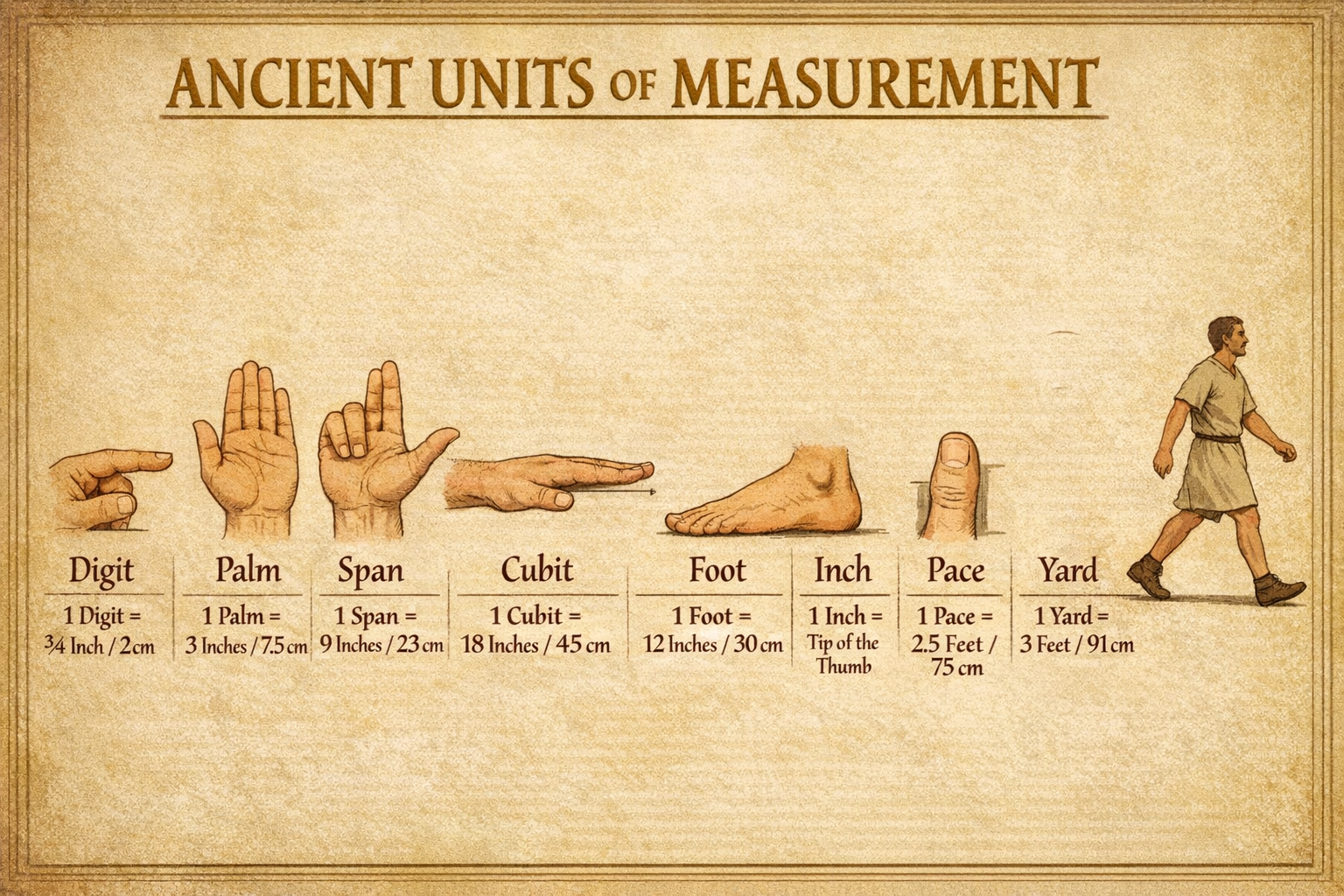
Ancient Units of Measurement: Hidden Ratios and Sacred Geometry Codes
The study of ancient units of measurement opens a critical gateway into understanding how early civilizations may have structured reality itself, revealing systems that extend far beyond simple practicality into the realm of geometry, astronomy, encoded knowledge, and hidden codes of ancient civilizations. Across cultures and epochs, units such as the cubit, the foot, the yard, and the megalithic yard appear with striking consistency, suggesting that measurement in the ancient world was not arbitrary, but governed by underlying ratios that may connect directly to the dimensions of the Earth, the movement of celestial bodies, and a deeper framework of sacred numbers.
When examined through this lens, ancient units of measurement (Sacred Numbers in Ancient Civilizations) begin to resemble a language—one capable of encoding information about space, time, and proportion. This raises a fundamental question: were these systems independently developed, or do they reflect a shared inheritance from a much older and possibly more advanced tradition of knowledge?
Ancient Units of Measurement and the Concept of Ratio
At the heart of all ancient units of measurement lies the concept of ratio. Unlike modern systems that prioritize absolute precision, ancient systems often relied on proportional relationships, allowing measurements to remain consistent even when units varied slightly (Sacred Numbers Measurements Systems).
This approach suggests that what mattered was not the exact length of a unit, but its relationship to other units and to larger systems. Ratios allowed for scalability, enabling the same principles to be applied from small objects to monumental structures. Within this framework, numbers such as 360 (The Cirle of Time and Space), 72 (Precession and the Great Cycle), and 108 (Cosmic Measurement Code) become essential, providing the mathematical backbone for translating geometry into physical measurement.
Ancient Units of Measurement and the Cubit System
However, beyond this simple definition lies a more structured system. The Royal Cubit, used in ancient Egypt, was standardized and subdivided into smaller units, suggesting a level of precision that goes beyond informal measurement.
The existence of multiple cubit variations across cultures raises an important possibility: these units may represent localized expressions of a broader system, each calibrated to maintain consistent ratios rather than identical lengths.
The Royal Cubit is particularly significant within the study of ancient units of measurement, as it appears in the construction of major structures such as pyramids and temples. Its consistent use suggests that ancient builders operated within a standardized system, one capable of producing large-scale precision.
What makes the Royal Cubit especially compelling is its approximate length of 52.36 cm, a value that appears repeatedly in the design of the Great Pyramid of Giza. The base of the pyramid measures roughly 440 Royal Cubits per side, while its original height is believed to be 280 Royal Cubits, forming a geometric relationship that closely approximates 2π when comparing perimeter to height. This is not a random outcome—it suggests that the builders were encoding mathematical constants into architecture thousands of years before such relationships were formally documented.
Even more intriguing is how this unit appears to reflect planetary dimensions. When scaled appropriately, the pyramid’s dimensions correspond to the Earth’s circumference with remarkable accuracy—within a fraction of a percent. This raises the possibility that the Royal Cubit was not just a human-derived measure, but one calibrated against the Earth itself. Such precision implies advanced geodetic knowledge, something difficult to reconcile with the conventional narrative of early civilizations.
Similar proportional systems appear in structures far removed from Egypt. At Angkor Wat, measurements of temple layouts reveal recurring ratios tied to solar cycles and astronomical constants, with lengths that can be broken down into units comparable in scale to the Royal Cubit. In Teotihuacan, grid layouts reflect standardized units that produce consistent ratios across pyramids, plazas, and avenues—again hinting at a shared or inherited system of measurement.
Some researchers have proposed that the Royal Cubit encodes relationships tied to the Earth’s dimensions or to specific geometric constants. While these interpretations remain debated, the precision observed in ancient construction supports the idea that measurement systems were highly developed.
If the Royal Cubit was part of a larger framework, then its use in architecture may represent an intentional encoding of knowledge rather than a purely practical choice. When the same numerical relationships—such as π, φ (the golden ratio ≈ 1.618), and Earth-based scaling factors—appear across distant civilizations and millennia, the question becomes difficult to ignore: were these cultures independently discovering the same truths, or were they preserving fragments of a much older, shared understanding?
Ancient Units of Measurement and the Megalithic Yard
The concept of the Megalithic Yard, proposed by Alexander Thom, introduces another layer to the study of ancient units of measurement. Based on extensive surveys of megalithic sites in Britain, Thom suggested that a standardized unit of approximately 0.829 meters was used in the construction of stone circles and other structures (Geometry of the Earth – link).
This unit appears repeatedly in sites such as Stonehenge, where the diameter of the outer circle measures approximately 100 Megalithic Yards, and the spacing of stones reflects consistent subdivisions of this unit. At Avebury, one of the largest stone circles in the world, the layout also adheres to multiples of the same measurement, suggesting intentional planning rather than organic or random placement.
The implication of this finding is profound: it suggests that prehistoric builders may have shared a common measurement system across large geographic areas. Even more striking is the possibility that this system extended beyond Britain. Similar proportional layouts have been identified in sites across Brittany in France, and even in parts of Iberia, where stone alignments reflect repeating intervals consistent with the Megalithic Yard.
When examined numerically, the Megalithic Yard also appears to connect with astronomical cycles. Thom proposed that many stone circles were designed using 366 divisions, corresponding to a solar year, and that the unit itself allowed for precise tracking of lunar and solar events. This level of astronomical integration implies not only measurement standardization but also a deep understanding of celestial mechanics.
If the Megalithic Yard is indeed real, then it raises the possibility that knowledge of measurement was transmitted through long-standing traditions, potentially originating from earlier cultures. The recurrence of similar units and geometric planning in sites separated by hundreds or thousands of kilometers suggests either sustained contact between ancient peoples or the inheritance of a shared system from a now-lost source.
In this context, the Megalithic Yard becomes more than a unit of length—it becomes a fragment of a larger intellectual framework, one that may have once connected ancient Europe to a broader network of knowledge spanning continents and epochs.
Ancient Units of Measurement and the Furlong
The furlong, later formalized in medieval England as 220 yards (approximately 201 meters), represents another intriguing example within ancient units of measurement. Defined as the length of a furrow in a plowed field, it reflects the integration of measurement with land use and human activity.
However, its deeper significance emerges when placed within a broader system of proportional relationships. The furlong is exactly 1/8 of a mile, and when broken down further, it aligns with units such as the chain (66 feet) and the rod (16.5 feet), forming a coherent system based on consistent ratios. These relationships are not arbitrary—they suggest a deliberate structuring of measurement that balances practicality with mathematical elegance.
What is particularly fascinating is how similar proportional thinking appears in much older structures. At Machu Picchu, agricultural terraces and urban layouts reflect modular planning based on repeating units, while at Chichen Itza, the pyramid known as El Castillo incorporates 365 steps, aligning with the solar year, and geometric proportions that reflect precise numerical relationships.
Even in ancient Mesopotamia, standardized units such as the cubit and the nindan (approximately 6 meters) were used to organize cities like Ur, where street grids and building dimensions followed consistent measurement rules. These systems often relied on sexagesimal (base-60) mathematics, a numerical framework that still underpins modern concepts of time and angles.
The recurrence of structured units—whether in the furlong, the cubit, or other systems—points to a shared philosophy: that measurement should reflect both the natural world and human needs. Ratios such as 1:2, 1:8, and 1:60 appear repeatedly across cultures, suggesting that ancient societies were working within a common mathematical language.
This blending of utility and geometry reinforces the idea that ancient measurement systems were holistic, integrating multiple aspects of life and knowledge. When these patterns are observed across continents—from medieval England to pre-Columbian America and ancient Mesopotamia—they hint at something deeper: either parallel discovery guided by universal principles, or the lingering echoes of a connected, knowledge-sharing world that predates recorded history.
Ancient Units of Measurement and Carl Munck’s “Code”
The work of Carl Munck introduces a more controversial perspective on ancient units of measurement, proposing that ancient sites encode geographic coordinates and numerical relationships tied to the Earth’s grid. According to this theory, monuments such as pyramids and megalithic structures are positioned in ways that reflect a global system of measurement, effectively turning the Earth into a coded map (Britannica: Ley Lines).
Munck argued, for example, that the coordinates of the Great Pyramid of Giza—approximately 29.9792° N latitude—mirror the modern value of the speed of light (299,792,458 m/s), a numerical coincidence that continues to fuel debate about intentional encoding versus chance. He extended this idea to other sites, suggesting that structures like Stonehenge and Machu Picchu also align with grid-based calculations involving degrees, minutes, and seconds of latitude and longitude. In his framework, numbers such as 360 (degrees of a circle), 72 (a key precessional number), and 108 (a number recurring in sacred traditions) are embedded within site placements and dimensions, forming a kind of planetary-scale numerical language. This raises the possibility that ancient builders were not only constructing monuments, but also anchoring them to a coordinate system that reflects an advanced understanding of the Earth as a sphere. If such encoding was intentional, it implies a level of geodetic precision and global awareness that challenges the conventional timeline of scientific development.
While this interpretation remains outside mainstream academic acceptance, it aligns with the broader pattern observed in sacred numbers and geometric relationships, raising the possibility that ancient measurement systems may have operated on multiple levels—practical, symbolic, and informational.

Ancient Units of Measurement and Global Consistency
One of the most compelling aspects of ancient units of measurement is their recurrence across cultures. Despite variations in length, the underlying ratios often remain consistent, suggesting a shared mathematical foundation. This consistency raises critical questions:
- Were these systems independently developed?
- Were they transmitted through cultural exchange?
- Or do they reflect a deeper inheritance from a lost body of knowledge?
Why do ratios such as 1:2, 1:8, and 1:60, along with constants like π and the golden ratio (1.618), appear in structures as distant as the Great Pyramid of Giza, Angkor Wat, and Teotihuacan? How did ancient cultures—separated by oceans and millennia—arrive at such strikingly similar mathematical frameworks without a shared reference point? Could maritime networks, far older than currently accepted, have enabled the transfer of knowledge across continents, supported by evidence of advanced navigation and cartography? Or does this recurring precision suggest that these civilizations inherited fragments of a much older, highly advanced culture that once understood the Earth, geometry, and astronomy at a level we are only beginning to rediscover? And perhaps most provocatively—are we looking at independent achievements, or at the surviving echoes of a connected, global civilization whose full story has yet to be uncovered?
The answers remain uncertain, but the patterns themselves are difficult to ignore… Did the ancients Inherit Science?
Ancient Units of Measurement and Sacred Geometry
The integration of ancient units of measurement with sacred geometry provides further evidence of a unified system. Measurements are not isolated values but components of geometric relationships involving circles, triangles, and other forms.
Structures built using these units often reflect precise geometric patterns, suggesting that measurement and design were inseparable. This integration supports the idea that ancient builders were not merely constructing buildings, but expressing mathematical and cosmological principles through physical form.
Ancient Units of Measurement and the Transmission of Knowledge
The persistence of ancient units of measurement across time suggests that these systems were actively preserved and transmitted. This transmission may have occurred through:
- apprenticeship and craft traditions
- oral knowledge systems
- initiatory schools and priesthoods
If knowledge was encoded within measurement systems, then the act of building itself becomes a form of education, ensuring that principles are passed down even when explicit explanations are lost.
Ancient Units of Measurement and the Possibility of Lost Science
The sophistication implied by ancient units of measurement raises the possibility that these systems are remnants of a more advanced scientific tradition. The ability to maintain consistent ratios across cultures, to integrate measurement with astronomy, and to construct precise structures suggests a level of knowledge that may not be fully accounted for in conventional history.
This does not necessarily imply technology in the modern sense, but rather a deep understanding of natural laws, geometry, and proportion.
Key Insights
• Ancient units of measurement rely on ratios rather than fixed values
• The cubit and Royal Cubit show standardized precision
• The Megalithic Yard suggests shared prehistoric systems
• Units like the furlong connect measurement with daily life
• Carl Munck’s theories propose global encoding systems
• Measurement may reflect a unified ancient knowledge framework
Additional Reading and Sources
Thom, Alexander — Megalithic Sites in Britain
Michell, John — Ancient Metrology
Neal, Richard — All Done with Mirrors
Magli, Giulio — Architecture, Astronomy and Sacred Landscape (link)
Neugebauer, Otto — The Exact Sciences in Antiquity (link)
Aveni, Anthony — Ancient Astronomy in Practice
Magli, Giulio — Architecture, Astronomy and Sacred Landscape (link)
Santillana & von Dechend — Hamlet’s Mill (link)
Ancient360 — Earth Geometric System (link)
Ancient360 — Sacred Geometry and Megalithic Architecture (link)
Ancient360 — Cycles of Time, Geometry, and Civilizations (link)
Ancient360 — Geometry Knowledge and Ancient Sciense (link)