Sacred Geometry and Megalithic Architecture — Cosmic Design in Stone
Sacred geometry megalithic architecture explores how ancient civilizations encoded mathematical order, cosmic cycles, and planetary movements into massive stone constructions that continue to puzzle researchers today. Across continents and cultures, megalithic structures demonstrate precise orientation, geometric planning, and astronomical alignment that suggest intentional relationships between architecture, celestial motion, and natural cycles.
From stone circles and pyramids to temples and earthworks, ancient builders constructed monuments that appear to reflect a deep understanding of geometry, astronomy, and environmental rhythms. These structures were not merely shelters or ceremonial spaces. Rather, they functioned as instruments for observing cosmic order, measuring time, and expressing a worldview in which Earth and sky formed a unified system.
Furthermore, the mathematical precision found in megalithic architecture raises enduring questions. How did ancient societies achieve such accuracy without modern tools? What knowledge systems guided their construction methods? And could these monuments preserve fragments of forgotten scientific traditions?
This article examines how sacred geometry shaped megalithic architecture, how structures aligned with celestial cycles, and how numerical patterns embedded in stone reveal sophisticated relationships between humanity and the cosmos.
Geometry in Stone — Mathematical Planning
Megalithic monuments across the world demonstrate careful geometric planning. Their layouts frequently incorporate circles, ellipses, triangles, and complex proportional relationships that suggest deliberate design rather than spontaneous construction.
Archaeological surveys show that many stone circles were constructed using consistent units of measurement and standardized spacing. Statistical studies of prehistoric monuments in Britain indicate repeated use of geometric templates and proportional ratios (Thom, 1967; Ruggles, 1999).
Moreover, these geometric forms were not purely aesthetic. They served functional roles in tracking solar and lunar motion, organizing ritual space, and symbolizing cosmic harmony.
The persistence of geometric planning suggests that architecture operated as a physical expression of universal order.
Key Observations
-
Repeating geometric forms across regions
-
Consistent measurement systems
-
Proportional design principles
-
Functional astronomical purpose
Cosmic Alignment — Solar Orientation
Many megalithic structures align with solar events such as solstices and equinoxes. These alignments allowed ancient observers to track seasonal cycles essential for agriculture and social organization.
Research in archeoastronomy demonstrates that numerous monuments mark the position of sunrise or sunset at key points of the year. Such orientations required careful long-term observation and precise architectural placement.
The integration of solar motion into architecture reveals a worldview in which celestial cycles governed earthly activity.
Lunar Cycles
Beyond solar tracking, some monuments appear designed to monitor complex lunar cycles. The Moon’s motion involves periodic patterns that repeat over long intervals, requiring sustained observation to identify.
Certain stone arrangements mark lunar standstill positions, events that occur approximately every 18.6 years. The ability to encode these cycles into architecture suggests advanced observational knowledge.
These structures therefore functioned as long-term astronomical records.
Key Observations
-
Solstice and equinox alignment
-
Lunar standstill tracking
-
Seasonal timekeeping systems
-
Long-term celestial observation
Earth–Sky Connection — Landscape Integration
Sacred geometry megalithic architecture often integrates surrounding landscapes into design. Monuments are positioned in relation to mountains, rivers, and horizon features that frame celestial events. The environment itself becomes part of the architectural system, forming a unified observational framework that links Earth’s geography with cosmic motion.
This integration reflects a holistic understanding of space in which natural and constructed environments operate together.
Orientation and Direction
Many ancient monuments emphasize cardinal directions, demonstrating awareness of Earth’s rotation and spatial orientation.
Directional alignment served symbolic and practical functions, establishing connections between terrestrial space and celestial order.
The consistent use of orientation suggests systematic cosmological planning.
Key Observations
-
Landscape-based design
-
Horizon alignment
-
Cardinal direction orientation
-
Environmental integration
Numerical Patterns — Sacred Ratios
Proportional relationships within megalithic architecture frequently correspond to mathematical ratios observed in nature. These include geometric relationships associated with growth patterns, harmonic proportions, and repeating numerical sequences.
Some researchers argue that ancient builders intentionally applied such ratios to create structures reflecting universal order. Although interpretations vary, measurable proportional consistency appears across multiple sites.
Repeating Measurements
Standardized measurement units appear in numerous ancient constructions, suggesting shared knowledge systems. These units enabled consistent geometry across large-scale projects.
The presence of standardized measures implies transmission of mathematical knowledge across generations.
Key Observations
-
Proportional design systems
-
Repeating numerical relationships
-
Standardized measurement units
-
Mathematical symbolism
Engineering and Construction — Precision Without Modern Tools
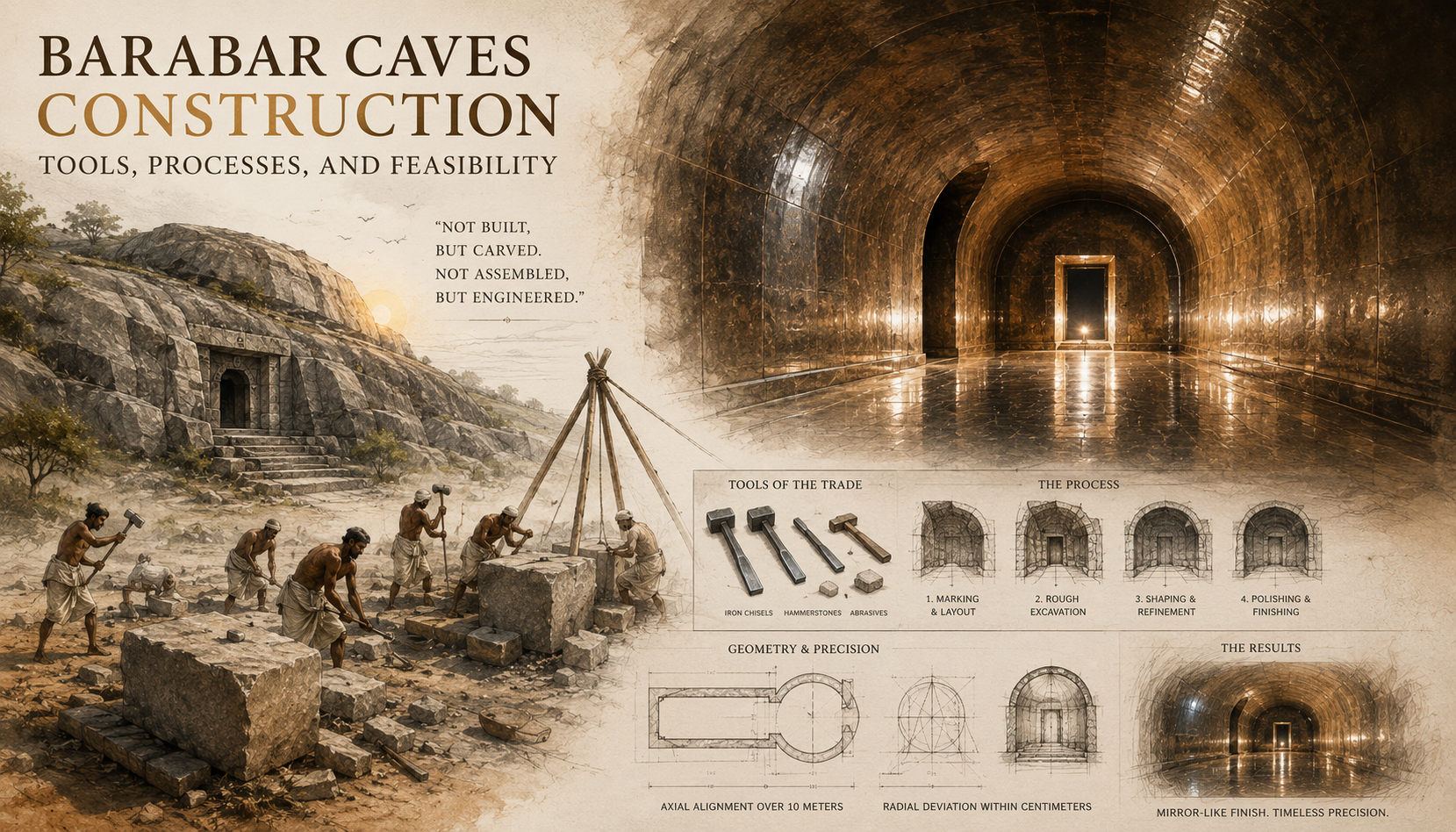
One of the most striking features of megalithic architecture is its precision. Massive stones weighing many tons were transported, shaped, and positioned with remarkable accuracy.
Experimental archaeology demonstrates that simple tools can achieve significant results. However, the scale and consistency of many monuments continue to provoke debate regarding construction methods and organizational knowledge.
Structural Stability
Many megalithic structures remain stable after thousands of years, demonstrating sophisticated understanding of load distribution and material properties.
Their durability reflects engineering knowledge that combined empirical observation with practical geometry.
Key Observations
-
Large-scale stone transport
-
Precise placement methods
-
Structural durability
-
Advanced engineering knowledge
Cultural Meaning — Symbolic Interpretation
Sacred geometry megalithic architecture also carried symbolic significance. Geometric forms expressed cosmological beliefs and encoded relationships between humanity and the universe.
Architecture served not only functional purposes but also philosophical and spiritual roles.
Ritual Function
Many monuments appear associated with ritual activities, seasonal ceremonies, and communal gatherings. Their spatial organization suggests intentional structuring of experience through geometry.
The built environment therefore shaped both observation and cultural practice.
Key Observations
-
Cosmological symbolism
-
Ritual architecture
-
Social organization
-
Cultural expression
Scientific Research
Modern studies in archeoastronomy, archaeology, and mathematics continue to investigate megalithic architecture. Researchers analyze alignments, measurement systems, and structural design to understand ancient knowledge.
Scholarly work by Thom (1967), Ruggles (1999), and Magli (2013) demonstrates measurable astronomical relationships in many ancient monuments, although interpretations remain debated.
These investigations reveal increasing evidence of sophisticated observational traditions in early societies.
Alternative Perspectives
While mainstream archaeology explains megalithic construction through gradual cultural development, alternative hypotheses propose the possibility of lost knowledge traditions or advanced prehistoric understanding of geometry and astronomy.
Although speculative, such perspectives encourage continued investigation and open questions regarding the origins of ancient knowledge systems.
The Legacy of Stone
Sacred geometry megalithic architecture represents one of humanity’s earliest attempts to understand cosmic order through physical form. These monuments embody a synthesis of mathematics, observation, engineering, and symbolic meaning.
Their enduring presence suggests that ancient builders sought to create structures reflecting universal principles that transcend time.
Whether interpreted as scientific instruments, ritual centers, or expressions of cosmic philosophy, megalithic structures remain powerful evidence of humanity’s persistent desire to align with the rhythms of the universe.
Key Insights
-
Sacred geometry structured megalithic architecture
-
Monuments align with solar and lunar cycles
-
Geometry expresses cosmic order
-
Numerical patterns repeat in design
-
Ancient builders demonstrated advanced knowledge
Additional Reading and Sources
Thom, A. (1967). Megalithic Sites in Britain. Oxford University Press.
Ruggles, C. (1999). Astronomy in Prehistoric Britain and Ireland. Yale University Press. (link)
Magli, G. (2013). Architecture, Astronomy and Sacred Landscape in Ancient Egypt. Cambridge University Press. (link)
Krupp, E. C. (1988). Skywatchers, Shamans and Kings. Wiley. (link)
Hoskin, M. (2001). Tombs, Temples and Their Orientations. Ocarina Books.
Ancient360 – Archeoastronomy (link)
Ancient360 – Cosmic Alignments (link)
Ancient360 – Sacred Geometry (link)
Sacred Geometry Earthly Cycles (link)
Birth of Sacred Geometry (link)