Sacred Number 360: The Circle of Time and Space
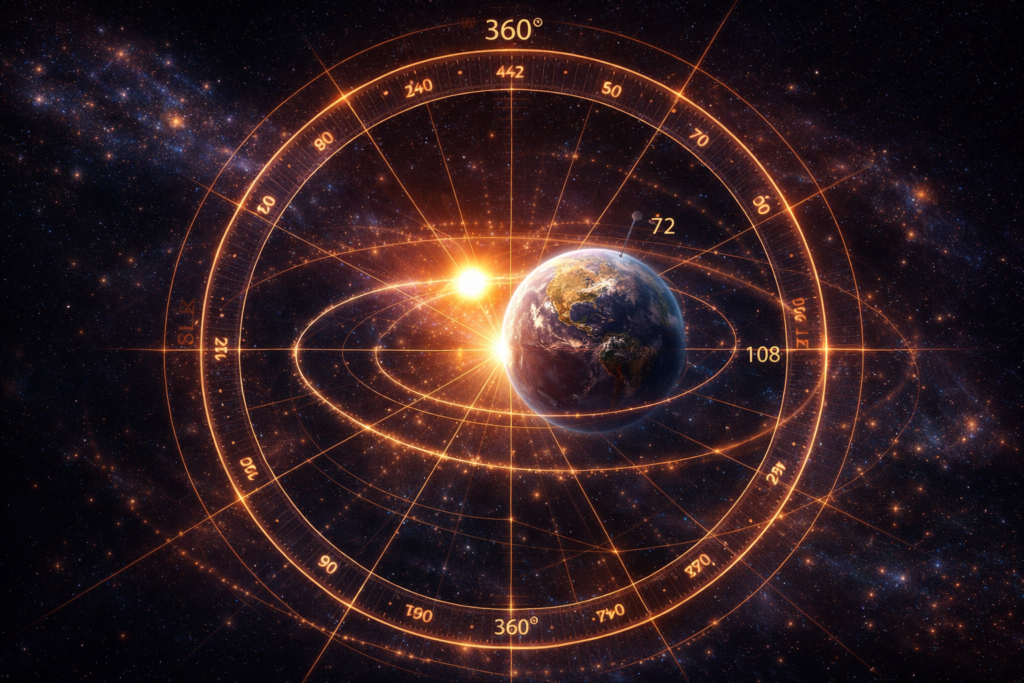
The sacred number 360 stands as one of the most fundamental numerical constants in the history of human knowledge, appearing consistently across geometry, astronomy, timekeeping systems, and ancient cosmological frameworks, where it functions not merely as a convenient division of the circle, but as a unifying principle that connects spatial measurement with temporal cycles and celestial motion. The presence of the sacred number 360 across civilizations separated by vast distances and epochs raises a critical and still unresolved question: was this number independently derived through observation and mathematical necessity, or does it reflect a deeper inheritance from a shared system of knowledge that predates recorded history?
From the division of the circle into 360 degrees to the structuring of ancient calendars and the encoding of celestial cycles, the sacred number 360 emerges as a central organizing principle, one that appears to bridge the observable patterns of the cosmos with the constructed systems of human understanding. When considered alongside other key numbers such as 72 and 108, the role of 360 becomes even more significant, forming a coherent framework through which ancient civilizations may have interpreted both time and space (Sacred Number 72 and Sacred Number 108).
Sacred Number 360 and the Geometry of the Circle
The most widely recognized manifestation of the sacred number 360 is its use in dividing the circle into 360 degrees, a convention that remains foundational in modern geometry, navigation, and astronomy. While this division is often explained as a practical choice—possibly linked to the approximate number of days in a year—the persistence and universality of this system suggest that it may carry deeper significance (Infinity, Cycles, Cosmic Balance).
A circle represents completeness, continuity, and cyclical return, and the division into 360 equal parts creates a structure that is both mathematically flexible and symbolically rich. The number 360 is highly composite, meaning it can be divided evenly by many integers (2, 3, 4, 5, 6, 8, 9, 10, 12, etc.), making it ideal for constructing proportional systems.
However, beyond its mathematical convenience, the sacred number 360 may reflect an attempt to encode the cyclical nature of the cosmos into a geometric form, transforming the movement of celestial bodies into measurable and repeatable units (Origins of Numerology).
Sacred Number 360 and Timekeeping Systems
The influence of the sacred number 360 extends directly into ancient systems of timekeeping. Early calendars often approximated the solar year as 360 days, later adding supplementary days to align with the actual solar cycle.
This structure suggests that 360 was not chosen randomly, but was seen as a foundational unit—a base cycle upon which adjustments could be made. In this sense, the sacred number 360 represents an idealized model of time, one that simplifies complex astronomical cycles into a coherent numerical framework.
The use of 360 in timekeeping creates a direct connection between geometry and temporality, reinforcing the idea that ancient civilizations may have conceptualized time as a circular, repeating phenomenon rather than a linear progression.
Sacred Number 360 and Its Relationship to 72
The connection between the sacred number 360 and the sacred number 72 is both direct and mathematically elegant, linking geometry with long-term celestial motion. As previously established, 72 years correspond to approximately one degree of axial precession, making it a fundamental unit of cosmic change. When multiplied:
- 72 × 360 = 25,920
This relationship reveals that 360 functions as the structural framework within which the precessional cycle unfolds, providing a complete geometric map of the heavens. Its use is deeply rooted in ancient systems, such as the 360-day ritual calendars of civilizations like Ancient Egypt and Mesopotamia, where it symbolized completeness and cyclical order. The divisibility of 360 into smaller units (such as 2, 3, 4, 5, 6, 8, 9, 10, and 12) made it ideal for encoding astronomical observations, including solar paths, lunar cycles, and horizon alignments.
In this sense, 360 can be understood as the container of cosmic time, while 72 represents the rate at which that container is traversed. Together, they form a system in which space (the circle) and time (the motion within it) are unified, allowing vast cycles like the Great Year to be expressed through simple and repeatable numbers.
Sacred Number 360 and Its Connection to 108
The relationship between the sacred number 360 and 108 further reinforces the coherence of ancient numerical systems, particularly in how they unify angular measurement with proportional scaling. Both numbers appear repeatedly in geometric constructions and astronomical observations, suggesting they were not chosen arbitrarily but discovered through careful study of natural and cosmic patterns. For example:
- 360 ÷ 3.333… ≈ 108
- 108 × 3.333… ≈ 360
While these relationships may appear approximate, they reflect underlying ratios that connect divisions of the circle with harmonic proportions found in geometry and astronomy. The number 108 is especially significant in relation to celestial scaling—for instance, the Sun’s diameter is roughly 108 times smaller than its distance from Earth, and similar ratios apply to the Moon, creating the conditions for phenomena like total solar eclipses.
When 360 degrees of a circle are interpreted alongside 108 as a scaling factor, a bridge emerges between angular space and perceived cosmic distance. This suggests that ancient observers may have been encoding not just how the sky moves, but how celestial bodies relate to one another in size and distance. In this way, 360 defines the structure of space through division, while 108 provides a proportional key to understanding the spatial relationships within that structure.
Together, these numbers form part of a broader numerical language in which geometry, astronomy, and symbolism converge into a unified system of knowledge.
Sacred Number 360 in Ancient Civilizations
The presence of the sacred number 360 can be observed across numerous ancient cultures, each integrating it into systems of mathematics, astronomy, and timekeeping. In Mesopotamia, the base-60 (sexagesimal) numerical system naturally produces 360 as a highly practical and divisible number, forming the foundation for circle measurement and early astronomy. In Ancient Egypt, the year was often conceptualized as 360 days plus five additional sacred days, linking solar cycles with ritual and cosmology.
In India, ancient astronomical texts and ritual systems incorporate divisions of time and space that echo the logic of 360, while the number also relates to the 108 beads of a mala, reinforcing its connection to cosmic cycles. Similarly, in Mesoamerica, calendrical systems such as the tun (360-day cycle) demonstrate a parallel understanding of cyclical time structured around this number.
The recurrence of 360 across geographically distant cultures suggests either independent discovery driven by its mathematical efficiency or the preservation of a shared body of knowledge transmitted over long periods. Its high divisibility makes it ideal for partitioning the sky, tracking planetary motion, and organizing calendars, which would have been essential for agriculture, navigation, and ritual life.
This widespread adoption raises a fundamental question: did these civilizations converge on 360 purely for its practical advantages, or does its repeated appearance point to a deeper, possibly interconnected tradition of cosmological understanding?
Sacred Number 360 and Archeoastronomy
Within archeoastronomy, the sacred number 360 provides a critical framework for understanding how ancient structures relate to celestial events. Alignments based on angular measurements, horizon markers, and observational geometry all rely on the division of space into consistent units.
If ancient builders were working with a 360-degree system, even implicitly, it would allow for precise orientation and alignment with solar, lunar, and stellar phenomena.
This possibility suggests that the sacred number 360 was not merely theoretical, but was actively applied in the construction of monuments and observational sites.
Sacred Number 360 and the Encoding of Knowledge
The recurrence of the sacred number 360 across multiple domains—geometry, timekeeping, astronomy, and architecture—suggests that it may have functioned as a core component of an encoded system of knowledge.
By embedding 360 into structures, calendars, and symbolic systems, ancient civilizations could preserve complex ideas in forms that were both durable and interpretable.
This raises the possibility that numbers themselves were used as carriers of knowledge, allowing information to survive even when written records were lost.
Sacred Number 360 and the Possibility of a Unified System
When considered alongside 72 and 108, the sacred number 360 appears to form part of a unified numerical system that integrates:
- time (precession and cycles)
- space (distance and proportion)
- geometry (division of the circle)
This triadic relationship suggests that ancient knowledge systems may have been far more integrated than modern disciplinary boundaries allow.
Sacred Number 360 and the Question of Origins
The origin of the sacred number 360 remains an open question. While practical explanations exist, they do not fully account for the consistency and depth of its application across cultures.
The possibility that this number reflects inherited knowledge—perhaps transmitted through oral traditions, symbolic systems, or architectural practices—cannot be dismissed.
If such a system existed, it would imply that the foundations of geometry and astronomy were established far earlier than currently understood.
Key Insights
• Sacred number 360 defines the division of the circle
• It connects geometry, timekeeping, and astronomy
• It forms a system with 72 and 108
• It appears across multiple ancient civilizations
• It may represent encoded and transmitted knowledge
• It challenges conventional timelines of scientific development
Additional Reading and Sources
Neugebauer, Otto — The Exact Sciences in Antiquity (link)
Aveni, Anthony — Ancient Astronomy in Practice
Magli, Giulio — Architecture, Astronomy and Sacred Landscape (link)
Santillana & von Dechend — Hamlet’s Mill (link)
Ancient360 — Archeoastronomy (link)
Ancient360 — Sacred Geometry (link)
Ancient360 — Cycles of Time, Geometry, Civilizations (link)
Ancient360 — Orientation, Architecture, Cosmic Alignments (link)