How Old Are Modern Humans
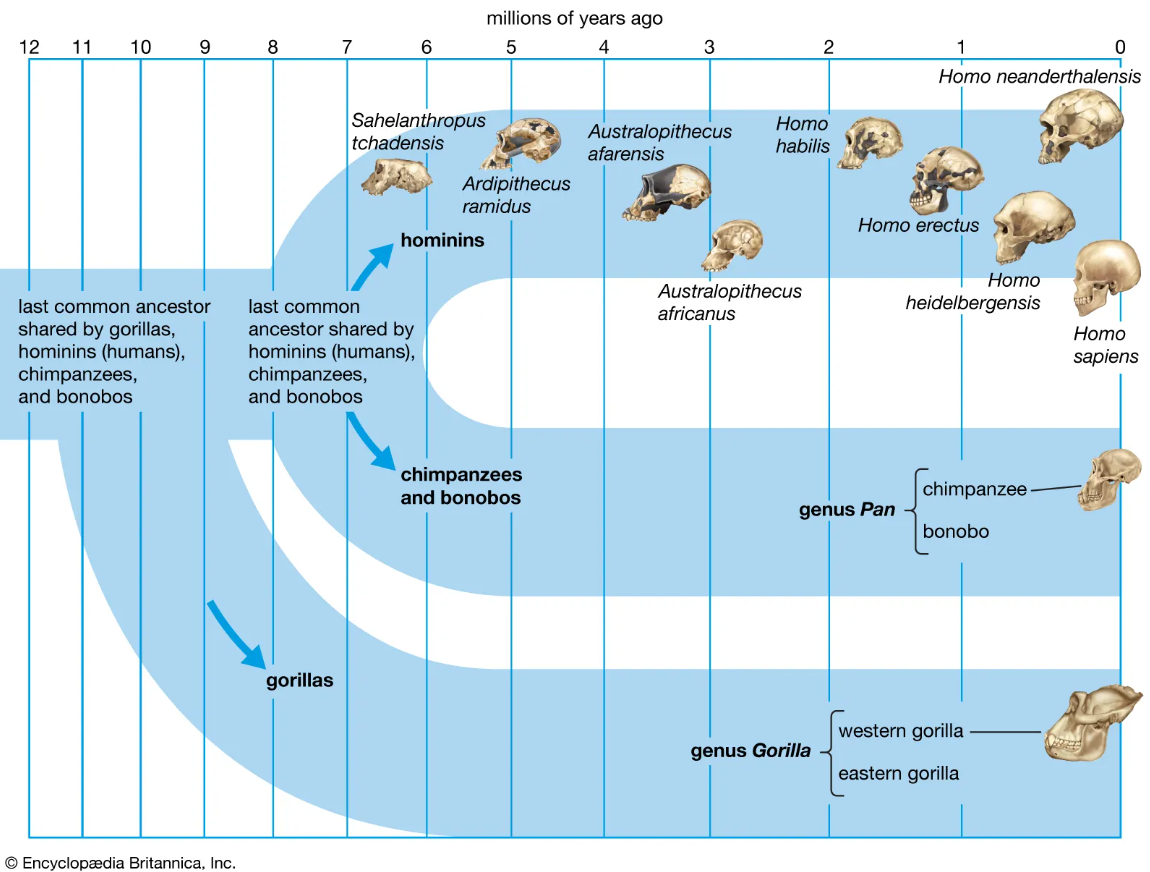
When did Homo Sapiens first appear on Earth? The question sounds simple — the answer is anything but. As fresh discoveries, new dating methods, and re-evaluations of fossils emerge, the timeline for the age of modern humans keeps moving backward. These shifts aren’t minor footnotes; they fundamentally change how we tell the story of human origins — whether as a linear ascent, a scattered mosaic, or a tale punctuated by catastrophic resets.
Pushing Back the Timeline
In 2017, fossils unearthed at Jebel Irhoud in Morocco (Nature, Hublin et al.) redefined the conversation. Dated to around 300,000 years ago, these remains suggested that Homo sapiens evolved earlier and across a wider geographic range than previously thought. This discovery challenged the long-held view that East Africa alone was the exclusive “cradle of humanity.”
Meanwhile, East African sites such as Omo Kibish and Herto in Ethiopia remain crucial reference points. These specimens, also dated to the 160,000–195,000 year range, provide strong evidence for early modern humans living and thriving in East Africa.
Unexpected Journeys
But the story doesn’t stop in Africa. In 2018, a fossilized upper jaw from Misliya Cave in Israel was dated to between 177,000 and 194,000 years ago (Science, Hershkovitz et al.). In 2019, reanalysis of a skull from Apidima Cave in Greece (Nature, Harvati et al.) suggested modern human morphology over 200,000 years ago in Europe. These findings, if confirmed, imply that early Homo sapiens groups ventured out of Africa much earlier than the well-known migrations ~60,000 years ago — and perhaps more than once.
Dating Challenges and Scientific Humility
Dating fossils is notoriously complex. Techniques like uranium-series, optically stimulated luminescence, argon-argon, and electron spin resonance each rely on different assumptions. Geological context, contamination, and post-depositional movement can skew results. That’s why timelines often shift as methods improve. Comprehensive reviews (e.g., Vidal et al., Nature 2022) help align these timelines, but caution remains essential.
A Fragmentary Record — and Possible Interruptions
What if the early history of modern humans wasn’t a single, smooth expansion but a series of migrations, collapses, and recoveries? Climate shifts, volcanic eruptions, or cosmic events may have disrupted populations and erased traces of culture and technology. A recent study (Phys.org, 2024) describes evidence of a comet airburst 12,800 years ago, underscoring how sudden events can radically alter human trajectories (The Younger Dryas Impact Hypothesis).
If catastrophic events like this occurred earlier, they might help explain why some regions show sudden appearances of sophistication — followed by long silences.
Questioning the Narrative
These discoveries encourage humility. The age of modern humans is not a fixed date carved in stone but a living scientific conversation. Every new bone, tool, or sediment layer has the potential to rewrite our shared story. The traditional linear view of human progress may give way to a more intricate picture — one shaped by migrations, lost knowledge, burned libraries, and disrupted timelines. In fact, among these findings we must also mention the The White Sands footprints. These are a set of ancient human footprints discovered in 2009 in the White Sands National Park in New Mexico. In 2021 they were radiocarbon dated, based on seeds found in the sediment layers, to between 21,000 and 23,000 years ago.
For Ancient360, this is where science meets curiosity. As more discoveries surface, we may find that Homo sapiens has been around — innovating, building, losing, and rediscovering — far longer than we once believed. Are we forgetting pages, chapters, books, or entire libraries of our past?
Sources:
-
Hublin J-J et al., “New fossils from Jebel Irhoud, Morocco and the pan-African origin of Homo sapiens,” Nature (2017).
-
Vidal CM et al., “Age of the oldest known Homo sapiens from eastern Africa,” Nature (2022).
-
Hershkovitz I et al., “The earliest modern humans outside Africa,” Science (2018).
-
Harvati K et al., “Apidima Cave fossils provide earliest evidence of Homo sapiens in Eurasia,” Nature (2019).
-
Phys.org, “New study reveals evidence for comet airburst 12,800 years ago” (2024).
Additional readings:
-
Who Built the Megalithic Structures All Over the Planet?
- What are the oldest Man Made Structures?
-
Göbekli Tepe: The World’s Oldest Megalithic Temple
- Archeoastronomical Sites: Mapping Ancient Skies