Climate History of the Last 40.000 Years
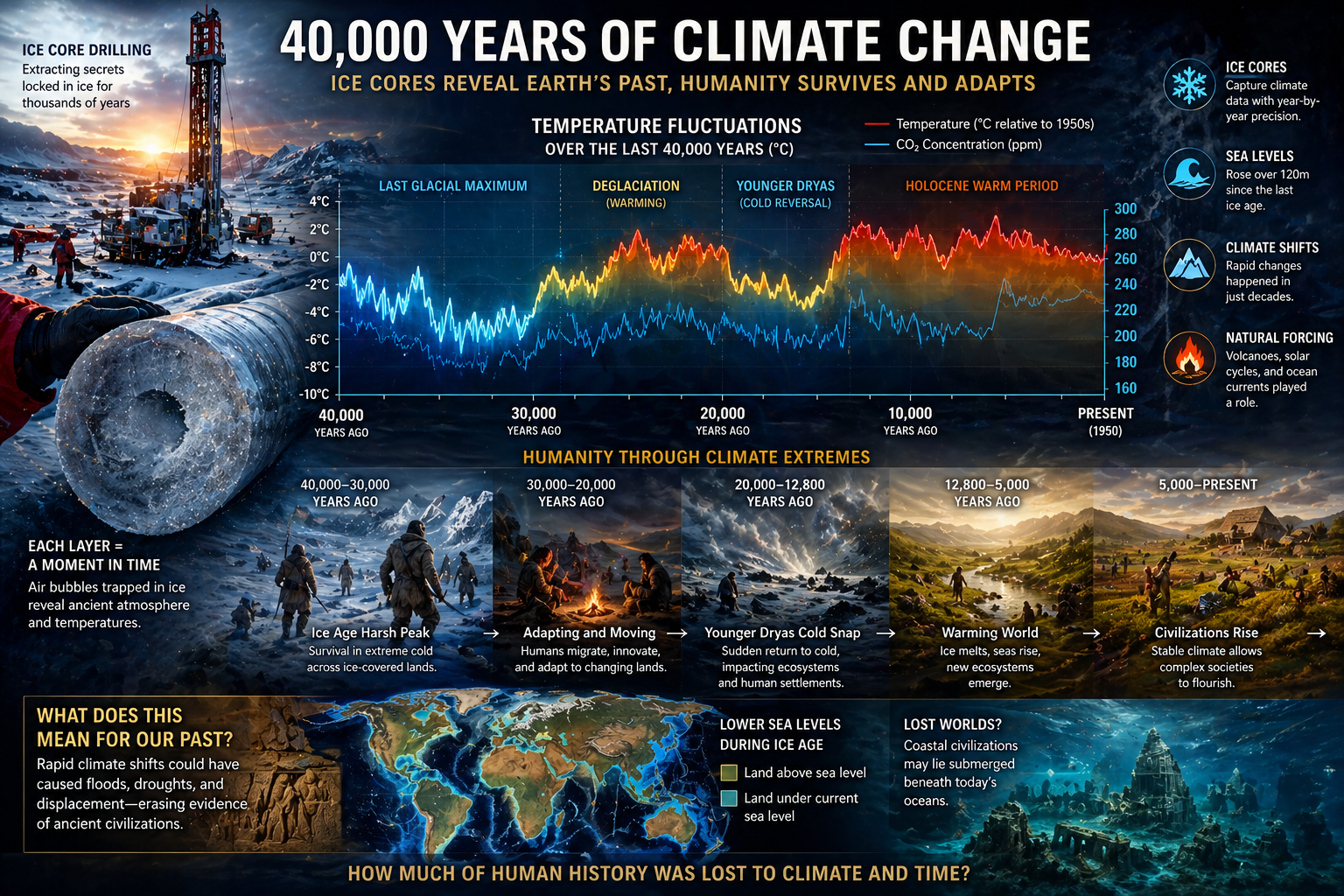
The Climate History of the Last 40,000 Years provides one of the most detailed windows into Earth’s recent past, revealing not a stable environment but a sequence of rapid and often extreme climatic shifts. This period, reconstructed through ice cores, sediment layers, and geological proxies, shows that climate change has not always been gradual; instead, it has frequently occurred in sudden transitions capable of reshaping ecosystems within generations. When viewed alongside evidence that modern humans existed long before this period, the Climate History of the Last 40,000 Years becomes more than a scientific reconstruction—it becomes a framework for questioning how human populations adapted, survived, and possibly transmitted knowledge across repeated environmental disruptions (Azial Precession of the Great Year – link).
Ice Core Records and Climate Reconstruction
Much of what is known about the Climate History of the Last 40,000 Years comes from ice cores extracted in Greenland and Antarctica. These cores preserve layers of snowfall compacted over millennia, effectively recording atmospheric conditions year by year. By analyzing trapped air bubbles, scientists can estimate past temperatures, greenhouse gas concentrations, and even volcanic activity.
One of the most striking findings is the presence of abrupt climate shifts known as Dansgaard–Oeschger events. These episodes show temperature increases of several degrees occurring within decades, followed by gradual cooling. Such patterns indicate that Earth’s climate system can reorganize rapidly, rather than changing only over long, predictable intervals.
This evidence challenges the assumption that ancient environments were stable enough to allow uninterrupted cultural development. Instead, it suggests that human populations lived within a constantly shifting landscape, where adaptation was not optional but necessary for survival (Milankovitch Cycle and Climate Forcing – link).
Rapid Warming and Cooling Phases
The Climate History of the Last 40,000 Years is marked by repeated transitions between colder (stadial) and warmer (interstadial) periods. These changes were not uniform across the planet; regional variations could be significant, creating complex environmental mosaics (Global Ancient Engineering Parallels – link).
During colder phases, large ice sheets expanded across northern regions, lowering sea levels and exposing land bridges that facilitated migration. Warmer phases, on the other hand, led to ice melt, rising seas, and the transformation of previously habitable areas into submerged landscapes.
These rapid oscillations imply that coastlines—often considered likely centers of early human settlement—were repeatedly reshaped or lost. If early communities established themselves along these zones, much of their material record may now lie beneath modern oceans. This possibility introduces a limitation in the archaeological record, which is largely based on accessible terrestrial sites (Ancient Energy Systems – Article1 – Article2).
Human Adaptation Windows
Despite these environmental challenges, humans not only survived but expanded into diverse regions across the globe during this period. The Climate History of the Last 40,000 Years coincides with major migration waves, technological developments, and cultural expressions, including early art and symbolic behavior.
Adaptation likely took multiple forms:
- Mobility in response to changing resources
- Development of tools suited to different climates
- Social structures capable of transmitting knowledge
These responses suggest a level of flexibility and resilience that is often underemphasized. However, they also raise a deeper question. If human populations were capable of adapting to repeated climatic stress, could they also have developed more complex systems—technological, architectural, or observational—that have not been fully preserved?
The current archaeological model tends to associate complexity with the relatively stable Holocene period. Yet, the Climate History of the Last 40,000 Years indicates that stability was the exception rather than the rule. This discrepancy invites reconsideration of how complexity is defined and identified in earlier contexts (Sacred Geometry as Universal Language – link).
The End of the Ice Age and Transitional Instability
The period between roughly 20,000 and 10,000 years ago marks the transition out of the last glacial maximum. This phase is characterized by significant warming, melting ice sheets, and rising sea levels. However, this transition was not smooth. It included abrupt reversals and fluctuations, suggesting that the climate system was highly sensitive to internal and external triggers.
As ice sheets retreated, vast amounts of freshwater entered the oceans, potentially disrupting circulation patterns such as the Atlantic Meridional Overturning Circulation. These disruptions could lead to sudden regional cooling, even within a broader warming trend.
Such instability would have had direct consequences for human populations, including shifts in habitable zones, resource availability, and migration routes. The idea that early societies developed in a calm, predictable environment becomes increasingly difficult to sustain under this evidence (First Astronomers Mapping the Sky Before Civilizations link).
Gaps in the Archaeological Narrative
The Climate History of the Last 40,000 Years highlights a mismatch between environmental complexity and the relative simplicity often attributed to human societies of the same period. While archaeological evidence confirms the presence of hunter-gatherer groups, the possibility of more complex or regionally advanced systems cannot be entirely excluded, particularly given the fragmentary nature of the record.
Several factors contribute to this gap:
- Submergence of coastal sites due to sea-level rise
- Erosion and glacial activity destroying earlier evidence
- Limited excavation in now-inhospitable regions
These constraints suggest that the current understanding of early human activity may be incomplete. Rather than assuming absence, it may be more accurate to consider the possibility of lost or undiscovered layers of human history—particularly in regions that have undergone significant environmental transformation (Sacred Numbers Measurement Systems link).
Conclusion
The Climate History of the Last 40,000 Years reveals a world defined by instability, rapid transitions, and environmental challenges that would have tested the limits of human adaptability. Yet, humans persisted, migrated, and developed cultural systems within this dynamic context. This persistence raises important questions about continuity and knowledge transmission across deep time. While the archaeological record provides valuable insights, it is shaped by preservation biases that may obscure earlier complexity. Recognizing these limitations does not overturn established science, but it encourages a broader and more nuanced investigation into how human societies may have interacted with—and adapted to—the shifting rhythms of Earth’s climate.
References and Further Reading
EPICA Community Members, Eight glacial cycles from an Antarctic ice core (link)
EPICA Ice Core Project (European Project for Ice Coring in Antarctica) (link)
NASA Earth Observatory – Paleoclimate Data and Ice Core Studies
Richard B. Alley, The Two-Mile Time Machine (link)
Wallace S. Broecker, The Great Ocean Conveyor (link)
ResearchGate – Studies on Dansgaard–Oeschger events and paleoclimate variability
Ancient Energy Systems: Myth or Technology? (link)
Ancient Hyper Forests and Giant Trees (link)
Pre Flood Civilization and Environmental Collapse (link)
Was the Ancient World Phisically Different? (link)
Giant Humans Before the Younger Dryas (link)
Ancient Construction Project Management (link)
Ice Age Civilization Lost Worlds Before Floods (link)
Lost Knowledge of Ice Age Rewritten History (link)
Ice Age Knowledge Science Before Younger Dryas (link)