Axial Precession and the Great Year
Axial Precession and the Great Year describe one of the slowest yet most profound movements of our planet—a gradual shift in Earth’s rotational axis that unfolds over thousands of years. While modern astronomy explains this motion with precision, the concept becomes more complex when placed alongside ancient structures, myths, and calendars that appear to reflect long-term celestial awareness. If Axial Precession and the Great Year were observable patterns in the sky, even indirectly, then the question is not only how they function scientifically, but whether early human societies recognized and recorded their effects in ways that remain only partially understood today (Milinkovitch Cycles and Climate Forcing – link).
Understanding Axial Precession and the Great Year
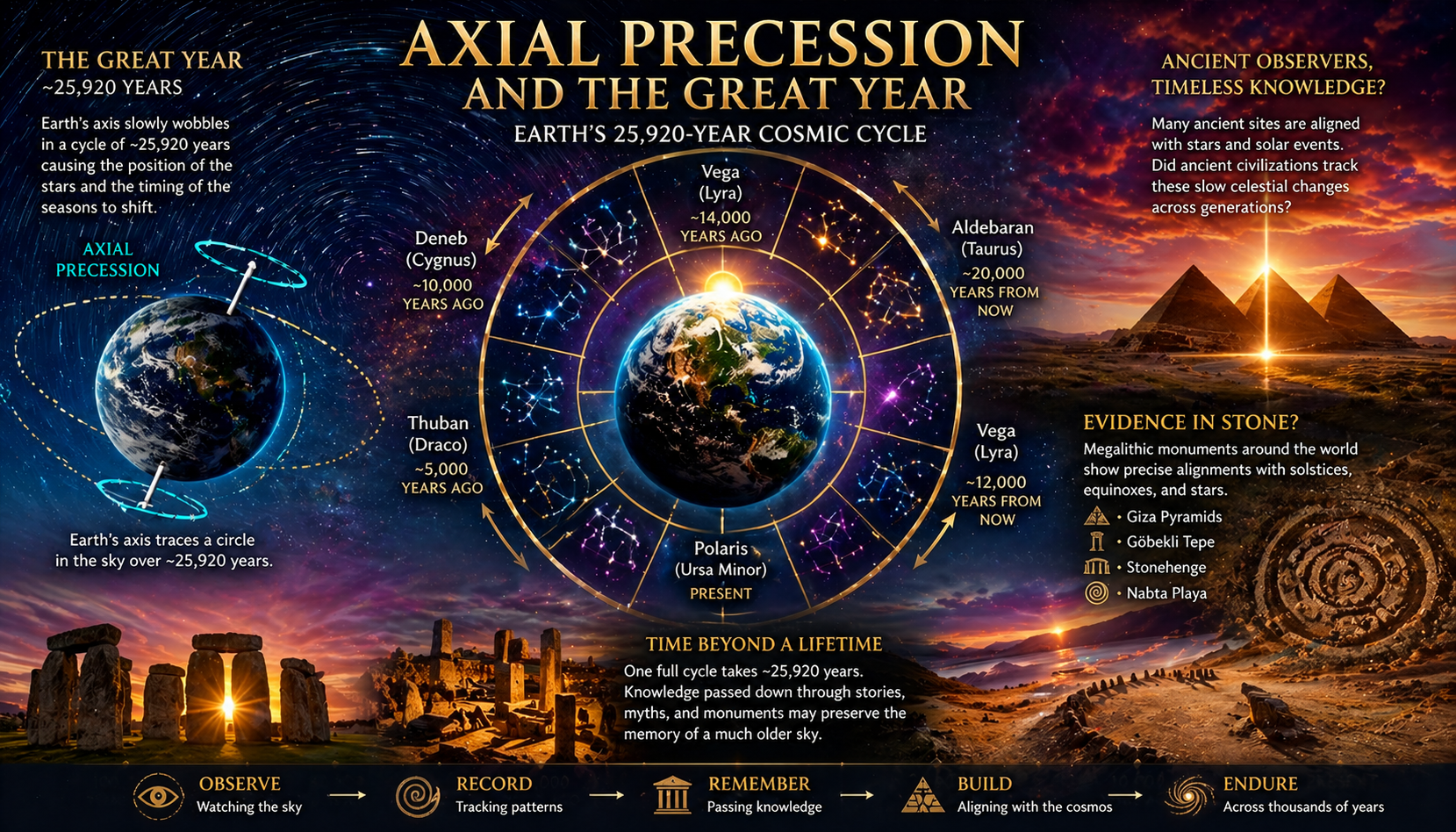
Earth does not spin in a perfectly stable way. Instead, its axis slowly wobbles, similar to a spinning top. This motion is known as axial precession, and it causes the orientation of Earth to shift over time. As a result, the position of the stars relative to Earth’s seasons gradually changes.
This full cycle takes approximately 25,920 years and is often referred to as the Great Year. During this period, the point where the Sun rises on the spring equinox slowly moves through the background of the zodiac constellations. Each shift is subtle within a human lifetime, but across centuries, the change becomes noticeable.
Axial Precession and the Great Year therefore operate as a long-term astronomical clock. Unlike daily or yearly cycles, this one unfolds across generations, requiring extended observation or cultural continuity to be recognized (Ancient Astronomical Monuments Aligned to Skies – link).
Observable Effects Across Time
Although axial precession is slow, its effects are measurable. Over long periods:
- The identity of the “pole star” changes
- The constellations aligned with seasonal events shift
- The timing of equinoxes moves relative to the stars
For example, the star currently known as Polaris has not always been the North Star, and it will not remain so indefinitely. Thousands of years ago, different stars occupied that position.
This raises an important consideration. While no single individual could observe the full cycle, societies that tracked the sky carefully over generations might detect gradual shifts. This does not require advanced technology, but it does require continuity, attention, and a cultural emphasis on celestial observation (Sacred Geometry in Ancient Architecture – link).
Ancient Structures and Long-Term Alignments
Certain ancient sites appear to align with solar or stellar positions. Structures such as megalithic circles, temples, and pyramidal complexes are often oriented toward solstices, equinoxes, or specific stars. While many of these alignments can be explained through seasonal observation, some researchers suggest that longer-term changes may also have been noticed.
For example, if a structure was originally aligned with a particular star rising at a key moment, that alignment would slowly drift due to axial precession. Over centuries, this shift might become significant enough to be recorded or corrected.
The interpretation remains debated. Some scholars argue that these alignments reflect practical calendrical systems, while others suggest they may indicate a deeper awareness of long-term celestial cycles. The evidence does not confirm precise knowledge of Axial Precession and the Great Year, but it opens the possibility that ancient observers were more attentive to gradual sky changes than often assumed (Ice Age Civilizations Lost Worlds Before the Floods – link).
Mythology and the Language of Cycles
In many ancient traditions, time is not described as linear but cyclical. Systems such as the Yuga cycles in Indian cosmology or similar frameworks in other cultures describe vast periods marked by change, decline, and renewal.
While these systems are symbolic, their structure sometimes echoes the idea of long-duration cycles. The connection between these traditions and Axial Precession and the Great Year is not direct, yet the parallels are notable. Both involve extended periods beyond immediate human experience, and both suggest a worldview shaped by repeating patterns rather than one-directional progression.
This does not imply that ancient cultures understood the mechanics of precession as modern science does. However, it raises the question of whether repeated observation of the sky over generations contributed to the development of cyclical time concepts (Ice Age Knowledge Science Before the Younger Dryas – link).
Human Continuity and the Problem of Timescale
If modern humans have existed for over 300,000 years, then multiple Great Year cycles would have occurred during that time. This introduces a critical question: how much observational knowledge could accumulate across such spans, and how much of it could survive periods of disruption?
Mainstream historical models often focus on the last 10,000 to 12,000 years, where agriculture and urbanization become visible in the archaeological record. However, this represents only a small fraction of human existence. If earlier populations experienced and adapted to long-term cycles such as axial precession, then traces of that awareness might not appear as continuous records but as fragments—embedded in architecture, encoded in myths, or preserved through oral traditions.
The absence of explicit documentation does not necessarily indicate absence of knowledge. It may instead reflect the difficulty of preserving information across periods marked by environmental stress, migration, or population decline.
Conclusion
Axial Precession and the Great Year provide a clear scientific explanation for one of Earth’s slowest astronomical cycles, yet their broader implications remain open to interpretation. When considered alongside ancient structures, cyclical mythologies, and the deep timeline of human existence, they invite a more nuanced perspective. The question is not whether ancient civilizations possessed modern astronomical models, but whether they observed and responded to long-term patterns in ways that are not yet fully recognized. This perspective does not replace established science; it expands the field of inquiry, encouraging a closer examination of continuity, memory, and the possibility that knowledge of the sky extended further into the past than currently acknowledged (Gobekli Tepe Gorgotten Down of Civilization – link).
References and Further Reading
NASA Earth Observatory – Axial Precession and Earth’s Motion (link)
Jean Meeus, Astronomical Algorithms (link)
Gerald Hawkins, Stonehenge Decoded (link)
E.C. Krupp, Echoes of the Ancient Skies (link)
Subhash Kak, The Astronomical Code of the Rigveda
ResearchGate – Studies on archaeoastronomy and precession (link)
John A. Burke, Seed of Knowledge, Stone of Plenty
EPICA Ice Core Project (European Project for Ice Coring in Antarctica)
Ancient Energy Systems: Myth or Technology? (link)
Ancient Hyper Forests and Giant Trees (link)
Pre Flood Civilization and Environmental Collapse (link)
Was the Ancient World Phisically Different? (link)
Giant Humans Before the Younger Dryas (link)