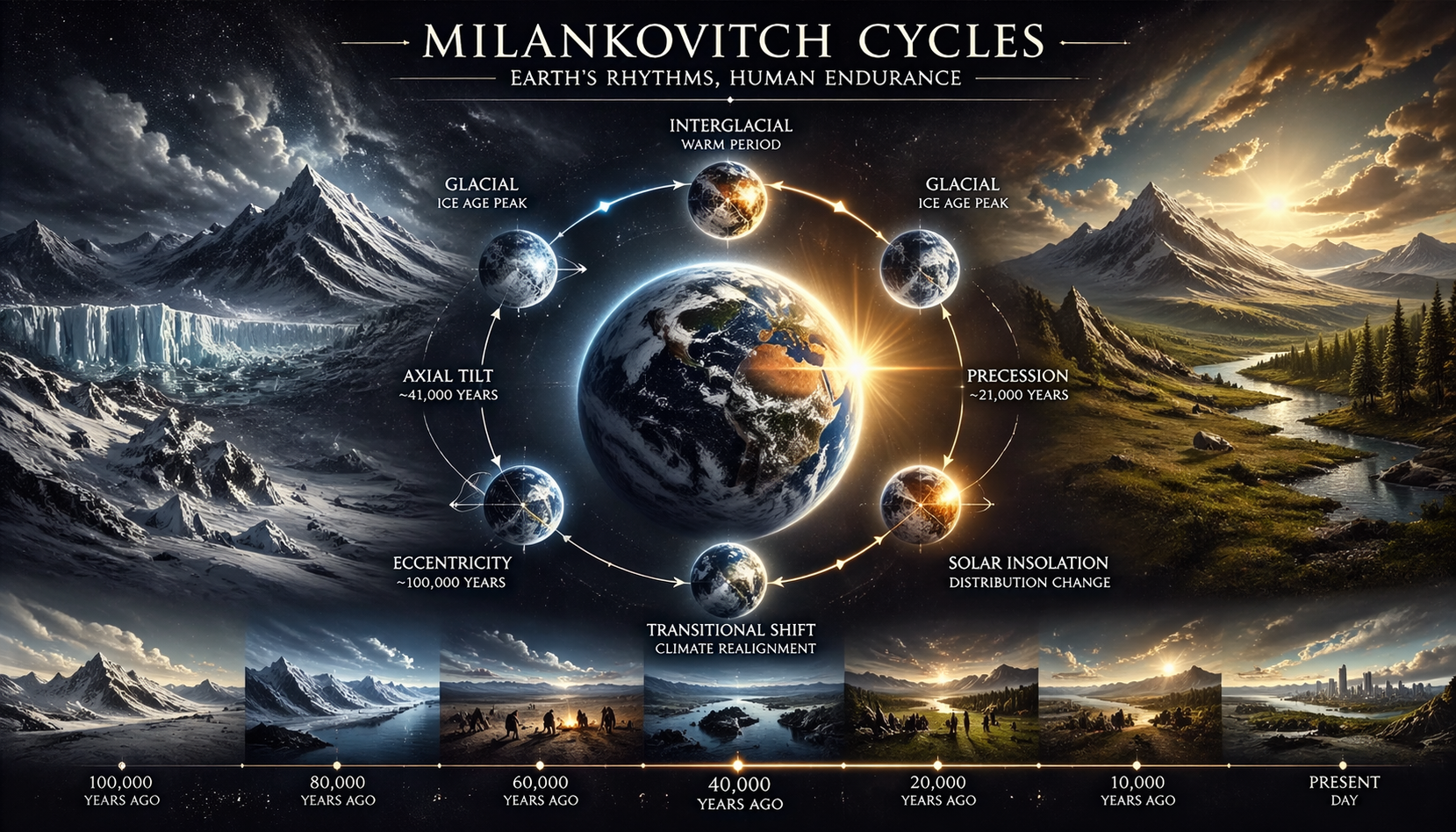
Milankovitch Cycles and Climate Forcing
Milankovitch Cycles and Climate Forcing form one of the central pillars in understanding Earth’s long-term climatic evolution, offering a mathematically grounded explanation for glacial and interglacial transitions across tens of thousands of years. Yet, while this framework is widely accepted within paleoclimatology, it also opens a series of deeper questions—particularly when placed alongside emerging evidence suggesting that anatomically modern humans may have existed for over 300,000 years. If this timeline holds, then Milankovitch Cycles and Climate Forcing are not merely abstract orbital mechanics; they represent environmental realities repeatedly experienced by human populations whose continuity challenges conventional historical narratives and invites a reassessment of what may have been lost, preserved, or encoded across deep time.
Orbital Mechanics Behind Milankovitch Cycles and Climate Forcing
At its core, Milankovitch Cycles and Climate Forcing describe how variations in Earth’s orbital geometry influence the distribution and intensity of solar radiation. These cycles are typically divided into three interacting components: eccentricity, axial tilt (obliquity), and precession. Each operates on distinct timescales, ranging from approximately 20,000 to over 100,000 years, producing complex interference patterns that affect seasonal contrast and latitudinal energy distribution.
What emerges from this model is not a simple linear climate progression, but a dynamic system of oscillations that periodically favor glaciation or warming. Ice core records from Antarctica and Greenland indicate that these orbital variations correlate strongly with shifts in atmospheric composition and temperature, suggesting that Milankovitch Cycles and Climate Forcing act as a pacing mechanism rather than a sole driver. Feedback systems—such as albedo changes, ocean circulation, and greenhouse gas fluctuations—amplify or dampen these orbital signals, creating abrupt transitions that sometimes unfold within centuries rather than millennia.
This raises a critical point: while the orbital cycles themselves are predictable, their climatic outcomes are not always gradual. The Earth system appears capable of rapid reorganization, implying that past environments may have shifted with a speed and intensity that challenges assumptions of slow, uniform change (Comet Caused the Younger Dryas and Megafauna Extinction link).
Glacial Timing Patterns and Their Implications
The paleoclimate record suggests that over the past 800,000 years, glacial cycles have followed a roughly 100,000-year rhythm, though this periodicity is not perfectly consistent. Earlier cycles appear more closely aligned with the 41,000-year obliquity signal, indicating that the climate system itself evolves over time in how it responds to orbital forcing.
This inconsistency is significant because it implies that Milankovitch Cycles and Climate Forcing do not operate as a rigid clock but rather as a probabilistic framework within which thresholds are crossed. Once certain tipping points are reached—such as ice sheet expansion or ocean circulation disruption—the system can shift abruptly into a new state (Solstices and Equinoxes in Ancient Megaliths: A Global Legacy link).
If anatomically modern humans have indeed existed for hundreds of thousands of years, then multiple full glacial cycles would have unfolded during their presence on Earth. This introduces a tension within mainstream archaeological narratives, which often place complex societal development within a relatively narrow Holocene window of the last 10,000 to 12,000 years. The question that emerges is not whether humans experienced these cycles, but how they adapted to them—and whether traces of those adaptations have been fully recognized or perhaps misinterpreted (Cosmic Orientation of Ancient Cities link).
Limits of Current Models and Interpretative Gaps
While Milankovitch Cycles and Climate Forcing provide a robust framework, they do not fully explain the timing or magnitude of all climatic events. Certain rapid transitions, including abrupt warming episodes and sudden cooling phases, appear to exceed what orbital forcing alone would predict. This has led to the incorporation of additional mechanisms, such as freshwater influx into the North Atlantic or volcanic activity, yet these explanations often remain case-specific rather than universally predictive.
This limitation is not a failure of the model but rather an indication of system complexity. However, it also opens a broader interpretative gap: if climate shifts were sometimes abrupt and severe, then the impact on human populations would likely have been equally significant. Migration, cultural transformation, and potential knowledge loss would not be peripheral effects but central responses to environmental instability (Equinoxes Across the Ancient World link).
Within this context, the discovery of early modern human remains—dated to over 300,000 years—takes on a different dimension. It suggests a continuity of human presence across multiple climatic regimes, each potentially marked by disruption. If so, then the absence of widely acknowledged technological or architectural continuity becomes a question worth examining. Is it a true absence, or does it reflect limitations in how evidence is classified, dated, or interpreted within existing frameworks?
Human Continuity Across Cycles: A Question of Memory and Material Evidence
Milankovitch Cycles and Climate Forcing imply that Earth’s climate has undergone repeated and sometimes dramatic transformations during the entire span of human existence. This raises a fundamental question: what remains of those earlier phases of human adaptation?
One possibility is that much of this history was lost due to environmental destruction, including glaciation, sea-level rise, and tectonic activity. Coastal regions—often considered prime locations for early settlement—would have been particularly vulnerable, now submerged beneath rising post-glacial seas. Another possibility is that elements of this deep history persist, not as direct archaeological continuity, but as fragmented expressions within myths, oral traditions, and symbolic systems.
In this light, global flood narratives, cyclical cosmologies, and recurring themes of destruction and renewal may reflect more than purely symbolic constructs. They may represent cultural attempts to encode and transmit memory across periods where written or material records were not preserved. This does not confirm any single hypothesis but suggests that such patterns warrant analytical attention rather than dismissal (Solstices Ancient Gateways of Light link).
Conclusion
Milankovitch Cycles and Climate Forcing offer a scientifically grounded framework for understanding Earth’s long-term climatic rhythms, yet their implications extend beyond geology and atmospheric science. When integrated with evidence of early human antiquity, they raise questions about continuity, adaptation, and the potential loss of knowledge across repeated environmental disruptions. The hypothesis does not assert that ancient civilizations existed in forms identical to later historical societies, but it opens the possibility that human experience during these cycles was more complex and more enduring than commonly assumed. In doing so, it encourages a broader investigation—one that remains anchored in evidence while remaining open to patterns that may not yet be fully understood.
References and Further Reading
Milutin Milankovitch, Canon of Insolation and the Ice-Age Problem (link)
ResearchGate – Paleoclimate and orbital forcing studies (link)
EPICA Ice Core Project (European Project for Ice Coring in Antarctica)
John A. Burke, Seed of Knowledge, Stone of Plenty
Andrija Puharich, The Sacred Mushroom
The Land of Chem (research interpretations on ancient knowledge systems)
Ancient Energy Systems: Myth or Technology? link