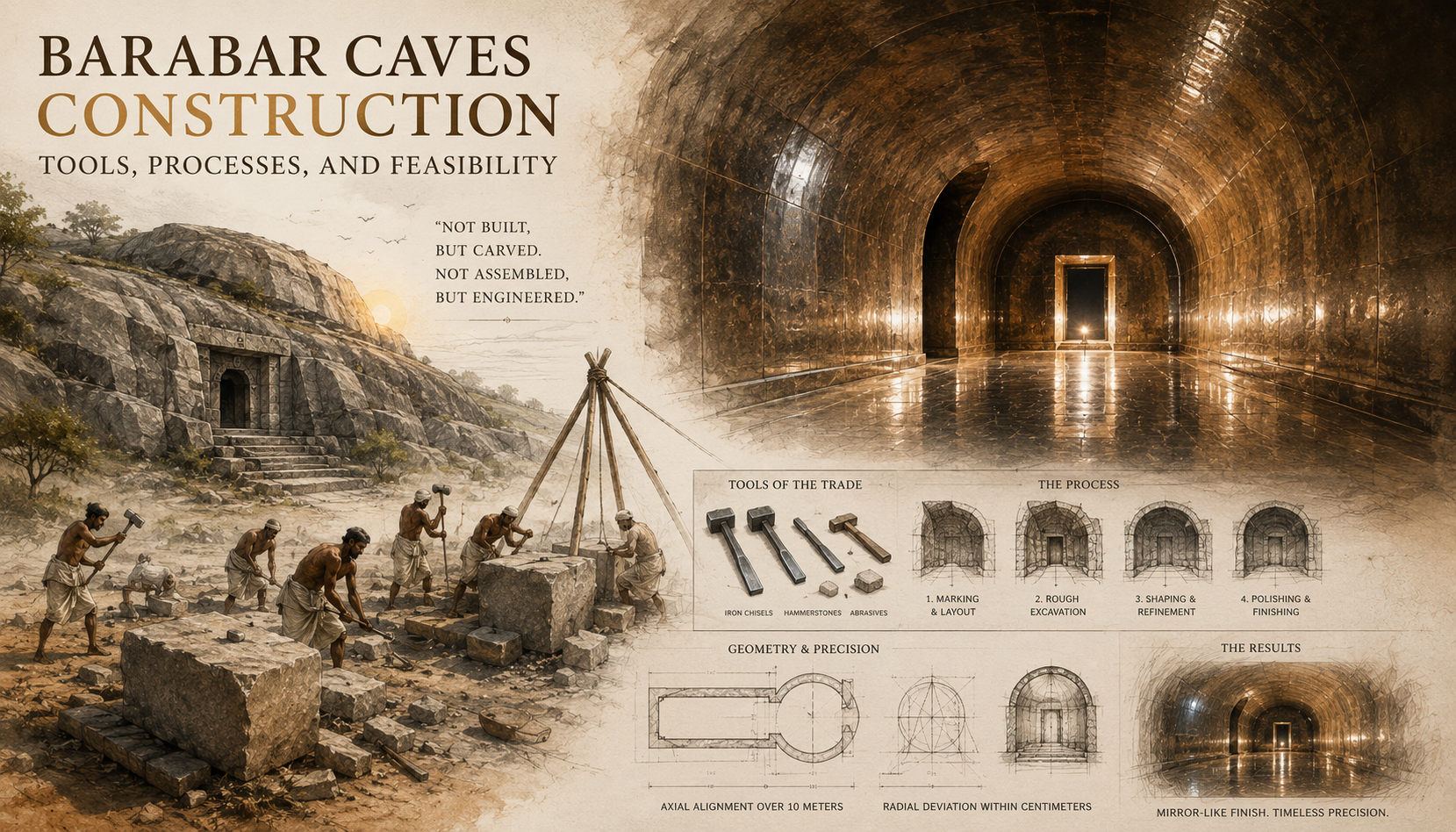
Precision Beyond Expectation
The concept of ancient engineering tolerances refers to the extraordinary degree of geometric accuracy observable in megalithic structures worldwide, where massive stone blocks weighing dozens or hundreds of metric tons (tens or hundreds of thousands of pounds) are fitted together with joints so precise that gaps are often less than a millimeter (less than 0.04 inches), a level of precision that rivals modern high-precision machining.
Such tolerances raise fundamental questions concerning measurement systems, construction methods, and technological capabilities attributed to early civilizations.
Measurement and Geometric Control
Engineering tolerances reflect the allowable variation in dimensions within a manufactured system, and achieving extremely small tolerances requires:
-
stable measurement standards,
-
repeatable tools,
-
and advanced understanding of geometry.
Many ancient structures demonstrate consistent alignment with cardinal directions and astronomical reference points, indicating sophisticated surveying techniques capable of controlling orientation across distances measured in kilometers (miles).
The geometric coherence observed in monumental architecture suggests not only practical construction skill but also advanced conceptual models of spatial measurement.
Surface Flatness and Joint Precision
In several ancient structures, stone surfaces exhibit remarkable flatness, with deviations measured in fractions of a millimeter across areas spanning several square meters (tens of square feet), while joints between blocks show complex interlocking geometries that distribute stress and enhance structural stability.
Such precision is especially striking considering the hardness of the materials involved, including granite and diorite, which possess compressive strengths requiring substantial energy to shape.
The consistency of these features across multiple sites implies standardized processes rather than isolated experimentation.
Structural Stability and Seismic Performance
Many megalithic structures display extraordinary resistance to seismic activity, suggesting that their design incorporated an understanding of dynamic loading and stress distribution, as evidenced by:
-
polygonal masonry allowing energy dissipation,
-
massive block interlocking,
-
and flexible structural behavior.
These characteristics demonstrate engineering principles that prioritize long-term stability and resilience.
Technological Implications
The extreme precision observed in ancient construction suggests that early builders possessed:
-
advanced material processing techniques,
-
effective measurement systems,
-
and systematic construction methods.
Whether these capabilities arose through incremental development or represent remnants of lost technological traditions remains a subject of ongoing investigation link.
Conclusion
The study of ancient engineering tolerances (link) reveals a level of precision that challenges conventional assumptions about early technological development and invites renewed investigation into the methods and knowledge systems underlying megalithic construction link.