Acoustic Engineering Ancient Structures: Sound, Resonance, and Intentional Design
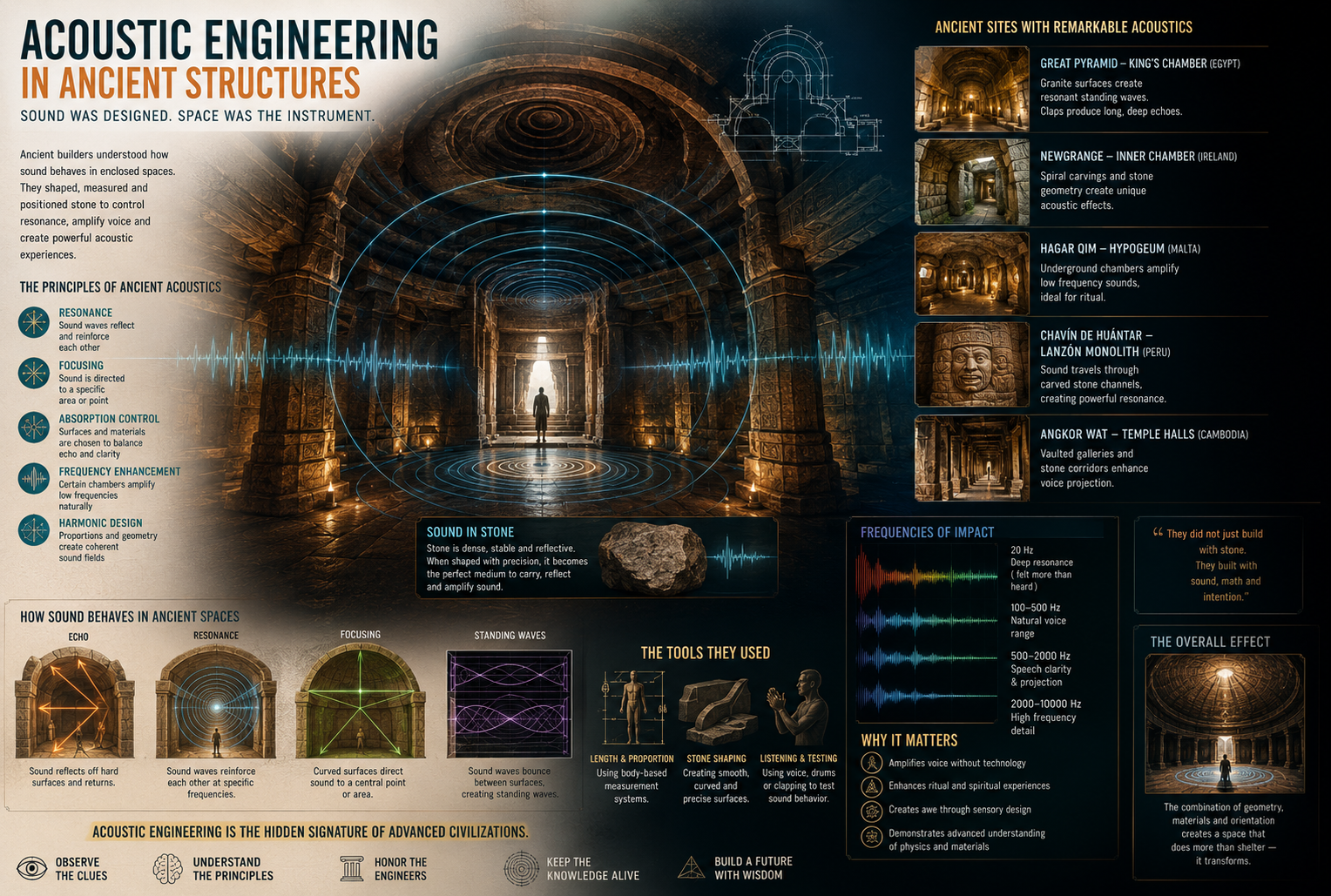
Acoustic Ecoustic Engineering Ancient Structures provides a framework for examining how sound may have been intentionally shaped within ancient built environments. The concept of Acoustic Engineering Ancient Structures becomes relevant when observing enclosed chambers, corridors, and stone surfaces that interact with sound in consistent and sometimes unusual ways. Rather than being accidental byproducts of construction, these acoustic effects may reflect deliberate design choices (Ancient Temples of Sounds and Stars article).
This raises a key question: were ancient builders aware of how sound behaves within space, and did they incorporate this understanding into their architectural systems?
Acoustic Engineering Ancient Structures and Resonance
Acoustic Engineering Ancient Structures often centers on the concept of resonance, where sound waves interact with a space in ways that amplify or sustain specific frequencies. Certain enclosed chambers in ancient sites produce noticeable echo patterns or standing wave effects. These observations suggest that:
- spatial dimensions may influence sound behavior
- material surfaces affect reflection and absorption
- geometry plays a role in how sound propagates
While not all structures exhibit strong acoustic properties, the repeated presence of such features in specific contexts raises the possibility of intentional design. In several ancient chambers, researchers have identified frequencies that correspond closely with the natural resonant range of the human voice, particularly in low-frequency chanting and rhythmic sound production. This has led to theories that ancient builders may have intentionally shaped spaces to enhance ceremonial communication, collective synchronization, or altered states of perception (Prehistoric Construction Systems Engineering Before Civilizations article). Sites such as Newgrange in Ireland, the Hypogeum of Malta, and certain Egyptian chambers exhibit acoustic anomalies that continue to attract scientific interest due to their consistency and measurable effects. The recurrence of these patterns across geographically separated civilizations suggests that knowledge of resonance may have been preserved, transmitted, or inherited through long-standing architectural traditions. While mainstream interpretations remain cautious, the precision involved raises the possibility that ancient societies possessed a more advanced understanding of vibrational behavior than is typically acknowledged.
Geometry and Acoustic Engineering Ancient Structures
The geometry of a structure is one of the most important factors in Acoustic Engineering Ancient Structures. Curved walls, narrow passages, and domed ceilings can alter how sound travels and concentrates. In some cases, sound appears to:
- focus toward central points
- travel along specific pathways
- create zones of amplification or silence
These effects may result from practical construction choices, but their consistency across different sites suggests that geometry may have been used with some level of awareness. Ancient builders repeatedly employed proportions, alignments, and spatial layouts that modern acoustic engineering recognizes as capable of shaping wave behavior and sound distribution. In certain temples and subterranean chambers, even quiet sounds can travel unexpectedly across long distances or become concentrated in precise locations, indicating careful spatial planning. Some researchers have proposed that these geometries were designed not only for ritual performance but also to harmonize architecture with natural frequencies associated with the Earth and atmosphere (prehistoric Construction Systems Engineering article). The mathematical precision observed in structures such as pyramids, circular sanctuaries, and megalithic chambers suggests that geometry may have served multiple functions simultaneously, combining structural stability, astronomical alignment, and acoustic performance within unified systems. Such complexity has led some scholars to speculate that ancient civilizations inherited fragments of sophisticated architectural knowledge from earlier, highly advanced cultures now lost to history.
Material Influence in Acoustic Engineering Ancient Structures
Material selection plays a critical role in Acoustic Engineering Ancient Structures. Stone, in particular, reflects sound differently depending on its density and surface finish. Polished surfaces tend to:
- reflect sound more efficiently
- reduce absorption
- enhance echo clarity
Rough surfaces, by contrast, scatter sound and reduce resonance. The presence of highly finished stone surfaces in certain chambers may therefore influence acoustic performance. Granite, basalt, limestone, and other stones used in ancient monuments also possess distinct mineral compositions that affect vibration, thermal behavior, and resonance characteristics. Some materials, particularly granite with its quartz content, exhibit piezoelectric properties under stress, leading to speculation that ancient builders may have observed energetic effects associated with pressure and vibration (Stone Functional Materials article). The deliberate placement of different stone types within specific chambers or structural zones suggests that material choice may have extended beyond aesthetics or availability alone. In agricultural and ceremonial contexts, these materials may have been selected to create stable environmental conditions, regulate sound, or enhance the sensory experience of sacred spaces. Although definitive proof remains limited, the consistent relationship between material selection and acoustic behavior supports the possibility that ancient civilizations possessed advanced empirical knowledge developed over centuries of experimentation and observation.
Case Observations and Acoustic Engineering Ancient Structures
Several ancient sites have been noted for their unusual acoustic properties. For example:
- enclosed chambers that amplify low-frequency sounds
- corridors where footsteps resonate over distance
- spaces where sound behaves differently depending on position
These features are not uniform across all structures, but their recurrence invites investigation. Acoustic Engineering Ancient Structures may therefore represent a specialized aspect of design rather than a universal principle. At the Hypogeum of Malta, certain vocal frequencies resonate strongly enough to vibrate throughout connected chambers, producing measurable physical and psychological effects on listeners. Similar acoustic behavior has been documented in Mayan pyramids, where echoes resemble bird calls, and in Egyptian structures where narrow passages intensify low-frequency vibrations. These repeated phenomena suggest that ancient builders were not constructing randomly but may have intentionally manipulated sound as part of broader architectural objectives. The appearance of comparable acoustic characteristics across distant civilizations raises important questions about whether advanced building principles were independently discovered or inherited from earlier sources of knowledge. Such patterns continue to fuel debate regarding the sophistication of ancient engineering and the possibility that some civilizations possessed scientific insights far beyond conventional historical assumptions (Systems vs Tools Reconstructing Lost Ancient Technologies article).
Ritual, Function, and Acoustic Engineering Ancient Structures
One interpretation of Acoustic Engineering Ancient Structures is that sound played a role in ritual or ceremonial practices. Controlled acoustic environments could enhance vocal projection, rhythm, or auditory experience.
Possible functions include:
- amplification of voice in enclosed spaces
- creation of immersive sound environments
- reinforcement of spatial awareness
These interpretations remain hypothetical but are grounded in observable acoustic behavior. They suggest that sound may have been considered an active element within architectural systems. In many ancient traditions, sound was associated with cosmology, healing, spiritual transformation, and the maintenance of harmony between human beings and natural forces. Resonant chambers and carefully designed ceremonial spaces may therefore have functioned as environments intended to influence psychological states, strengthen communal rituals, or synchronize participants through rhythm and vibration. Some researchers propose that repetitive chanting, percussion, and harmonic resonance could have interacted with enclosed stone spaces in ways that amplified emotional and sensory experiences. The integration of acoustics into sacred architecture suggests that ancient civilizations may have viewed sound not merely as communication, but as a force capable of affecting matter, consciousness, and environmental balance (Knowledge Loss Cycles and Systems Reset article). This possibility aligns with broader evidence that many ancient cultures pursued a highly integrated understanding of energy, astronomy, agriculture, and architecture within unified systems of knowledge.
Limits of Acoustic Interpretation
As with other aspects of ancient engineering, Acoustic Engineering Ancient Structures must be approached with caution. Not all acoustic effects imply intentional design.
Limitations include:
- lack of direct documentation
- changed structures over time
- modern alterations affecting sound behavior
These factors make it difficult to determine whether acoustic properties were deliberate or incidental. The goal is to identify patterns without overextending conclusions. Nevertheless, the absence of written explanations does not necessarily indicate the absence of sophisticated knowledge, particularly in cultures where information was transmitted orally or symbolically. Many ancient technologies were developed through long-term empirical practice rather than formal scientific theory, meaning advanced understanding could exist without surviving technical documentation. Modern archaeology also faces the challenge of interpreting incomplete ruins that may no longer reflect their original environmental conditions, materials, or acoustic performance. Because of this, conclusions regarding ancient acoustics must remain provisional while still recognizing that repeated architectural patterns across civilizations deserve serious investigation. A balanced approach allows researchers to explore the possibility of advanced inherited knowledge without abandoning evidence-based analysis (Cultural Memory Cataclysms Flood Myths article).
Acoustic Engineering Ancient Structures and System Integration
When viewed within a broader framework, Acoustic Engineering Ancient Structures may represent one component of integrated systems that include:
- material selection
- spatial design
- environmental interaction
This perspective aligns with the idea that ancient construction was not isolated but coordinated (Ancient Construction Project Management article). Sound, like structure and orientation, may have been part of a unified approach to design. Ancient civilizations often aligned architecture with celestial events, water systems, seasonal cycles, and geographic features, suggesting that acoustic design may have existed within a larger network of environmental relationships. Resonance, geometry, and material behavior could therefore have been integrated into structures intended to support agriculture, ritual activity, governance, or social cohesion. In some interpretations, temples and megalithic complexes functioned not only as symbolic monuments but also as carefully calibrated environments designed to interact with natural energies and human perception. Such system-based thinking reflects a level of sophistication that challenges simplistic assumptions about ancient engineering capabilities. Whether inherited from a lost civilization or independently refined over millennia, these integrated approaches suggest that ancient societies may have possessed forms of applied knowledge far more advanced than traditionally recognized (Lost Geometry Knoweldge: Did Ancients Inherit Science? article).
Conclusion
References and Further Reading
ResearchGate – Studies on archaeoacoustics (link)
ResearchGate – Studies on ancient materials and engineering (link)
John A. Burke, Seed of Knowledge, Stone of Plenty (link)
Christopher Dunn, The Giza Power Plant (link)
ResearchGate – Studies on cultural transmission and knowledge systems
Research on cultural transmission and collective memory
Studies on climate instability and post-Ice Age sea level rise (link)
Geological evidence surrounding the Younger Dryas period (link)
Research into megalithic architecture and archaeoastronomy
Richard B. Alley, The Two-Mile Time Machine
Ancient Energy Systems: Myth or Technology? (link)
Ancient Hyper Forests and Giant Trees (link)
Pre Flood Civilization and Environmental Collapse (link)
Was the Ancient World Phisically Different? (link)
Giant Humans Before the Younger Dryas (link)
Ancient Construction Project Management (link)
Ice Age Civilization Lost Worlds Before Floods (link)
Lost Knowledge of Ice Age Rewritten History (link)
Ice Age Knowledge Science Before Younger Dryas (link)
Geometry and Earth Scaling (link)
How Ancient Builders Measured the Stars (link)