Systems vs Tools: Reconstructing Lost Ancient Technologies
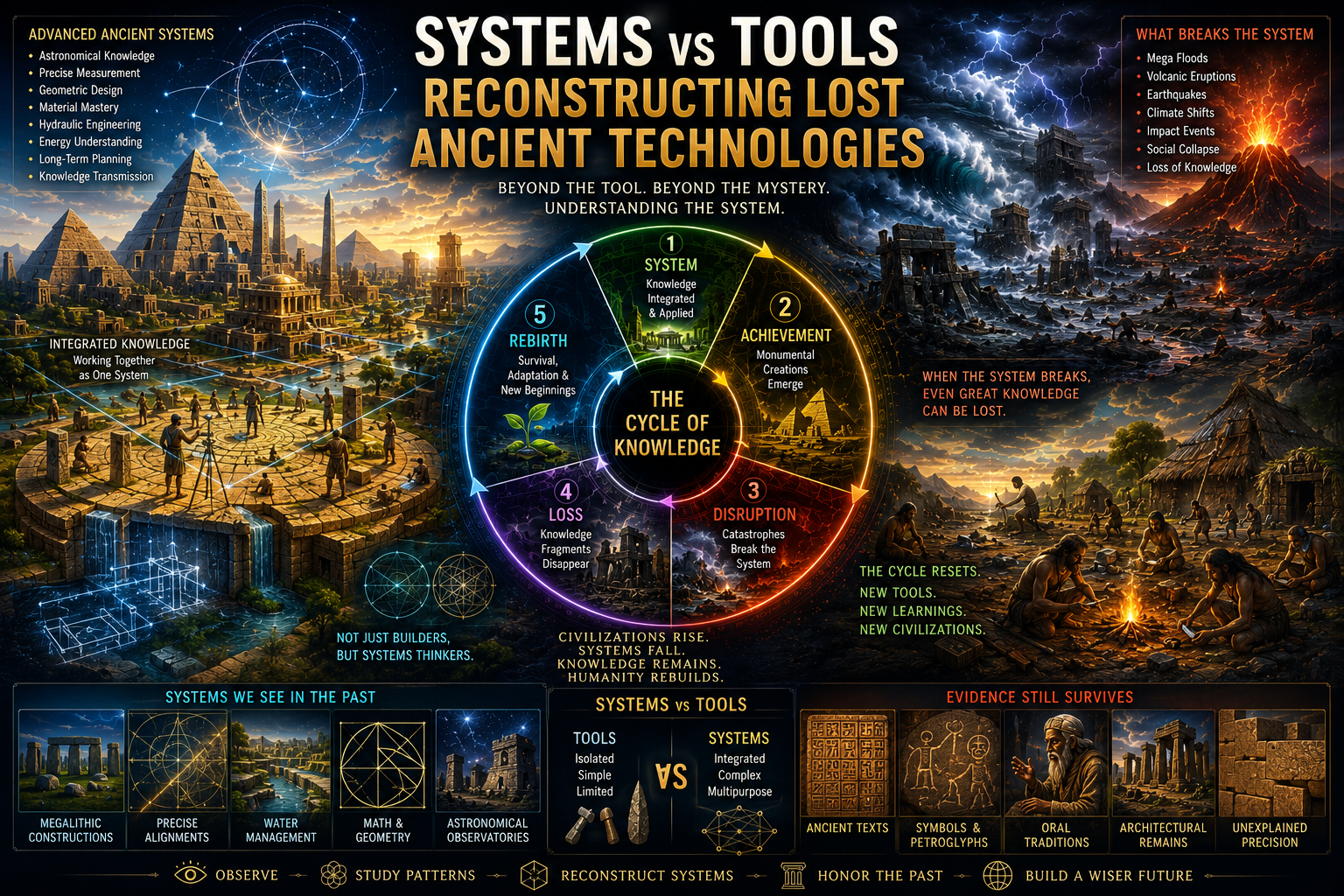
Lost Ancient Technologies represent one of the most debated and misunderstood aspects of early human history, often framed as isolated tools rather than integrated systems of knowledge. The concept of Lost Ancient Technologies becomes more complex when considering that ancient societies may not have relied solely on individual instruments, but on coordinated systems involving measurement, material understanding, environmental awareness, and long-term planning (Ancient Construction Project Management link). When viewed in this way, Lost Ancient Technologies raise a critical question: is the apparent simplicity of surviving artifacts a reflection of limited capability, or the result of fragmented evidence from systems that are no longer fully preserved?
Lost Ancient Technologies as Systems, Not Tools
Lost Ancient Technologies are often interpreted through the lens of individual artifacts—stone tools, construction methods, or isolated techniques. However, this approach may overlook the possibility that these elements were part of larger, interconnected systems. Large-scale constructions, precise alignments, and consistent architectural patterns suggest coordination beyond simple trial and error. These features indicate:
- standardized measurement practices
- shared design principles
- long-term planning and execution
If such elements existed, then Lost Ancient Technologies may have functioned as systems rather than collections of independent tools. This perspective shifts the focus from isolated objects to the relationships between them (Global Ancient Engineering Parallels link).
Measurement and Precision in Lost Ancient Technologies
One of the most striking aspects of Lost Ancient Technologies is the level of precision observed in ancient structures. Megalithic sites across different regions demonstrate consistent geometry, alignment, and proportion. These characteristics suggest the use of measurement systems that were:
- repeatable
- transferable
- adaptable to different environments
While the exact nature of these systems remains uncertain, their آثار can be observed in surviving structures. This raises the possibility that knowledge of measurement was more advanced or more systematically applied than currently assumed. Rather than viewing precision as an isolated achievement, it may be more accurate to interpret it as a product of an underlying system (Ancient Measurement Systems link).
Material Knowledge and Lost Ancient Technologies
Lost Ancient Technologies also imply a deep understanding of materials. Stone selection, shaping techniques, and structural stability indicate familiarity with physical properties and long-term behavior.
This knowledge may not have been formalized in written form, but it could have been transmitted through practice, observation, and tradition. Over time, such knowledge becomes embedded within systems rather than documented explicitly.
The challenge for modern interpretation lies in reconstructing these systems from incomplete evidence. Without the original context, techniques appear isolated, even if they were once part of a broader framework (Lost Ancient Tools link).
Environmental Integration in Lost Ancient Technologies
Another important dimension of Lost Ancient Technologies is their apparent integration with the environment. Many ancient structures are positioned with respect to:
- solar and lunar cycles
- topographical features
- water sources
This suggests that environmental observation was not separate from construction but integral to it. Systems may have combined astronomical awareness, geographic understanding, and engineering practices into a unified approach. Such integration reinforces the idea that Lost Ancient Technologies were not مجرد tools, but coordinated systems responding to both natural and human factors (Megalith Cutting Precision link).
Disruption and Fragmentation of Lost Ancient Technologies
If Lost Ancient Technologies were system-based, then their disappearance becomes easier to understand. Systems are more vulnerable to disruption than individual tools because they depend on continuity, المعرفة transfer, and social organization.
Events such as climate shifts, flooding, or population displacement—such as those associated with the Younger Dryas—could interrupt these systems. Once disrupted, knowledge may fragment into isolated practices, losing the coherence that originally defined it. Over time, what remains are traces:
- structures without clear construction records
- techniques without documented theory
- patterns without explicit explanation
This fragmentation contributes to the perception that ancient capabilities were limited, when in reality the system itself may be incomplete (Prehistoric Construction Systems Engineering link).
Reconstructing Lost Ancient Technologies
Reconstructing Lost Ancient Technologies requires moving beyond artifact-based analysis toward system-based interpretation. This involves:
- examining patterns across regions
- identifying recurring principles
- integrating data from multiple disciplines
Rather than searching for singular “advanced tools,” the focus shifts to understanding how knowledge was organized and applied.
This approach does not assume hidden or unknown technologies in the modern sense. Instead, it explores the possibility that ancient systems operated differently—optimized for their environment, materials, and cultural context (Ancient Construction Project Management – Systems Before Theory link).
Rethinking Technological Progress
Lost Ancient Technologies challenge the assumption that technological development follows a simple linear trajectory. If systems can be disrupted and lost, then progress may involve cycles of ظهور, decline, and rediscovery.
This perspective aligns with broader patterns observed in climate history and cultural memory. It suggests that what is perceived as innovation may, in some cases, represent re-emergence.
Understanding this possibility requires careful analysis and restraint. The goal is not to replace one narrative with another, but to expand the framework within which evidence is interpreted (Engineering Before Civilization link).
Conclusion
Lost Ancient Technologies invite a shift in perspective—from viewing the past as a sequence of isolated inventions to understanding it as a network of interconnected systems. By considering how measurement, materials, environment, and organization may have functioned together, it becomes possible to interpret ancient achievements in a more coherent way. While definitive conclusions remain limited by available evidence, the concept of Lost Ancient Technologies opens a pathway for deeper investigation into how knowledge is created, maintained, and sometimes lost across time.
References and Further Reading
John A. Burke, Seed of Knowledge, Stone of Plenty (link)
ResearchGate – Studies on ancient engineering and systems thinking (link)
NASA – Earth observation and environmental systems
Andrija Puharich, The Sacred Mushroom
Christopher Dunn, The Giza Power Plant (link)
Encyclopaedia Britannica — Ancient Architecture (link)
National Geographic — Megalithic Structures Around the World
JSTOR — Comparative Architecture Studies
UNESCO — World Heritage Construction Sites
Fletcher, Banister — A History of Architecture (link)
World Atlas — Ancient Architecture Materials (link)
Encyclopaedia Britannica — Geometry in Architecture (link)
National Geographic — Ancient Engineering and Alignments (link)