
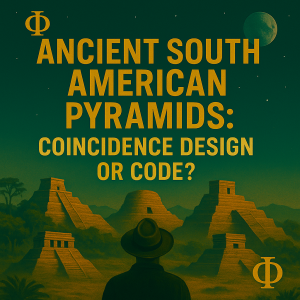
Did you know that… ancient South American pyramids number in the hundreds and may encode cosmic and mathematical knowledge?
South America is home to more than 300 pyramid structures—silent giants of the past, scattered across Peru, Bolivia, Ecuador, and northern Chile. While some stand proudly above ground, others lie buried beneath centuries of soil and mystery, waiting to be rediscovered. But what purpose did these ancient pyramids serve? Were they mere ceremonial sites—or something more?
The Pyramid of Caral: A Golden Beginning
Let’s start with one of the most astonishing sites: the Great Pyramid of Caral in Peru. With a base of 150 meters and rising 28 meters high, this structure is aligned with true north. What’s more, Caral dates back over 5,000 years, making it older than the Egyptian pyramids. Scholars suggest its proportions may encode the Golden Ratio (Phi)—a mathematical constant found in everything from seashells to spiral galaxies. Coincidence? Or precision engineering from a lost science?
Huaca del Sol: A Solar and Hydraulic Wonder
Another stunning example is Huaca del Sol, once standing 40 meters tall, built by the Moche civilization. Its massive base stretches over 340 meters. Not only is it believed to align with solar events and water flow, but it might also serve as a geodesic marker—a point in a larger sacred geometry across the Andes. This suggests a deliberate awareness of landscape, light, and perhaps even planetary positioning.
Túcume: Adobe Megastructures with Cosmic Clues
In the Lambayeque Valley of northern Peru, the Pyramids of Túcume form a complex of 26 adobe pyramids. The largest, Huaca Larga, spans over 700 meters—making it one of the longest ancient pyramids on Earth. It’s aligned with the cardinal points, and researchers believe its proportions may reflect the Golden Ratio. Some even argue the site functions as a cosmological map, interwoven with solar patterns and sacred numbers.
Cochasquí: Orion’s Echo in the Andes
Traveling north to Ecuador, the lesser-known Pyramids of Cañar present yet another enigma. The Cochasquí Pyramid, featuring 15 terrace platforms, is aligned with equinox sunrises and the Orion constellation. This layout suggests advanced astronomical knowledge—potentially encoded in stone and space. Again, the presence of the Golden Ratio emerges, as does the possibility of encoded astronomical calendars.
Akapana: Bolivia’s Celestial Cross
And then there’s Akapana, in Bolivia. This semi-subterranean pyramid spans 257 meters and stands 16.5 meters high, shaped in a stepped cross. Its cardinal orientation and platform layout suggest alignment with both solar and lunar cycles—possibly acting as a celestial observatory and timekeeper.
Coincidence… or Blueprint?
Mainstream archaeology often labels these structures as ceremonial or religious sites. But the presence of precise cardinal alignments, Fibonacci sequences, Phi proportions, and intercontinental geodesic positioning tells another story—one that mirrors patterns found in pyramids across Egypt, Mesopotamia, and even Asia.
Could these South American pyramids be part of a global, ancient code? Some alternative researchers argue they were not just temples, but repositories of lost knowledge—vibration chambers, observatories, and even tools of ancient science.
So, what’s the truth?
Are these just the remnants of forgotten civilizations…
Or the intentional markers of a unified, encoded blueprint that spanned the ancient world?
Coincidence—or ancient code? You decide.


2 Responses
Where they built in the same era or different times? Above the equator but some of the pyramids are not . How is that to be measured?
Thanks for reading the article and for your questions. So, according to mainstream archaeology, these structures and pyramids were built over thousands of years by different cultures that likely had no direct contact with one another. Their similarities—cardinal alignments, solar orientations, geometric planning—can be explained by careful local observation of the sky and landscape. The equator doesn’t necessarily connect or separate them in any mysterious way; it simply changes how the sky appears from each location. Still, it’s fair to wonder:
How did civilizations separated by time and distance place such similar importance on the stars? Were these ideas discovered independently? Or did some knowledge travel farther than we think? Or could there be parts of our early human story that we haven’t uncovered yet?
…We may not have all the answers—but the questions themselves remind us that history is still being written.