Barabar Caves: Precision Beyond Explanation
The Barabar Caves provide one of the clearest measurable examples of advanced spatial engineering in the ancient world. While many ancient monuments inspire awe visually, the Barabar Caves invite a more technical form of investigation because their sophistication becomes increasingly apparent through measurement. Their dimensions, geometric consistency, curvature accuracy, and polished granite surfaces reveal not random excavation, but controlled architectural planning executed with extraordinary discipline. The caves therefore stand not merely as religious monuments, but as physical evidence of a civilization deeply familiar with geometry, spatial organization, material behavior, and precision craftsmanship (Barabar Caves Polished Granite article).
Located in Bihar and traditionally dated to the Mauryan period around the 3rd century BCE, the caves are commonly associated with the reign of Ashoka and the Ajivika ascetics. Yet the more closely researchers examine the measurable characteristics of these chambers, the more difficult it becomes to dismiss them as simple hand-carved shelters. The interiors display highly controlled symmetry, smooth cylindrical curvature, aligned central axes, and polishing consistency across some of the hardest stone available. Such features strongly imply sophisticated planning systems supported by organized labor, measurement techniques, and long-term technical knowledge.
Granite presents enormous engineering challenges even today. With a hardness between 6 and 7 on the Mohs scale and high compressive strength often exceeding 130–250 megapascals, granite resists shaping, smoothing, and precision finishing. Excavating hundreds of cubic meters of this material while maintaining geometric accuracy inside enclosed chambers would require not only immense labor but also repeatable systems for verification and correction. The caves therefore raise important questions: What measuring methods were used? How were curves maintained so consistently? How was error minimized in confined spaces illuminated only by ancient light sources?
These questions become even more compelling when viewed against the broader timeline of human civilization. Modern humans have existed for approximately 300,000 years, yet surviving written history spans only a small fraction of that period. Countless technologies, techniques, and systems may have disappeared through climate change, warfare, societal collapse, or simple erosion of memory. The Barabar Caves may represent one surviving fragment of a much larger tradition of ancient precision engineering that is only partially understood today.
Barabar Caves Measurements and Overall Layout
The overall layout of the Barabar Caves demonstrates extraordinary architectural intentionality. The principal caves—Sudama, Lomas Rishi, Visvakarma, and Karan Chaupar—combine rectangular halls with circular or apsidal chambers connected through carefully aligned passages. This arrangement creates a deliberate spatial sequence rather than a random excavation pattern (Sacred Geometry in Megaliths article). The transition from linear spaces into curved chambers appears mathematically controlled, suggesting the use of pre-planned geometric layouts before excavation even began.
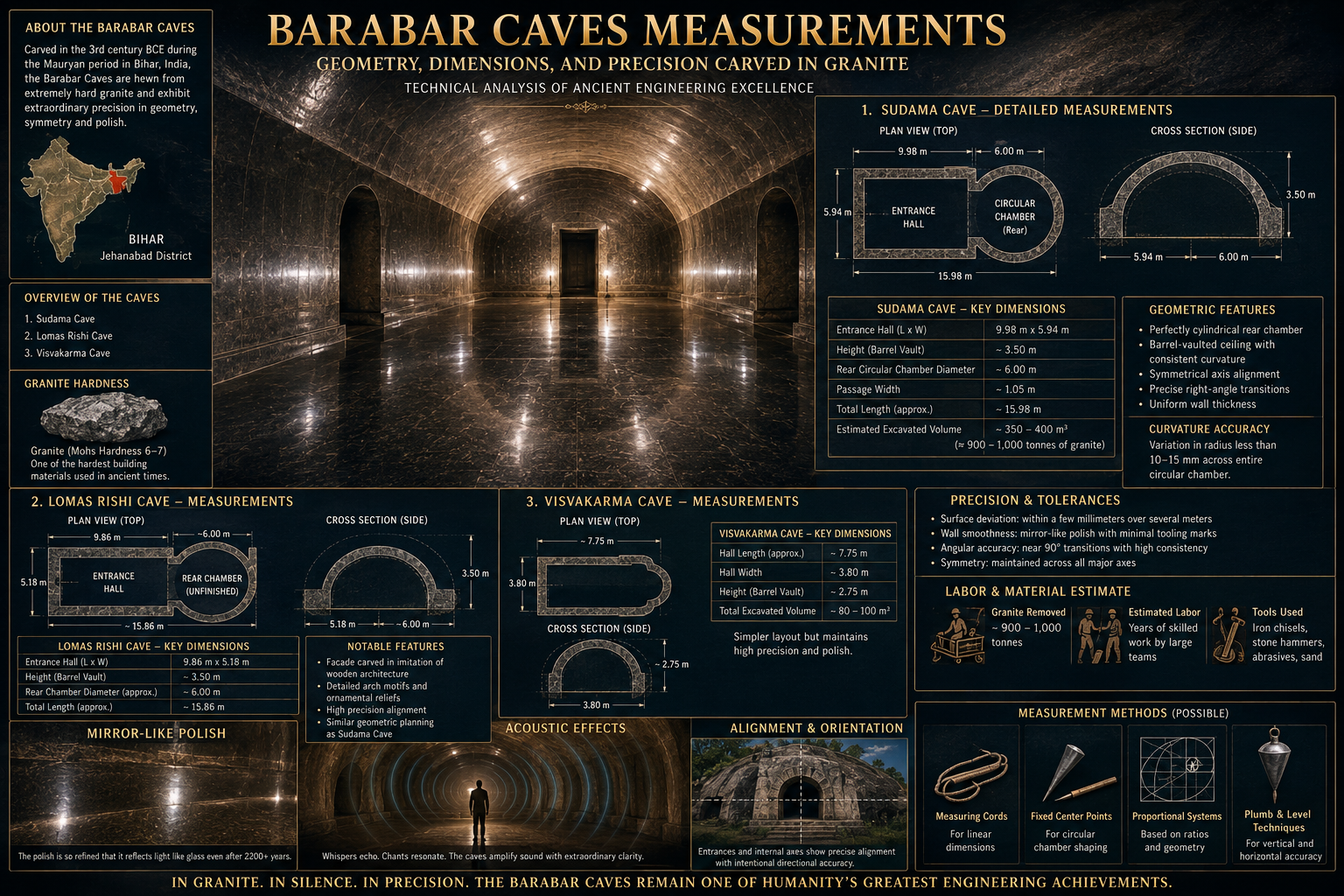
Sudama Cave Measurements (approximate)
- Entrance hall: ~9.98 meters long × ~5.94 meters wide
- Height: ~3.5 meters with barrel-vaulted ceiling
- Rear circular chamber diameter: ~6 meters
- Estimated wall curvature deviation: extremely minimal across the chamber
Lomas Rishi Cave Measurements (approximate)
- Entrance hall: ~9.86 meters long × ~5.18 meters wide
- Height: ~3.5 meters
- Rear chamber: unfinished but follows similar geometric ratios
- Entrance façade carved with advanced arch motifs imitating timber architecture
These measurements reveal proportional relationships repeated across multiple caves. Rectangular chambers transition into rounded forms with controlled symmetry, creating balanced spatial compositions that appear governed by ratios rather than improvisation. In modern architecture, such consistency would normally require layout grids, centerline references, and repeated verification measurements.
Particularly remarkable is the alignment between chambers. Internal passages connect spaces through carefully maintained central axes, minimizing asymmetry despite excavation occurring within irregular granite hills. Maintaining such alignment inside solid rock would have required constant orientation checks and probably the use of cords, plumb systems, marking pigments, or geometric reference points. The caves therefore suggest a highly organized engineering methodology rather than isolated artistic craftsmanship.
Geometric Consistency in Barabar Caves Measurements
One of the most astonishing aspects of Barabar Caves Measurements is the geometric consistency visible throughout the interiors. The circular chambers display curvature so controlled that many researchers compare them to mechanically generated forms. Even slight deviations in radius would become visually obvious across polished reflective surfaces, yet the chambers maintain remarkable continuity over large areas (Sacred Architecture and Cosmic Alignments article). Such consistency strongly suggests intentional geometric systems rather than rough shaping refined afterward.
Key geometric features include:
- near-perfect cylindrical and apsidal curvature
- consistent radii across circular chambers
- symmetrical alignment along central axes
- balanced ratios between length, width, and height
- smooth transitions between vertical walls and vaulted ceilings
The Sudama Cave’s rear chamber is especially significant because its geometry implies the use of a fixed central reference point during excavation. To maintain a constant radius in granite, workers would likely have needed pivot-based measuring systems similar to compasses, rotating cords, or template frameworks. Even modern stoneworkers rely heavily on reference systems when creating curved surfaces because small errors compound rapidly over distance.
The barrel-vaulted ceilings further reveal advanced spatial understanding. These ceilings are not random arches but carefully controlled curves maintaining continuity along the chamber length. Similar vaulting principles later became central to Roman and Islamic architecture, where geometric precision was essential for stability and aesthetics. The appearance of such forms in the Barabar Caves suggests ancient Indian builders possessed sophisticated intuitive or mathematical knowledge of curvature centuries before many comparable traditions emerged elsewhere.
This level of geometry also implies planning before excavation began. Removing stone is irreversible; mistakes inside granite are difficult to hide or repair. Therefore, the builders likely developed detailed conceptual layouts prior to carving, reflecting organized engineering traditions capable of translating abstract spatial concepts into physical stone with extraordinary precision.
Surface Precision and Tolerances
Barabar Caves Measurements extend beyond dimensions into the realm of surface tolerances and finishing accuracy. The polished granite walls reveal surprisingly low deviation across broad surfaces, creating reflective planes that amplify even minor irregularities. Because polished granite reflects light directly, imperfections become visually exaggerated, meaning the builders had to maintain unusually consistent shaping before final polishing could even begin (Lost Geometry: Did Ancients Inherit Science? article).
Estimated tolerances based on field observations include:
- surface deviation often within only a few millimeters across several meters
- nearly seamless transitions between adjoining surfaces
- highly uniform curvature throughout enclosed chambers
- minimal visible tool interruption beneath polished finishes
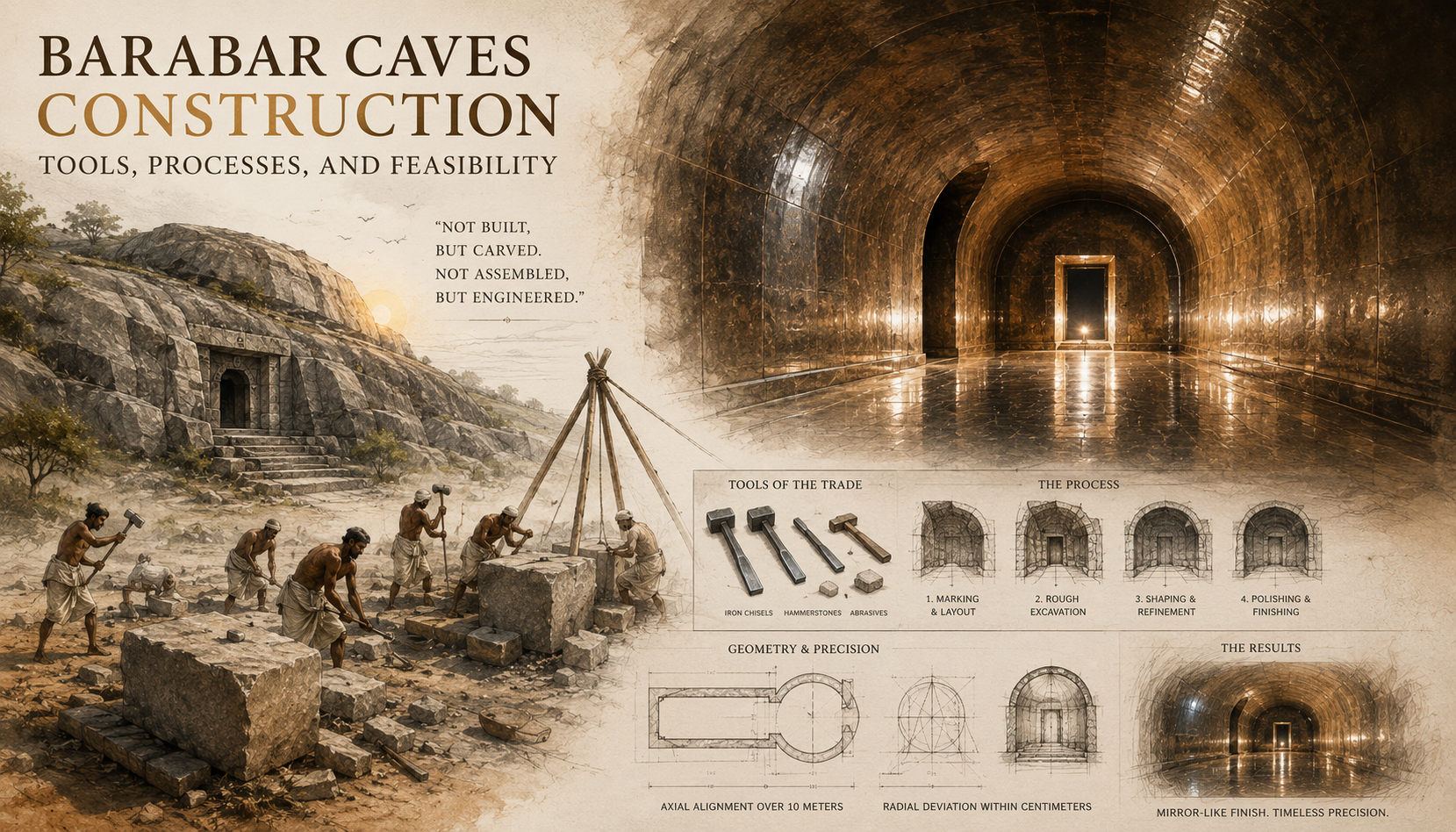
Achieving this precision in granite is an extraordinary technical accomplishment. Granite contains hard crystalline structures that fracture unpredictably under force, making controlled shaping difficult even with modern tools. Ancient builders would have needed progressive abrasion techniques involving hammering, grinding, smoothing, and polishing stages sustained over long periods. The consistency suggests a standardized workflow rather than random manual effort.
Modern experimental archaeology demonstrates that producing flat or curved polished granite surfaces manually requires repeated verification using straightedges, measuring cords, reflected light analysis, or tactile methods. The Barabar interiors imply that ancient craftsmen possessed practical systems capable of maintaining accuracy during excavation and finishing simultaneously. This may have involved master artisans supervising teams of specialists responsible for separate stages of shaping and polishing.
The reflective quality itself also contributes to the mystery. Some sections appear polished to a gloss level approaching modern stone-finishing standards. Such surfaces would require progressively finer abrasives and immense patience. The fact that this finish survives after more than two millennia demonstrates both the durability of the process and the extraordinary technical confidence of the builders.
Barabar Caves Measurements and Volume Excavation
Another critical aspect of Barabar Caves Measurements is the sheer volume of granite removed during excavation. When viewed externally, the caves may appear modest in scale, but internal measurements reveal massive labor demands requiring long-term organization and coordinated workforce management. Excavating granite is vastly more difficult than removing softer stone, meaning every cubic meter represented enormous physical effort (Ancient Energy Systems article).
Estimated Sudama Cave Excavation Volume
- Rectangular chamber: ~200–220 cubic meters
- Circular chamber: ~170 cubic meters
- Total excavation volume: ~350–400 cubic meters of granite
Given granite’s average density of approximately 2.7 tonnes per cubic meter, this means:
- Total stone removed: roughly 900–1,000 tonnes
To place this into perspective, removing and shaping 1,000 tonnes of granite without explosives, power tools, or mechanized hauling would require a highly organized labor system. Workers would need to coordinate excavation, debris removal, shaping, polishing, ventilation, lighting, and structural preservation simultaneously within confined spaces. Such projects likely extended across many years or even decades (Acoustic Engineering and Ancient Structures article).
This logistical complexity strongly suggests centralized authority and resource management. The Mauryan Empire possessed sophisticated administrative structures capable of mobilizing labor at large scales, similar to other ancient civilizations responsible for pyramids, aqueducts, and megalithic construction. The caves therefore reflect not only technical skill, but social organization powerful enough to sustain specialized engineering projects over long durations.
The precision maintained despite this excavation scale remains particularly remarkable. Large-volume excavation typically introduces cumulative alignment errors, uneven surfaces, and structural inconsistencies. Yet the Barabar Caves preserve controlled geometry throughout, implying continuous measurement verification during every stage of construction.
Alignment and Orientation
Barabar Caves Measurements also reveal deliberate orientation and axial alignment throughout the structures. Entrances, passages, and internal chambers maintain notable geometric consistency despite the irregular natural landscape surrounding them. This suggests orientation was planned intentionally rather than determined purely by convenience or geology.
Key observations include:
- entrances positioned along stable directional axes
- internal chambers aligned symmetrically
- central passage lines maintained consistently
- spatial transitions follow controlled linear geometry
- exterior façades integrated with interior orientation
Although definitive astronomical alignments remain debated, the precision of the internal axes strongly indicates systematic planning. Ancient civilizations worldwide frequently integrated architecture with celestial observation, seasonal cycles, or symbolic directional systems. Even when direct astronomical targeting was absent, orientation often carried ritual or cosmological significance (Stone Functional Materials article).
The Lomas Rishi façade demonstrates especially advanced architectural integration. Its carved arch replicates timber construction techniques in stone with striking proportional balance. This suggests ancient Indian builders were already translating complex architectural principles across materials while preserving visual harmony and structural coherence.
Orientation also mattered practically. Light penetration, airflow, thermal regulation, and ritual movement patterns could all be influenced by entrance placement and chamber geometry. The caves therefore likely balanced symbolic, environmental, and engineering considerations simultaneously—a hallmark of sophisticated ancient design traditions.
Measurement Systems Behind Barabar Caves Measurements
The extraordinary consistency observed in the Barabar Caves naturally raises the question of measurement systems. How did ancient builders maintain alignment, symmetry, and curvature inside enclosed granite spaces centuries before modern surveying instruments? While direct evidence of the tools themselves is limited, the measurable outcomes strongly imply the use of systematic spatial control methods.
Possible techniques may have included:
- measuring cords for linear distances
- plumb bobs for vertical alignment
- fixed center points for circular excavation
- geometric templates or guides
- ratio-based proportional systems
- repeated verification during shaping and polishing
Ancient India possessed advanced mathematical traditions long before many later civilizations formalized geometry in written form. Concepts involving proportion, spatial reasoning, and numerical systems were already deeply embedded within architecture, astronomy, ritual design, and urban planning. The builders of the Barabar Caves therefore operated within a broader intellectual culture capable of abstract mathematical thought and practical engineering application.
Maintaining symmetry inside granite chambers would require constant correction because excavation errors accumulate rapidly. Ancient craftsmen likely worked incrementally, repeatedly checking dimensions while refining surfaces over extended periods. This resembles modern precision manufacturing principles where verification is integrated continuously throughout production rather than only at completion.
The caves thus reveal something profoundly important: ancient engineering sophistication did not necessarily depend on advanced machines. Precision can emerge through disciplined systems, accumulated knowledge, and highly refined craftsmanship sustained across generations (Knowledge Loss Cycles and System Reset article).
Limits of Measurement Interpretation
Despite the extraordinary clarity provided by Barabar Caves Measurements, interpretation still requires caution. Time, erosion, weathering, seismic activity, and human interaction have altered portions of the caves over more than two thousand years. Modern measurements therefore represent approximations rather than exact reconstructions of the original geometry.
Several limitations remain important:
- erosion and surface wear over time
- incomplete preservation of original finishes
- absence of construction records
- uncertainty regarding original reference points
- potential restoration or damage in later periods
These limitations remind us that archaeology operates through partial evidence. It is easy either to underestimate ancient achievements or exaggerate them beyond available data. Responsible analysis requires balancing curiosity with measurable observation. The goal is not to invent impossible technologies, but to recognize the extraordinary capabilities ancient societies demonstrably possessed (Yuga Cycles and Mythological Time Systems article).
At the same time, the absence of complete evidence should not become an excuse for dismissing difficult questions. Many ancient technologies—including Roman concrete formulations, Damascus steel production, and certain megalithic transportation methods—remain only partially understood today despite extensive research. Lost techniques are historically normal, not exceptional.
The Barabar Caves therefore occupy an important middle ground: they are neither supernatural mysteries nor ordinary excavations. They are genuine engineering achievements whose precision continues to challenge modern assumptions about the ancient world.
Barabar Caves Measurements in a Broader Context
When placed within the broader context of ancient engineering, Barabar Caves Measurements align with patterns visible across numerous high-precision archaeological sites worldwide. Different civilizations separated by geography and culture repeatedly demonstrate sophisticated geometry, material control, and spatial planning despite lacking modern industrial technology.
Comparable patterns include:
- precision stone fitting in Incan architecture
- astronomical alignment at Göbekli Tepe
- acoustic engineering in Egyptian temples
- advanced hydraulic planning at Angkor
- geometric proportionality in Greek and Roman architecture
These parallels do not necessarily imply direct contact between civilizations. Instead, they suggest that ancient humans, through observation and experimentation over thousands of years, developed highly advanced practical systems adapted to their environments. Human intelligence did not suddenly appear in the modern era; it has existed throughout our species’ long history.
Modern archaeology increasingly reveals that ancient societies were often far more sophisticated than earlier historians assumed. Urban sanitation, metallurgy, astronomy, agriculture, mathematics, and architecture reached astonishing levels long before industrialization. The Barabar Caves fit within this broader pattern of underestimated ancient capability.
Given that humans have existed for roughly 300,000 years while recorded history spans only a tiny fraction of that timeline, it remains entirely possible that many traditions of engineering and craftsmanship have disappeared without leaving extensive documentation. Stone survives longer than memory, and structures like the Barabar Caves may therefore preserve traces of knowledge systems largely forgotten today (Climate History of the Last 40,000 Years article).
Conclusion
The Barabar Caves provide measurable evidence of extraordinary technical sophistication in the ancient world. Through geometry, spatial organization, polished granite finishing, volume excavation, and alignment precision, the caves demonstrate engineering control far beyond what is typically associated with ancient hand-carved structures. Their dimensions reveal not randomness, but disciplined planning rooted in mathematical consistency and material understanding.
The caves also illuminate the capabilities of the civilization that created them. Ancient India during the Mauryan era was not an isolated or primitive culture, but a highly organized society capable of coordinating labor, transmitting specialized knowledge, and sustaining technically demanding architectural projects over long periods. The Barabar Caves therefore stand as monuments not only to craftsmanship, but to intellectual systems sophisticated enough to merge geometry, engineering, acoustics, and symbolic architecture into unified designs.
While the exact construction methods remain partially uncertain, the measurable outcomes themselves are undeniable. Hundreds of cubic meters of granite were excavated and polished with astonishing accuracy using techniques that continue to provoke investigation today. These achievements challenge simplistic narratives of technological progress and remind us that ancient civilizations often possessed practical knowledge systems of remarkable sophistication.
Ultimately, the Barabar Caves are more than archaeological curiosities. They are surviving mathematical and architectural records carved into stone—evidence that ancient humans engaged with precision, proportion, and spatial mastery at levels still capable of inspiring wonder in the modern world (Axial Precession and the Great Year article).
References and Further Reading
A History of Ancient and Early Medieval India (link)
The Wonder That Was India (link)
Ancient Indian Architecture More Advanced Thank You Thought (link)
Seed of Knowledge, Stone of Plenty (link)
Academia.edu – Archaeological Survey of India documentation on the Barabar Caves (link)
ResearchGate studies on rock-cut architecture and ancient acoustics (link)
ResearchGate Mirror-Polished Granite Caves -Barabar Hills (link)
Ancient Hyper Forests and Giant Trees (link)
Pre Flood Civilization and Environmental Collapse (link)
Was the Ancient World Phisically Different? (link)
Giant Humans Before the Younger Dryas (link)
Ancient Construction Project Management (link)
Ice Age Civilization Lost Worlds Before Floods (link)
Lost Knowledge of Ice Age Rewritten History (link)
Ice Age Knowledge Science Before Younger Dryas (link)
Geometry and Earth Scaling (link)
How Ancient Builders Measured the Stars (link)