Barabar Caves: Precision Beyond Explanation
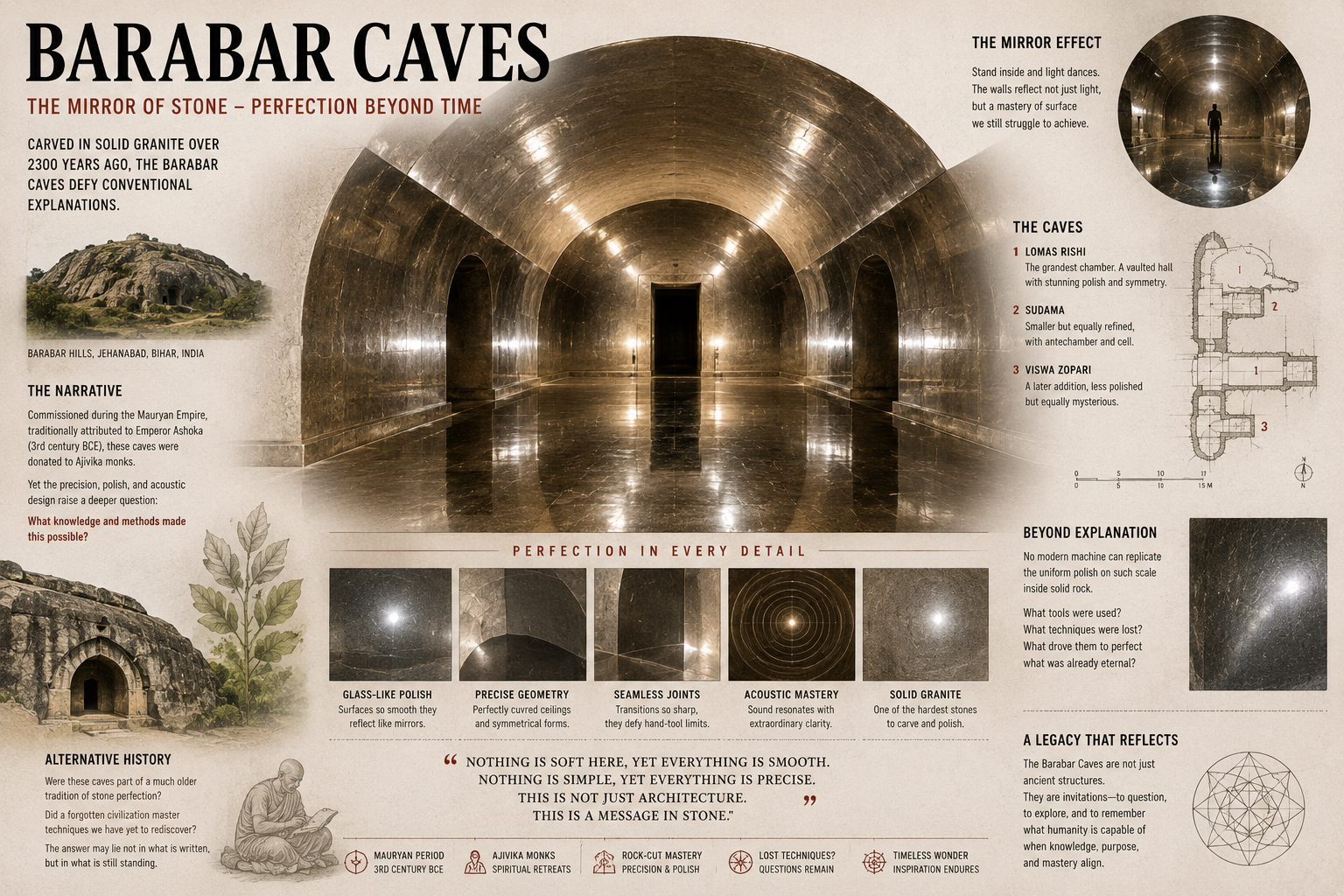
The Barabar Caves represent one of the most extraordinary achievements of ancient rock-cut engineering anywhere in the world. Carved directly into some of the hardest granite formations in India, these chambers display levels of precision, symmetry, and surface finishing that remain difficult to replicate even with many modern tools. Located in the Jehanabad district of Bihar and traditionally dated to the Mauryan period during the 3rd century BCE, the caves are often associated with the reign of Ashoka and his grandson Dasharatha. Yet despite this accepted chronology, the technical sophistication visible inside the caves continues to raise profound questions about the methods, labor systems, and engineering knowledge available at the time.
The most famous chambers, including the Sudama and Lomas Rishi caves, feature interiors cut with astonishing geometric consistency. The walls curve smoothly into barrel-vaulted ceilings, while the surfaces possess a reflective polish so refined that modern visitors frequently compare it to black glass or machine-finished stone. Granite ranks between 6 and 7 on the Mohs hardness scale, making it significantly more difficult to shape and polish than softer sedimentary stones such as limestone or sandstone. Achieving such uniform finishing across entire chambers would require not only immense labor but also a highly organized process involving measurement, planning, abrasion control, and likely generations of accumulated stone-working expertise.
What makes the Barabar Caves especially intriguing is that they emerge from a historical period already demonstrating signs of remarkable sophistication in mathematics, astronomy, metallurgy, urban planning, and philosophy. Ancient India during the Mauryan era governed one of the largest empires of the ancient world, spanning nearly 5 million square kilometers at its height. This was a civilization capable of coordinating massive infrastructure projects, trade networks, taxation systems, and monumental architecture long before modern industrial technologies existed. The caves therefore should not be viewed as isolated anomalies but as evidence of a highly organized and technically capable society whose achievements may still be underestimated today.
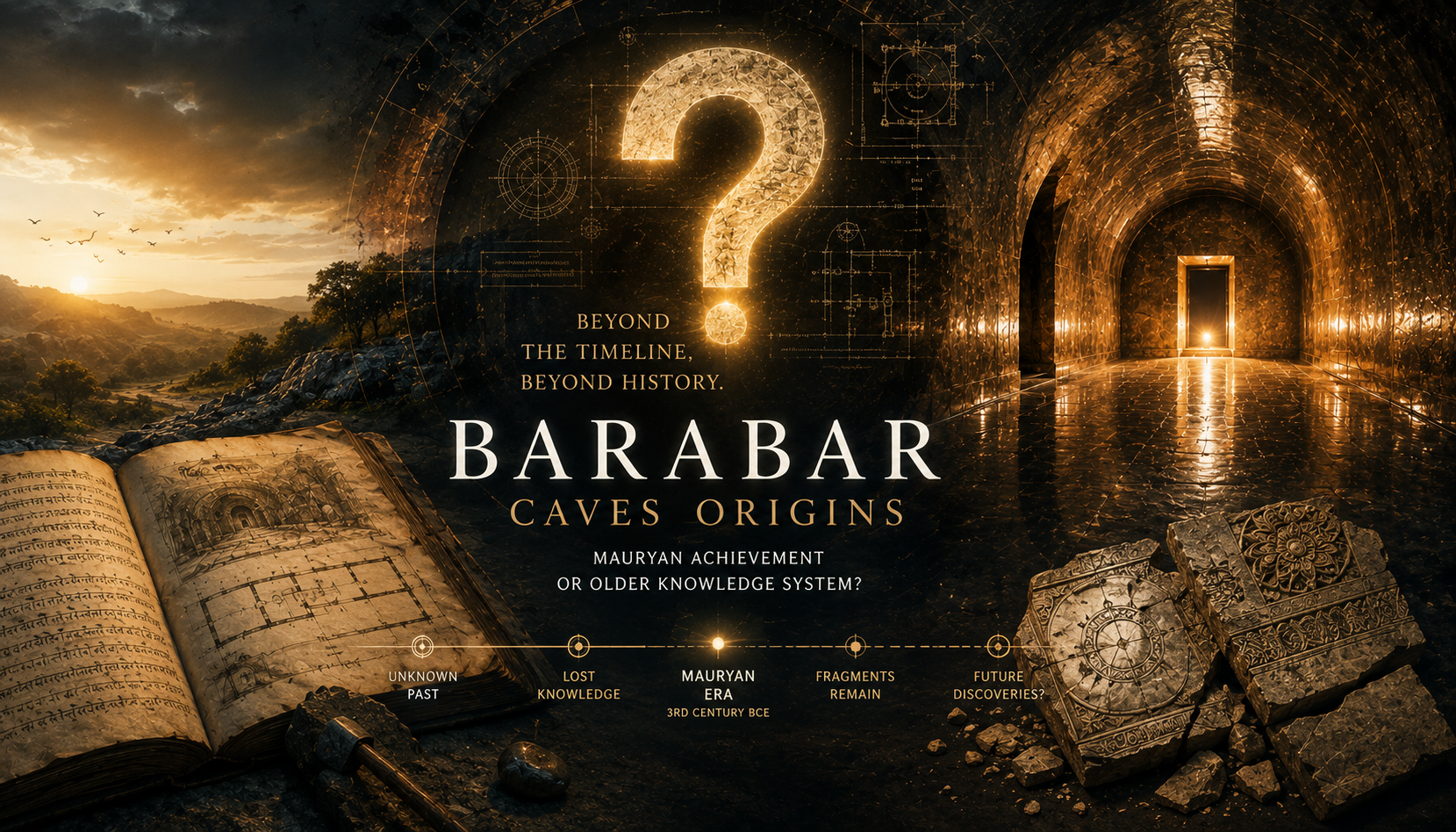
The deeper mystery lies not only in how the caves were made, but why such extraordinary effort was invested into them. Were they purely religious retreat spaces for the Ajivika sect, as mainstream archaeology suggests? Or do their precision, acoustics, and material treatment hint at broader knowledge systems now only partially understood? In a human timeline stretching back roughly 300,000 years, with written history representing only a tiny fraction of that span, the Barabar Caves may be one surviving fragment of a much larger and more complex story about ancient knowledge, experimentation, and cultural continuity (Climate History of the Last 40.000 Years article).
The Barabar Caves and Their Architectural Precision
The architectural precision of the Barabar Caves immediately distinguishes them from most ancient rock-cut structures. Unlike rough excavations or naturally expanded caverns, the interiors appear intentionally shaped according to strict geometric principles. The chambers feature near-perfect curvature, sharply defined transitions between surfaces, and layouts that maintain remarkable proportional consistency despite being carved entirely from solid granite. Such precision strongly implies advanced planning methods rather than improvised excavation.
The interiors display:
- perfectly curved walls and ceilings
- sharply defined geometric transitions
- symmetrical chamber proportions
- highly consistent surface leveling
- intentional alignment of entryways and interior axes
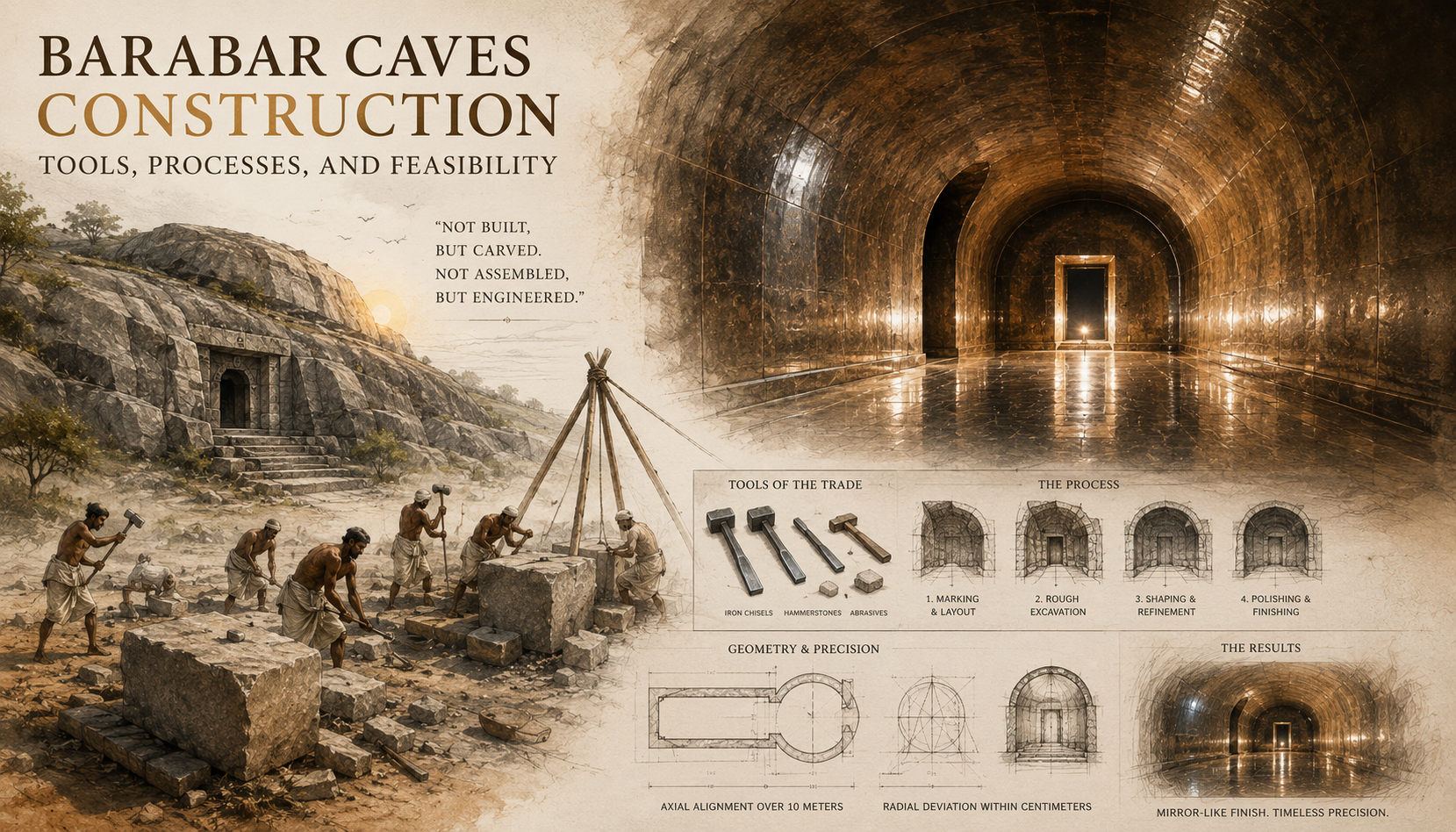
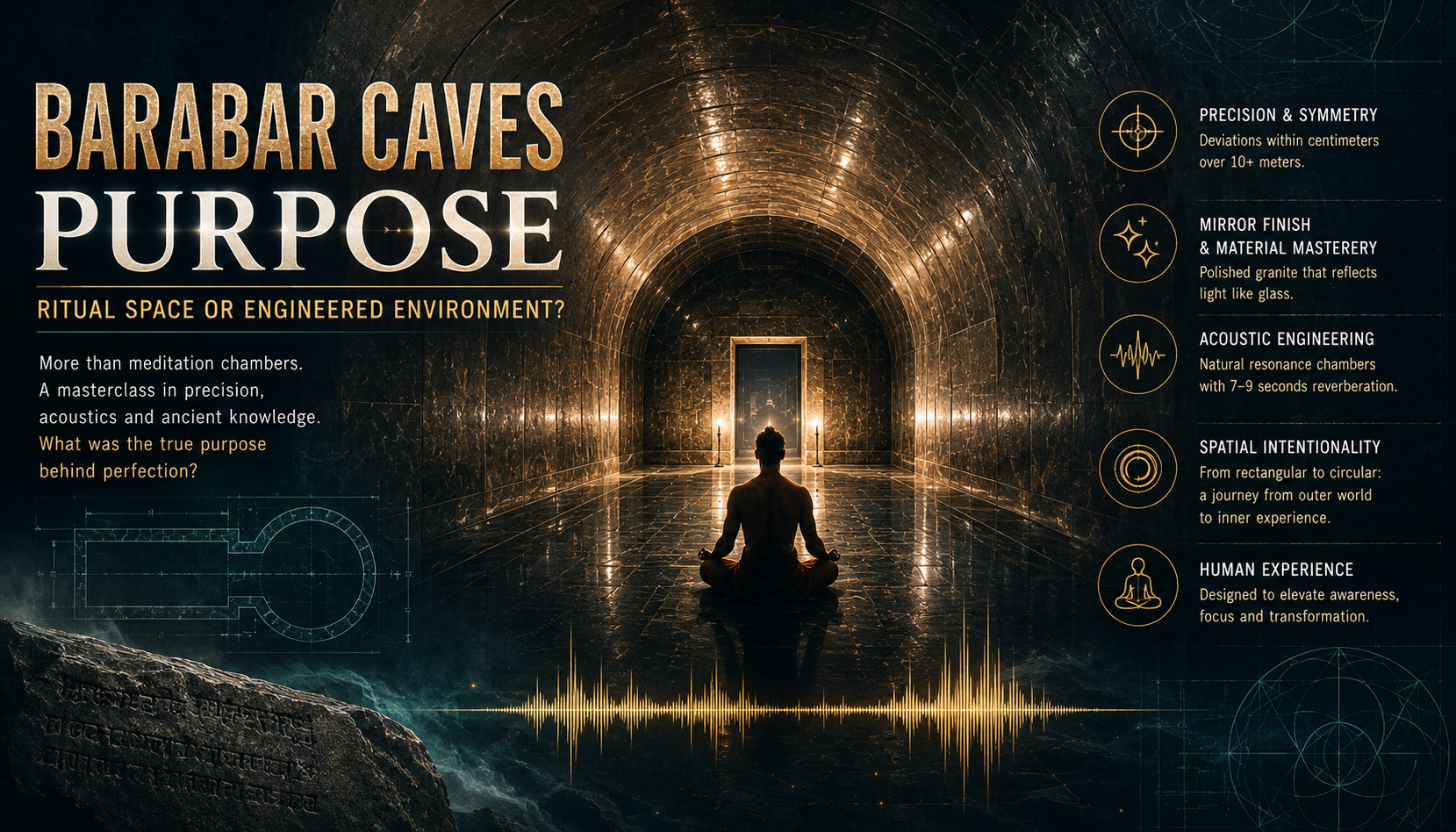
The Sudama Cave, for example, contains a circular rear chamber connected to a rectangular entrance hall through a carefully proportioned passageway. The dimensions and curvature suggest deliberate mathematical planning, likely involving measuring cords, geometric templates, or standardized construction ratios. The barrel-vaulted ceilings resemble later architectural forms found across India, raising questions about whether the caves influenced later structural traditions or inherited knowledge from even older systems now lost to time (Axial Precession and the Great Year article).
The Lomas Rishi Cave adds another remarkable feature: an exterior entrance carved in imitation of wooden architecture, complete with curved arch motifs and detailed relief patterns. This indicates that the builders were translating existing architectural traditions into stone with extraordinary confidence. Such imitation suggests a civilization already familiar with advanced structural aesthetics and capable of preserving design language across different materials.
Modern engineers studying ancient precision often note that achieving symmetry inside enclosed granite chambers is far more difficult than constructing above-ground monuments. Visibility is limited, errors are difficult to correct, and granite resists shaping tools aggressively. The consistency observed throughout the Barabar interiors therefore suggests disciplined craftsmanship supported by organized labor, careful measurement systems, and long-term technical specialization.
Mirror-Like Polishing in the Barabar Caves
Perhaps the most astonishing feature of the Barabar Caves is the mirror-like granite polishing covering the interior walls. Even today, after more than 2,200 years of weathering, many surfaces retain an extraordinary reflective quality. Light glides across the walls in a way that resembles polished obsidian or modern industrial finishing rather than hand-worked stone. Visitors often describe the chambers as visually unnatural because the surfaces appear too smooth and geometrically consistent to associate easily with ancient manual labor.
This level of polishing implies:
- extensive abrasive processing
- highly controlled surface refinement
- standardized finishing techniques
- advanced understanding of stone properties
- long-duration labor specialization
Granite is composed largely of quartz and feldspar crystals, materials extremely resistant to abrasion. Producing reflective finishes on granite today typically involves progressive grinding stages using increasingly fine abrasives such as quartz sand, emery, or diamond compounds. Ancient builders would likely have relied on combinations of sand, hematite, plant fibers, stone rubbers, and repetitive polishing techniques sustained over long periods. Yet the challenge remains immense: polishing entire chambers uniformly by hand would require extraordinary coordination and consistency (Yuga Cycles and Mythological Time Systems article).
The polish itself is commonly referred to by archaeologists as the “Mauryan polish,” a finishing technique visible on some pillars and sculptures from the same era. However, the Barabar interiors represent perhaps the most extreme surviving example. The consistency across curved ceilings and enclosed spaces suggests systematic methodology rather than artistic improvisation. Was there a guild of highly specialized polishers? Were water-assisted abrasives used? Did ancient Indian craftsmen possess techniques now forgotten or simplified over centuries of technological transition? These questions remain open.
The existence of such precision also challenges assumptions about ancient labor organization. The caves imply not merely craftsmanship, but institutional capability: trained workers, resource allocation, logistical planning, and leadership structures capable of sustaining long-term engineering projects. Sophisticated architecture does not emerge from isolated genius alone; it requires a civilization organized enough to support technical mastery across generations.
Acoustic Effects Inside the Barabar Caves
The acoustic properties of the Barabar Caves are among their most unusual and least understood characteristics. Due to the polished granite surfaces and enclosed geometry, sound reflects intensely within the chambers, producing prolonged echoes and resonant amplification. Even a whisper can generate reverberations lasting several seconds, while chanting or percussion creates immersive acoustic effects that dramatically alter human perception inside the space.
This behavior is influenced by:
- highly reflective polished surfaces
- curved chamber geometry
- confined interior dimensions
- absence of sound-absorbing materials
- resonance-enhancing architectural proportions
Researchers and visitors alike have observed that low-frequency vocal tones become especially powerful inside certain chambers. The smooth granite minimizes acoustic diffusion, causing sound waves to bounce repeatedly across the surfaces. In modern acoustics, such effects are carefully engineered in concert halls, meditation spaces, and resonance chambers. The possibility that ancient builders intentionally recognized and utilized these properties deserves serious consideration (Knowledge Loss Cycles and System Reset article).
The caves were historically associated with the Ajivikas, an ascetic philosophical sect contemporary with early Buddhism and Jainism. Ritual chanting, meditation, and oral transmission likely played central roles within these communities. In such contexts, acoustics may not have been incidental at all. Resonance could amplify collective rituals, induce altered states of awareness, or reinforce spiritual experiences through sensory immersion. Ancient cultures frequently integrated architecture with psychology, symbolism, and cosmology in ways modern analysis often separates artificially.
This raises broader questions found across many ancient sites worldwide. Why do so many sacred structures exhibit unusual acoustic behavior? From Egyptian temples to Mayan pyramids and Neolithic stone circles, resonance repeatedly appears in ritual architecture. Whether through experimentation or accumulated tradition, ancient societies may have understood that sound profoundly affects human consciousness and social cohesion.
Conventional Explanations and Their Limits
Mainstream archaeology attributes the Barabar Caves to highly skilled manual labor using iron chisels, hammerstones, abrasives, and sustained polishing methods. This explanation is entirely plausible and supported by evidence showing advanced metallurgy existed during the Mauryan period. Ancient India possessed sophisticated ironworking traditions, and Mauryan artisans clearly demonstrated exceptional craftsmanship in pillars, sculptures, and monumental construction. However, even within conventional explanations, important technical questions remain unresolved.
Several key questions continue to invite investigation:
- How was polishing maintained so uniformly across curved granite surfaces?
- What measuring systems ensured symmetrical excavation?
- How were errors corrected inside confined chambers?
- What organizational structure coordinated labor specialization?
- How long would each chamber realistically require to complete?
Experimental archaeology demonstrates that shaping granite manually is extraordinarily labor-intensive. Even with modern steel tools, achieving precision curvature and reflective polishing across entire chambers demands immense effort. Some researchers estimate that completing the caves may have required decades of continuous work involving teams of specialized laborers. This does not invalidate mainstream interpretations but instead highlights how technically ambitious the project truly was (Stone Functional Materials article).
Another important factor is the historical tendency to underestimate ancient societies. Modern culture often unconsciously assumes technological progress follows a simple linear path from primitive to advanced. Yet archaeological discoveries repeatedly reveal periods of lost sophistication, forgotten techniques, and regional knowledge systems that rival modern engineering in specific domains. Roman concrete, Damascus steel, Incan masonry, and Egyptian stone alignment all illustrate how technical mastery can emerge, disappear, and later be rediscovered imperfectly.
The Barabar Caves therefore should not be framed as impossible mysteries, but as reminders that ancient civilizations may have possessed highly refined practical knowledge rooted in observation, repetition, and long-term cultural continuity.
Alternative Perspectives on the Barabar Caves
Alternative interpretations of the Barabar Caves often emerge because their precision appears unexpectedly advanced for their accepted historical period. Some theories propose the use of lost techniques, advanced abrasives, or highly efficient organizational systems no longer fully understood today. Others suggest the caves preserve fragments of older architectural traditions inherited from civilizations whose histories have largely disappeared. While many speculative claims lack direct evidence, the broader conversation reflects a legitimate recognition that ancient human capabilities are frequently underestimated.
These perspectives generally propose that:
- ancient methods may have been more efficient than assumed
- specialized knowledge may have disappeared over time
- engineering traditions may have extended across generations
- sophisticated systems can exist without modern machinery
- historical narratives may omit large portions of human development
It is important to distinguish evidence-based curiosity from unsupported fantasy. There is currently no verified proof of advanced lost machines or impossible technologies at Barabar. However, there is strong evidence of exceptional craftsmanship, organized labor, mathematical planning, and advanced material understanding. Ancient societies often developed solutions uniquely adapted to their environments, resources, and cultural priorities. Their methods may seem unfamiliar precisely because they followed different technological pathways than industrial civilization (Reconstructing Lost Ancient Technology article).
The idea of “lost knowledge” is also historically realistic. Civilizations collapse, libraries burn, trade networks fragment, and specialized skills vanish when political systems fail. The Bronze Age collapse erased entire writing systems and disrupted technological continuity across the Mediterranean. Similarly, many ancient Indian scientific and architectural traditions survive only in fragmented texts or oral transmission. What appears mysterious today may once have been part of widely understood technical traditions now partially forgotten.
Viewed in this light, the Barabar Caves become less a supernatural anomaly and more a surviving window into the capabilities of ancient human societies operating at remarkably sophisticated levels of coordination and craftsmanship.
Barabar Caves in the Context of Lost Systems
When considered within the broader framework of ancient systems thinking, the Barabar Caves may represent more than isolated architectural achievements. Their geometry, acoustics, polishing, and environmental integration suggest a civilization capable of combining multiple domains of knowledge into unified construction practices. Ancient societies often did not separate engineering, spirituality, mathematics, and natural philosophy the way modern disciplines do. Instead, architecture frequently operated as an intersection of all these fields simultaneously.
The caves suggest:
- integration of material science and architecture
- advanced understanding of granite behavior
- precise shaping and finishing systems
- deliberate acoustic engineering
- long-term transmission of technical knowledge
This systems-based perspective becomes even more compelling when viewed alongside other ancient achievements across the world. The precision stonework of the Inca, the astronomical alignments of Göbekli Tepe, the hydraulic sophistication of Angkor, and the acoustic properties of Egyptian temples all reveal cultures deeply engaged with geometry, environment, and sensory experience. While these civilizations developed independently, they share a common pattern: sophisticated understanding achieved through observation, experimentation, and intergenerational continuity (Acoustic Engineering Ancient Structures article).
The larger historical question is how much human knowledge has disappeared over time. Rising sea levels after the last Ice Age submerged vast coastal regions where early civilizations likely concentrated. Earthquakes, erosion, volcanic eruptions, warfare, and climate transitions erase evidence continuously. Given that modern humans have existed for roughly 300,000 years while recorded history covers only a small fraction of that span, it is entirely possible that major chapters of technological and cultural development have been lost.
The Barabar Caves therefore stand not only as monuments of ancient India, but as reminders of humanity’s fragile relationship with memory itself. Civilizations rise, refine knowledge, collapse, and are forgotten, while stone occasionally preserves fragments of what written history no longer remembers.
Conclusion
The Barabar Caves remain among the most extraordinary examples of ancient precision engineering ever discovered. Their mirror-like granite polishing, geometric consistency, acoustic resonance, and technical refinement reveal a level of craftsmanship that continues to challenge assumptions about the ancient world. Far from primitive excavations, these chambers demonstrate advanced planning, material knowledge, labor organization, and architectural sophistication operating at remarkable levels more than two millennia ago.
Conventional archaeology provides credible foundations for understanding how the caves may have been created, yet many technical details remain difficult to fully reconstruct. The immense labor required, the precision achieved within hard granite, and the consistency of the finishing all suggest a civilization possessing highly refined methods developed over generations. Whether these techniques were widespread or highly specialized, they reveal ancient India as a center of intellectual and technical achievement far beyond simplistic historical stereotypes.
At the same time, the Barabar Caves encourage broader reflection about humanity’s forgotten past. With most of human existence undocumented and countless settlements lost to geological and climatic change, surviving structures like these may represent only fragments of much larger systems of knowledge. Myths, oral traditions, sacred architecture, and anomalous engineering achievements together hint at a deeper historical complexity still only partially understood.
Ultimately, the Barabar Caves remind us that ancient civilizations were not merely surviving the natural world—they were studying it, shaping it, and embedding meaning into stone with extraordinary precision. Their work continues to echo across time, inviting modern observers to reconsider both the sophistication of the past and the fragility of human knowledge itself.
References and Further Reading
A History of Ancient and Early Medieval India (link)
The Wonder That Was India (link)
Ancient Indian Architecture More Advanced Thank You Thought (link)
Seed of Knowledge, Stone of Plenty (link)
Academia.edu – Archaeological Survey of India documentation on the Barabar Caves (link)
ResearchGate studies on rock-cut architecture and ancient acoustics (link)
ResearchGate Mirror-Polished Granite Caves -Barabar Hills (link)
Ancient Hyper Forests and Giant Trees (link)
Pre Flood Civilization and Environmental Collapse (link)
Was the Ancient World Phisically Different? (link)
Giant Humans Before the Younger Dryas (link)
Ancient Construction Project Management (link)
Ice Age Civilization Lost Worlds Before Floods (link)
Lost Knowledge of Ice Age Rewritten History (link)
Ice Age Knowledge Science Before Younger Dryas (link)
Geometry and Earth Scaling (link)
How Ancient Builders Measured the Stars (link)