What Are Archimedean Solids?
Archimedean solids are a special set of 13 convex polyhedra that have highly symmetrical arrangements of two or more types of regular polygons at each vertex. Unlike Platonic solids, which use only one type of polygon, Archimedean solids combine different polygons while maintaining equal edge lengths. In addition to their geometric beauty, these solids have fascinated philosophers, mathematicians, and mystics for centuries for their perceived connection to the harmonic structure of the universe.
These solids reflect not only mathematical perfection but also the cosmic order observed in nature, from crystal formations to molecular structures, echoing the principles seen in sacred geometry and Platonic solids.
Historical Background of Archimedean Solids
Named after the ancient Greek mathematician Archimedes, these solids were first described in antiquity, though much of his original work was lost. Knowledge of Archimedean solids survived through later writers such as Pappus of Alexandria. During the Renaissance, scholars rediscovered these forms, and in 1619, Johannes Kepler reconstructed the complete set of 13 and gave them Latin names.
The Archimedean solids are closely linked to the Platonic solids, with several Archimedean forms being created through truncation or expansion of Platonic shapes. This geometric lineage demonstrates the continuity between mathematics, architecture, and cosmic symbolism.
The 13 Archimedean Solids
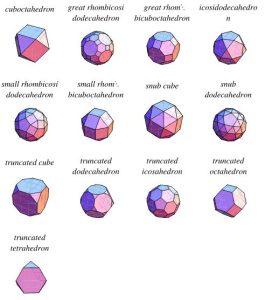
Here are the 13 Archimedean solids, along with brief descriptions and symbolic associations:
-
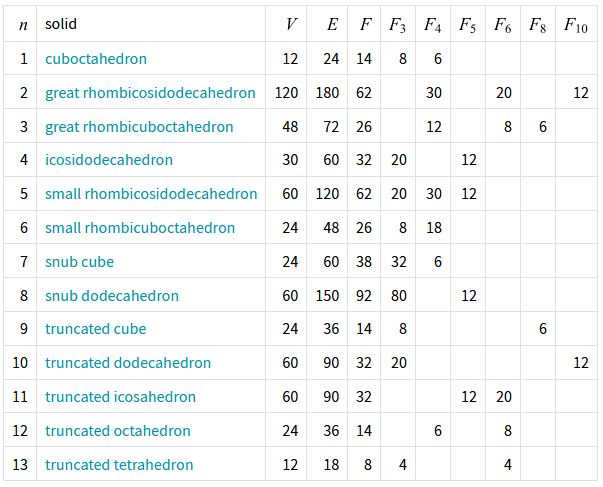
Cuboctahedron – 8 triangles + 6 squares; symbolizes balance and harmony.
-
Icosidodecahedron – 20 triangles + 12 pentagons; represents unity and cosmic order.
-
Truncated Cube – 8 triangles + 6 octagons; often linked to transformation.
-
Truncated Dodecahedron – 12 decagons + 20 triangles; reflects expansion and wholeness.
-
Truncated Octahedron – 8 hexagons + 6 squares; symbolizes integration of dualities.
-
Truncated Icosahedron – 12 pentagons + 20 hexagons; associated with geodesic structures and harmony.
-
Truncated Tetrahedron – 4 hexagons + 4 triangles; signifies growth and spiritual ascension.
-
Small Rhombicosidodecahedron – 20 triangles + 30 squares + 12 pentagons; conveys structural perfection.
-
Small Rhombicuboctahedron – 8 triangles + 18 squares; symbolizes foundational stability.
-
Great Rhombicosidodecahedron – 20 triangles + 30 squares + 12 decagons; embodies cosmic complexity.
-
Great Rhombicuboctahedron – 12 squares + 8 hexagons + 6 octagons; reflects dynamic equilibrium.
-
Snub Cube – 32 triangles + 6 squares; represents duality and motion.
-
Snub Dodecahedron – 80 triangles + 12 pentagons; associated with evolution and transformation.
Note: Each solid maintains symmetry at all vertices, reflecting the universal principle “as above, so below” in sacred geometry.
Geometric Properties and Symmetry
Archimedean solids exhibit vertex-transitivity, meaning all vertices are identical in structure, and their edges are all equal in length. This high degree of symmetry makes them ideal for studying geometric harmony in natural forms and architecture.
| Solid | Faces | Vertices | Edges | Symbolic Meaning |
|---|---|---|---|---|
| Cuboctahedron | 14 | 12 | 24 | Balance |
| Icosidodecahedron | 32 | 30 | 60 | Unity |
| Truncated Cube | 14 | 24 | 36 | Transformation |
| Truncated Dodecahedron | 32 | 60 | 90 | Wholeness |
| Truncated Icosahedron | 32 | 60 | 90 | Harmony |
| Snub Dodecahedron | 92 | 60 | 150 | Evolution |
Archimedean Solids in Nature and Sacred Geometry
Archimedean solids are not just mathematical curiosities—they appear in sacred architecture, art, and nature.
-
Architecture: Geodesic domes, temple structures, and pyramid designs often use truncated forms to achieve stability and energy flow.
-
Nature: Molecular structures, viruses (like the icosahedral virus), and crystal lattices mirror these geometric patterns.
-
Sacred Geometry: These solids resonate with the principles of the Flower of Life and Platonic solids, reflecting cosmic harmony and energy alignment.
Many mystics believe studying these shapes enhances spiritual awareness and offers a deeper understanding of the energetic blueprint of the cosmos.
Further Reading and References
-
Cromwell, P. Polyhedra. Cambridge University Press, 1997.
-
Ball, W.W.R., Coxeter, H.S.M. Mathematical Recreations and Essays, 13th ed., Dover, 1987.
Internal: Platonic Solids, Flower of Life, Sacred Geometry
Outbound: Wolfram MathWorld, Cambridge Geometry Resources


References
__________________________________________________________________________________
- Ball, W. W. R. and Coxeter, H. S. M. Mathematical Recreations and Essays, 13th ed. New York: Dover, p. 136, 1987.
- Coxeter, H. S. M. “The Pure Archimedean Polytopes in Six and Seven Dimensions.” Proc. Cambridge Phil. Soc. 24, 1-9, 1928.
- Coxeter, H. S. M. “Regular and Semi-Regular Polytopes I.” Math. Z. 46, 380-407, 1940.
- Coxeter, H. S. M. §2.9 in Regular Polytopes, 3rd ed. “Historical Remarks.” New York: Dover, pp. 30-32, 1973.
- Coxeter, H. S. M.; Longuet-Higgins, M. S.; and Miller, J. C. P. “Uniform Polyhedra.” Phil. Trans. Roy. Soc. London Ser. A 246, 401-450, 1954
- Stott, A. B. “Geometrical Deduction of Semiregular from Regular Polytopes and Space Fillings.” Verhandelingen der Koninklijke Akad. Wetenschappen Amsterdam 11, 3-24, 1910.
- Cromwell, P. R. New York: Cambridge University Press, pp. 79-86, 1997.
- Weisstein, Eric W. “Archimedean Solid.” From MathWorld–A Wolfram Web Resource. https://mathworld.wolfram.com/ArchimedeanSolid.html.
- Geometry Technologies. “The 5 Platonic Solids and the 13 Archimedean Solids.” http://www.scienceu.com/geometry/facts/solids/.
- Holden, A. Shapes, Space, and Symmetry. New York: Dover, p. 54, 1991.
- Pearce, P. Structure in Nature Is a Strategy for Design. Cambridge, MA: MIT Press, pp. 34-35, 1978.
- Pugh, A. Polyhedra: A Visual Approach. Berkeley: University of California Press, p. 25, 1976.
- Geometry Technologies. “The 5 Platonic Solids and the 13 Archimedean Solids.” http://www.scienceu.com/geometry/facts/solids/.