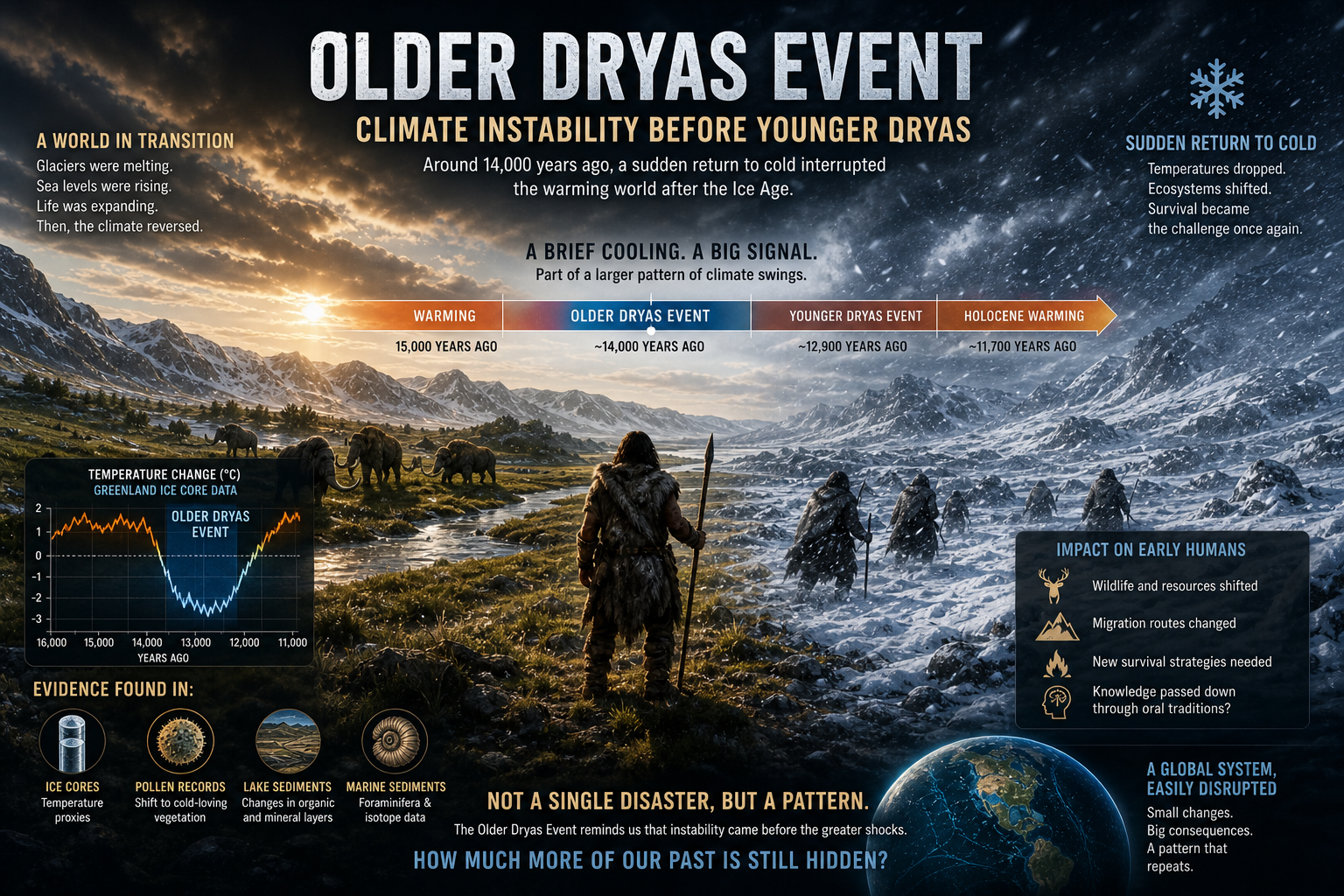
The Older Dryas Event marks an early phase of climate instability during the end of the last Ice Age, interrupting a broader warming trend around 14,000 years ago (Younger Dryas Event and Abrupt Climate Reversal link). The Older Dryas Event demonstrates that Earth’s climate system was not stabilizing as temperatures rose, but instead oscillating between warmer and colder conditions. When placed within the wider timeline of human existence—now understood to extend far beyond 300,000 years—the Older Dryas Event raises a critical question: if early humans lived through repeated climate disruptions, what evidence of their adaptation, knowledge, or continuity may have been lost or remains unrecognized?
The Older Dryas Event in Climate History
The Older Dryas Event occurred during a transitional period when glaciers were retreating and global temperatures were increasing following the Last Glacial Maximum. However, this warming phase was not linear. The Older Dryas Event introduced a sudden return to colder conditions, revealing that the Earth system was already unstable.
This instability suggests that climate change during this period operated through thresholds and feedback mechanisms rather than gradual progression. The Older Dryas Event therefore represents not an isolated occurrence but part of a sequence of oscillations that would later culminate in the more pronounced Younger Dryas (Climate History of the Last 40,000 Years link).
Evidence Supporting the Older Dryas Event
The existence of the Older Dryas Event is supported by ice core data and terrestrial records. Greenland ice cores show a clear temperature decline following an initial warming, while European pollen sequences indicate a temporary return to cold-adapted vegetation.
These independent datasets suggest that the Older Dryas Event was not limited to a single region, although its global extent remains less clearly defined than later climatic disruptions. This relative subtlety may explain why the Older Dryas Event is less prominent in mainstream narratives, despite its importance in understanding overall climate behavior.
Shorter or less intense events are often underrepresented, yet they can provide essential insight into how climate systems operate under stress.
Climate Mechanisms Behind the Older Dryas Event
The Older Dryas Event likely reflects a climate system operating near critical thresholds. As ice sheets melted, large volumes of freshwater entered the oceans, potentially disrupting circulation patterns responsible for distributing heat across the planet (Axial Precession and the Great Year link).
Even modest disturbances in these systems could have triggered cooling phases. This indicates that the Earth’s climate during this period was highly sensitive, capable of rapid and repeated shifts.
The significance of the Older Dryas Event lies in this sensitivity. It shows that instability was already present, setting the stage for larger disruptions that would follow.
Human Survival During the Older Dryas Event
By the time of the Older Dryas Event, modern humans were already widely distributed across Eurasia and other regions (Tracing the First Humans link). These populations were adaptive and mobile, capable of responding to environmental change. However, the cooling associated with the Older Dryas Event would have created immediate pressures:
- shifting ecosystems and food sources
- changes in migration routes
- increased environmental stress
If such conditions occurred repeatedly, as the climate record suggests, then human survival depended on continuous adaptation rather than isolated responses. This raises a broader perspective: early humans may have developed knowledge systems—practical or observational—that helped them navigate recurring instability (Submerged Words: Civilizations Beneath the Sea link).
The absence of clear evidence for such systems does not necessarily imply their absence, but may reflect the difficulty of preserving knowledge across long periods marked by environmental disruption (Milankovitch Cycles and Climate Forcing link).
The Older Dryas Event as a Precursor to Larger Disruptions
The Older Dryas Event can be understood as an early signal within a broader pattern of climate instability. It precedes the Younger Dryas and occurs within a sequence of oscillations that characterize the end of the Ice Age.
Rather than viewing the Younger Dryas as an isolated catastrophe, the presence of the Older Dryas Event suggests a system already under stress. Smaller fluctuations may have preceded larger shifts, indicating a cumulative process rather than a single episode.
For human populations, this distinction is significant. Repeated disruptions, even if individually moderate, may have had a profound cumulative impact on settlement patterns, cultural continuity, and knowledge transmission (Cycles of Time: Geometry and Civilization link).
Rethinking the Archaeological Record
The Older Dryas Event also highlights limitations in how early human history is reconstructed. Climate events of shorter duration may leave limited archaeological traces, particularly if they do not align with major cultural transitions emphasized in current models (Ancient Megaflods and Lost Civilizations link). However, several factors complicate the picture:
- coastal settlements from this period may now be submerged due to rising sea levels
- glacial activity and erosion may have destroyed earlier evidence
- large regions remain underexplored
If the Older Dryas Event represents just one of several disruptions experienced by early humans, then it is reasonable to consider that parts of human history may not yet be fully visible in the available record. This does not require abandoning established archaeology, but it does suggest that the current narrative may be incomplete (Did Ancients Inherit Science? link).
Conclusion
The Older Dryas Event reveals that the end of the last Ice Age was marked by instability rather than steady warming. As an early interruption in this transition, the Older Dryas Event provides insight into a climate system capable of rapid change and repeated oscillation. When considered alongside the long timeline of human existence, it raises important questions about adaptation, resilience, and the potential loss of knowledge across multiple environmental disruptions. Rather than a minor fluctuation, the Older Dryas Event can be seen as part of a larger pattern—one that invites deeper investigation into the relationship between Earth’s changing climate and the enduring yet partially hidden story of humanity (Lost Lineages in our DNA link).