Younger Dryas Event and Abrupt Climate Reversal
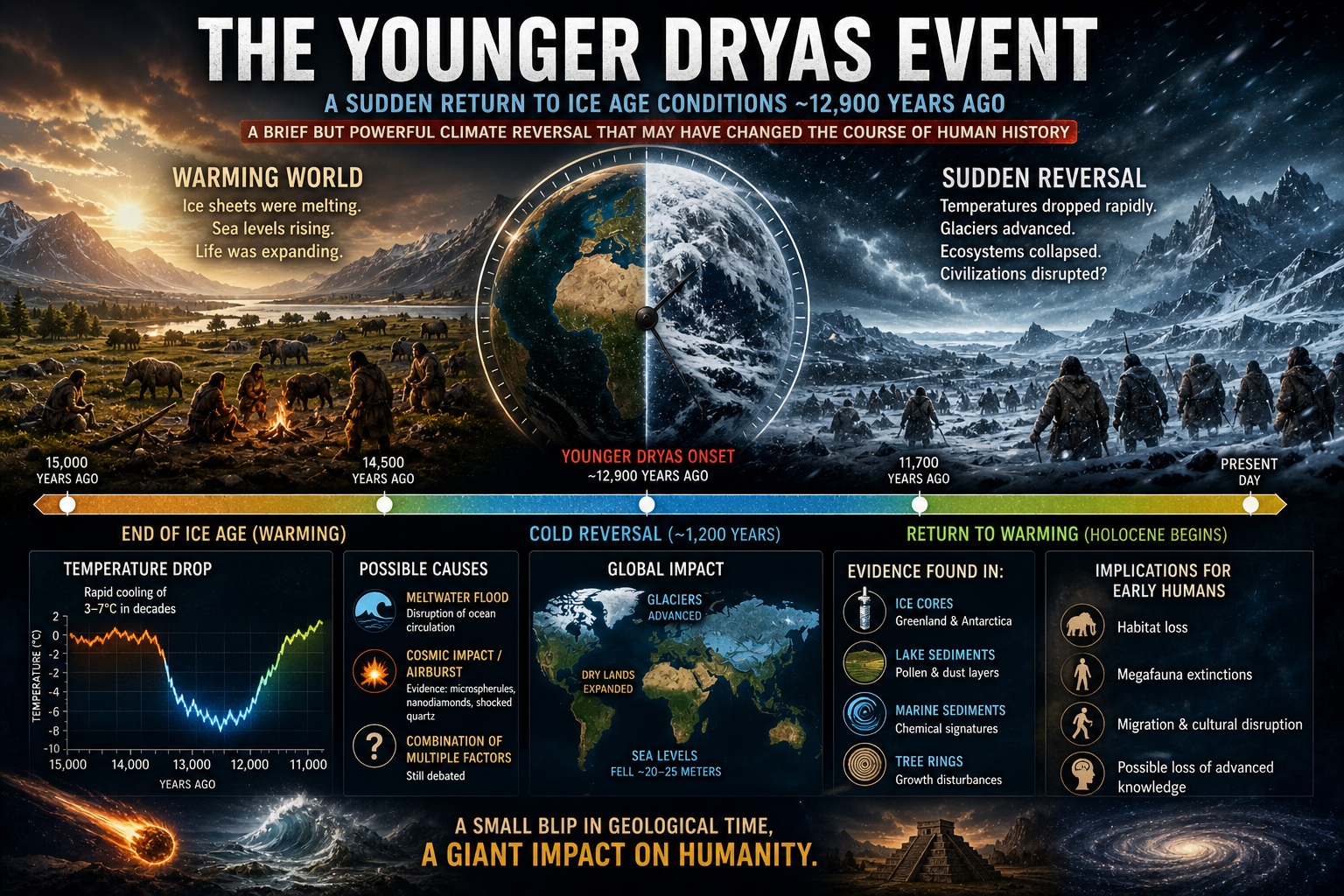
The Younger Dryas Event stands as one of the most abrupt and puzzling climate episodes in the Climate History of the Last 40,000 Years, marking a sudden return to near-glacial conditions at a time when the Earth was emerging from the last Ice Age. Occurring approximately 12,900 years ago, this event interrupts what would otherwise appear to be a steady warming trend, suggesting that Earth’s climate system is capable of rapid reversals even after long periods of stabilization. When considered alongside the presence of human populations across multiple continents, the Younger Dryas Event raises important questions about how such a sudden environmental shift may have affected early societies, and whether traces of those disruptions persist in archaeological records or cultural memory (Cliamte History of the Last 40,000 Years link).
A Sudden Climate Reversal
At the end of the last glacial maximum, temperatures were rising, ice sheets were retreating, and ecosystems were gradually shifting toward conditions more similar to those of today. Then, within a relatively short period—possibly decades—the trend reversed. Temperatures in parts of the Northern Hemisphere dropped sharply, returning to conditions resembling those of the Ice Age.
This cooling phase lasted for roughly 1,200 years before warming resumed just as abruptly. Evidence from ice cores, lake sediments, and pollen records confirms that the Younger Dryas Event was not a localized anomaly but a widespread climatic shift affecting large regions of the planet.
What makes this event particularly significant is its speed. The transition into colder conditions appears to have occurred far more rapidly than traditional gradual climate models would predict, reinforcing the idea that Earth’s systems can cross thresholds and reorganize quickly (Axial Precession and the Great Year link).
Competing Explanations
Despite extensive study, the exact cause of the Younger Dryas Event remains debated. As a consequence of a likely possible meteor strike or meteror showers, airbusts, or solar flames, two primary explanations dominate current discussions:
- One hypothesis focuses on ocean circulation, glaciers melted, large volumes of freshwater may have entered the North Atlantic, disrupting the flow of warm water carried by ocean currents. This disruption could have reduced heat transport to northern regions, triggering rapid cooling.
- Another hypothesis suggests a more sudden external trigger, such as a cosmic impact or airburst event. Some researchers point to layers of unusual materials—such as microspherules and elevated levels of certain elements—as possible indicators of such an event. However, this interpretation remains controversial, and consensus has not been reached.
Both explanations highlight a broader point: the Younger Dryas Event does not fit neatly into a single, universally accepted model. Instead, it represents a complex interaction of factors, some of which may not yet be fully understood (Milankovitch Cycles and Climate Forcing link).
Environmental and Ecological Consequences
The return to colder conditions would have had immediate effects on ecosystems. Vegetation zones shifted, animal populations were disrupted, and water availability changed across regions. In North America, the period coincides with the decline of large megafauna, although the extent to which climate versus human activity contributed to these extinctions remains under discussion.
For human populations, the implications would have been equally significant. Communities adapted to warming conditions would suddenly face colder environments, reduced resources, and shifting landscapes. Migration patterns may have been altered, and previously viable regions may have become difficult to inhabit.
This suggests that the Younger Dryas Event was not only a climatic event but also a potential turning point in human development (Pre-Flood Civilizations and Environmental Collapse link).
Implications for Early Human Societies
The Younger Dryas Event occurs near the transition between the Pleistocene and the Holocene, a period often associated with the beginnings of agriculture and more settled forms of life. However, the presence of such a dramatic climate reversal complicates this narrative.
If early human groups were already experimenting with semi-sedentary lifestyles, a sudden return to colder conditions could have disrupted these developments. Alternatively, the stress imposed by environmental instability may have accelerated innovation and adaptation.
There is also a broader question that extends beyond immediate survival. If human populations had already existed for tens of thousands of years prior to this event, then the Younger Dryas Event would represent just one of several major disruptions they experienced. This raises the possibility that earlier cultural or technological developments may have been interrupted or lost, leaving only partial traces in the archaeological record (Ancient Solar and Lunar Calendars link).
Cultural Memory and the Possibility of Encoded Events
One of the more intriguing aspects of the Younger Dryas Event is its potential connection to widespread myths describing sudden catastrophes, floods, or dramatic environmental change. While such narratives are often interpreted symbolically, their global distribution invites consideration of whether they might preserve distant memories of real incidents.
This perspective does not assert a direct link between specific myths and the Younger Dryas Event, but it suggests that repeated exposure to abrupt climate shifts could have influenced how ancient cultures understood and described their world. Stories of destruction and renewal may reflect a long-term pattern of environmental instability rather than isolated imaginative constructs.
Conclusion
The Younger Dryas Event illustrates how quickly Earth’s climate can shift, even during periods that appear to be moving toward stability. Its abrupt onset, uncertain causes, and wide-ranging effects make it a key point in understanding both environmental systems and human history. When viewed within the broader context of long-term human existence, it raises important questions about continuity, adaptation, and the potential loss of knowledge across repeated cycles of disruption. Rather than offering definitive answers, the Younger Dryas Event encourages continued investigation into the relationship between climate, human kind, and the deeper layers of history that may still remain partially hidden (Lost Knowledge of the Ancients link).
References and Further Reading
Richard B. Alley, The Two-Mile Time Machine (link)
Wallace S. Broecker, The Great Ocean Conveyor (link)
EPICA Community Members, Eight glacial cycles from an Antarctic ice core (link)
EPICA Ice Core Project (European Project for Ice Coring in Antarctica) (link)
NASA Earth Observatory – Paleoclimate Data and Ice Core Studies
Richard B. Alley, The Two-Mile Time Machine (link)
Wallace S. Broecker, The Great Ocean Conveyor (link)
ResearchGate – Studies on Dansgaard–Oeschger events and paleoclimate variability
Ancient Energy Systems: Myth or Technology? (link)
Ancient Hyper Forests and Giant Trees (link)
Pre Flood Civilization and Environmental Collapse (link)
Was the Ancient World Phisically Different? (link)
Giant Humans Before the Younger Dryas (link)
Ancient Construction Project Management (link)
Ice Age Civilization Lost Worlds Before Floods (link)
Lost Knowledge of Ice Age Rewritten History (link)
Ice Age Knowledge Science Before Younger Dryas (link)
National Snow and Ice Data Center (NSIDC) – Younger Dryas research (link)