Black Sea Deluge: Rapid Sea-Level Rise Event
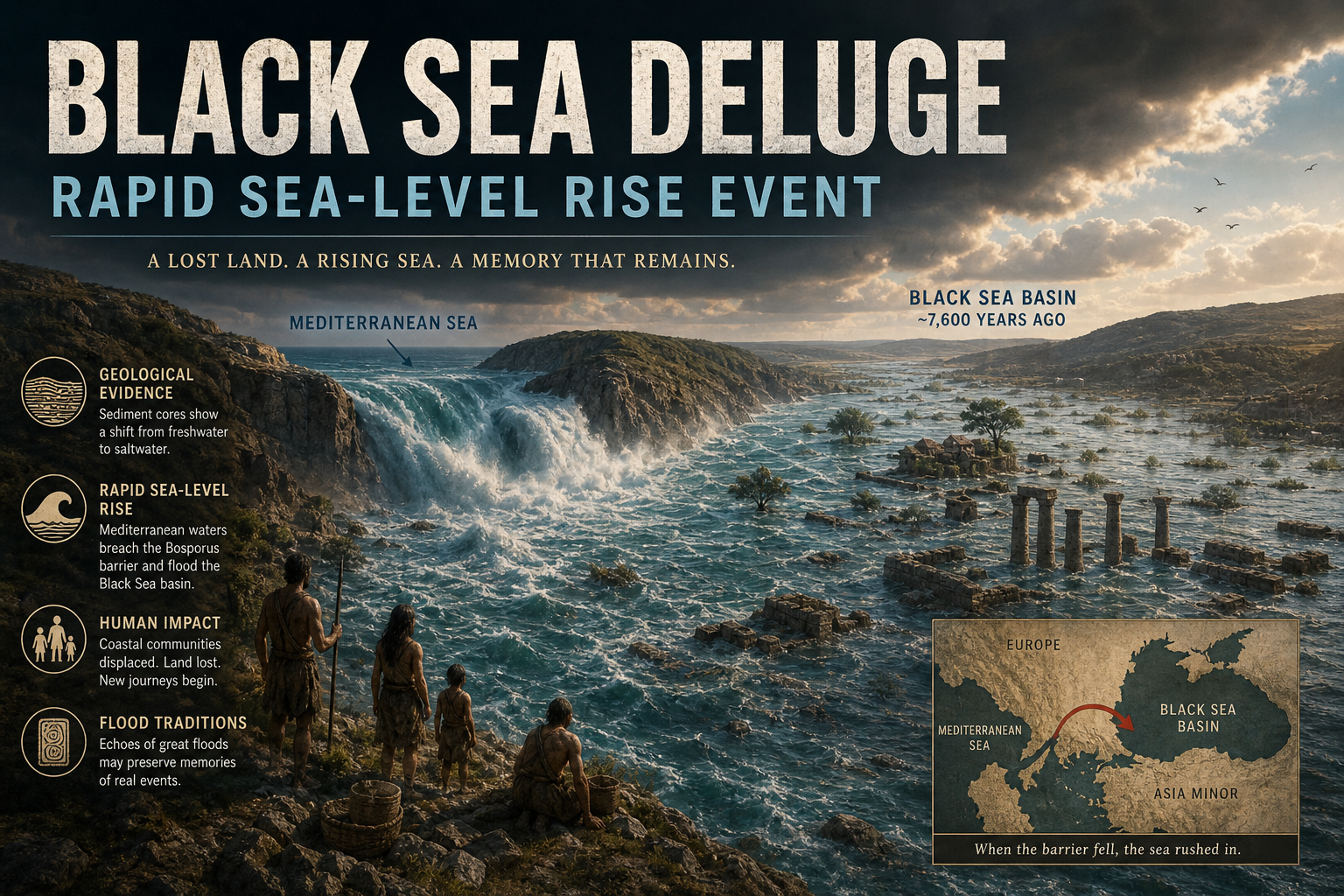
The Black Sea Deluge is often described as a rapid sea-level rise event that may have occurred around 7,600 years ago, when rising Mediterranean waters are thought to have breached a natural barrier and flooded the Black Sea basin (Milankovitch Cycles and Climate Forcing link). The Black Sea Deluge stands out because it represents a localized but potentially catastrophic events—one that may have directly impacted human populations living along fertile coastal plains. When considered within the broader pattern of post-Ice Age environmental changes, the Black Sea Deluge raises an important question: to what extent did sudden flooding events reshape early human settlements, and could such occurrences have contributed to the persistence of flood narratives across different cultures?
The Black Sea Deluge Hypothesis
The Black Sea Deluge hypothesis proposes that as global sea levels rose following the last Ice Age, the Mediterranean Sea eventually overtopped a land barrier at the Bosporus. This breach would have allowed saltwater to rush into the lower-lying freshwater Black Sea basin (Civilizations Lost beneath Ice and Fire link).
According to this model, the inflow may have been sudden and forceful, transforming a relatively stable environment into a rapidly expanding seas. Shorelines would have retreated quickly, potentially displacing populations and submerging settlements.
The scale and speed of this events remain debated. Some researchers support a catastrophic flooding scenario, while others suggest a more gradual transition. However, even a moderate but sustained rise in water levels could have significantly altered the region (Axial Precession and the Great Year link).
Geological Evidence of the Black Sea Deluge
Evidence for the Black Sea Deluge comes from sediment cores, underwater surveys, and geological analysis of the basin. Marine sediments found beneath the Black Sea indicate a transition from freshwater to saltwater conditions.
Researchers have also identified ancient shorelines and possible submerged structures, suggesting that areas once above water are now submerged. These findings support the idea that the region experienced a major transformation in water levels.
However, interpretations differ. Some studies suggest that the inflow may have occurred over longer periods rather than as a single sudden event. This uncertainty highlights a recurring theme in paleoclimate research: distinguishing between rapid catastrophe and accelerated gradual change is often challenging (Climate History of the last 40,000 Years link).
Human Impact of the Black Sea Deluge
If the Black Sea Deluge occurred as a rapid flooding event, the impact on human populations would have been significant. Coastal regions are typically rich in resources, making them attractive for early settlement. A sudden rise in water levels would have:
- displaced communities
- reduced available land
- forced migration into new territories
Even in a more gradual scenario, the cumulative effect would still involve long-term pressure on populations, requiring adaptation and relocation. This leads to a broader question. If such events occurred not only here but in multiple regions worldwide, then early human history may include repeated episodes of displacement and מחדש organization. These patterns may not always leave clear archaeological traces, especially if affected areas are now underwater (Ancient Ocean Navigation Finding Land Without Tools link).
The Black Sea Deluge and Flood Traditions
One of the most discussed aspects of the Black Sea Deluge is its potential connection to widespread flood narratives. Stories of great floods appear across many cultures, often describing sudden inundation, loss of land, and survival through adaptation.
While it is not possible to directly link a single event to specific myths, the Black Sea Deluge provides a plausible real-world scenario that could contribute to such narratives. Repeated exposure to rising sea-levels and flooding events would likely leave a lasting impression on cultural memory.
This perspective does not claim that myths are literal records of specific events. Instead, it suggests that they may preserve generalized memories of environmental instability experienced over generations (Younger Dryas Event link and Older Dryas Event link)
Rethinking Early Human Settlements
The Black Sea Deluge also highlights a limitation in current archaeological models. Much of early human settlement is believed to have occurred near coastlines, yet these areas are the most affected by post-glacial sea-level rise (Prehistoric Construction Systems Engineering link).
If large portions of ancient coastal landscapes are now submerged, then part of the archaeological record is effectively inaccessible. This raises the possibility that early human activity—potentially more complex than currently assumed—remains undiscovered beneath modern seas.
The Black Sea Deluge therefore becomes more than a regional episode. It serves as a reminder that the absence of evidence may reflect environmental transformations rather than historical simplicity (Ancient Construction Similarities Global Parallels link).
Conclusion
The Black Sea Deluge illustrates how rising sea levels at the end of the Ice Age may have produced localized but significant disruptions to human populations. Whether catastrophic or gradual, the event reflects a broader pattern of environmental change that early humans were required to navigate. When viewed alongside other climatic and geological phenomena, it reinforces the idea that human history has unfolded within a dynamic and often unstable world. This perspective invites further investigation into how such disruptions may have shaped migration, memory, and the fragments of history that remain visible today (Lost Knowledge of the Ancients link).
References and Further Reading
William Ryan & Walter Pitman, Noah’s Flood: The New Scientific Discoveries About the Event That Changed History (link)
National Geographic Society – Black Sea flood hypothesis (link)
Richard B. Alley, The Two-Mile Time Machine (link)
Wallace S. Broecker, The Great Ocean Conveyor (link)
EPICA Community Members, Eight glacial cycles from an Antarctic ice core (link)
EPICA Ice Core Project (European Project for Ice Coring in Antarctica) (link)
NASA Earth Observatory – Paleoclimate Data and Ice Core Studies
Richard B. Alley, The Two-Mile Time Machine (link)
Wallace S. Broecker, The Great Ocean Conveyor (link)
ResearchGate – Studies on Dansgaard–Oeschger events and paleoclimate variability
Ancient Energy Systems: Myth or Technology? (link)
Ancient Hyper Forests and Giant Trees (link)
Pre Flood Civilization and Environmental Collapse (link)
Was the Ancient World Phisically Different? (link)
Giant Humans Before the Younger Dryas (link)
Ancient Construction Project Management (link)
Ice Age Civilization Lost Worlds Before Floods (link)
Lost Knowledge of Ice Age Rewritten History (link)
Ice Age Knowledge Science Before Younger Dryas (link)
National Snow and Ice Data Center (NSIDC) – Younger Dryas research (link)