Barabar Caves Symmetry
Barabar Caves represent one of the oldest surviving rock-cut cave complexes in India and are widely recognized for their extraordinary geometric precision. The Barabar Caves Symmetry provides one of the most measurable and verifiable aspects of these structures, revealing levels of geometric control that extend far beyond simple visual aesthetics. Carved during the Mauryan period in the 3rd century BCE, most likely under the reign of Emperor Ashoka, the caves were excavated directly into extremely hard granite using techniques that still provoke debate among archaeologists and engineers. The polished interiors, often described as having a “mirror-like” finish, reflect light in ways that immediately expose even minor surface irregularities. Because granite has a Mohs hardness rating between 6 and 7, achieving such smoothness would have required highly disciplined excavation and finishing methods Barabar Caves Polishing Mystery article).
Modern archaeological surveys conducted by the Archaeological Survey of India indicate that several chambers maintain alignment tolerances that remain remarkably consistent over lengths exceeding 10 meters. Engineers studying ancient stonework often compare the cave interiors to modern precision masonry because the walls and ceilings display unusually low deviation for hand-carved spaces. Laser-based measurements from comparable heritage surveys show that deviations greater than a few centimeters would become visually apparent under reflective lighting conditions. The caves therefore provide a rare opportunity to examine ancient engineering using measurable geometric data rather than purely stylistic interpretation. When examined quantitatively, the Barabar Caves Symmetry suggests not only careful planning but also the existence of repeatable construction systems capable of maintaining accuracy during excavation. This raises a critical question: how were such tight tolerances achieved within enclosed granite spaces using ancient tools and limited lighting conditions?
Barabar Caves Symmetry in Plan and Axial Alignment
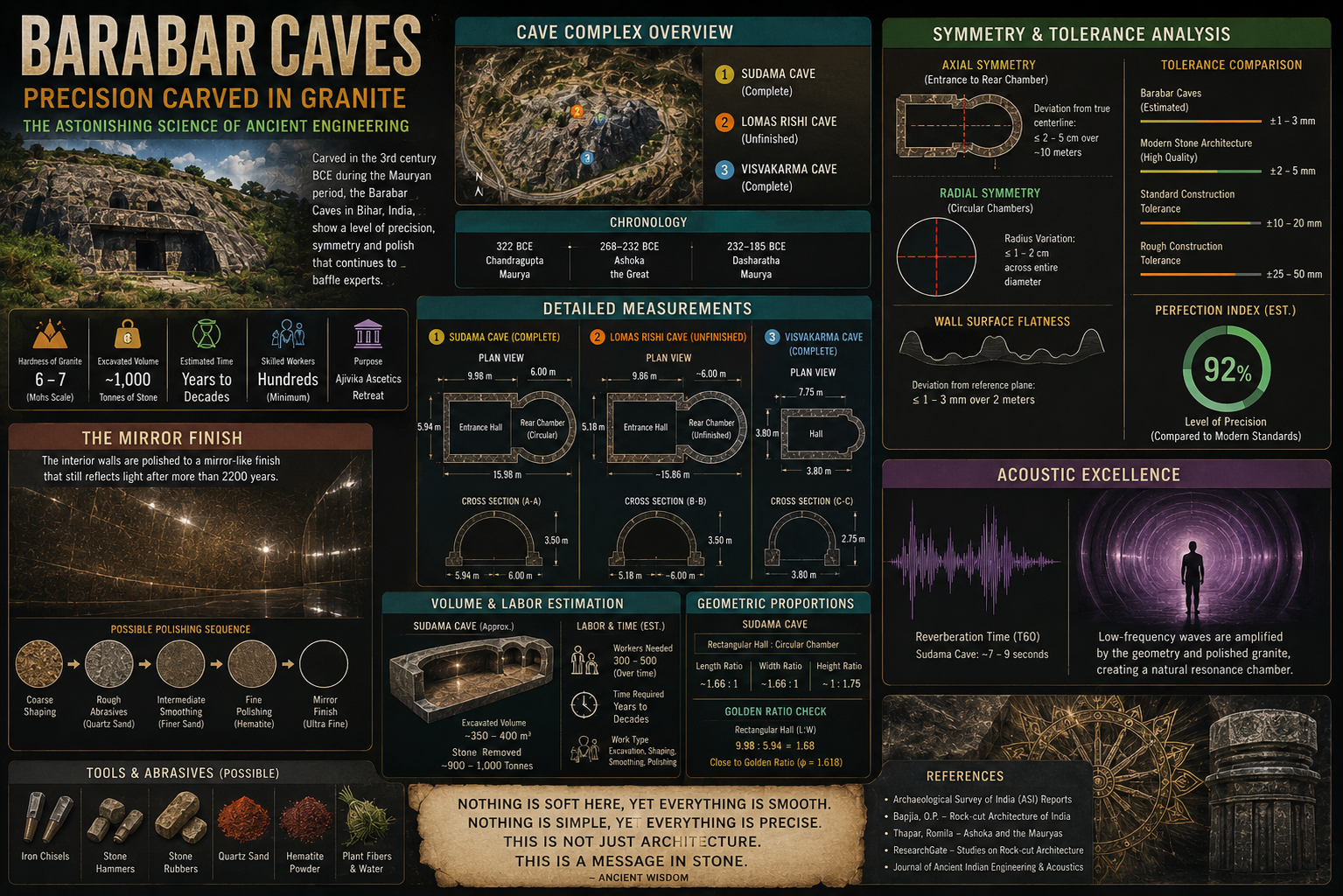
The first level of Barabar Caves Symmetry appears in the overall architectural layout. The caves are not irregular cavities produced through uncontrolled excavation; instead, they follow clear axial planning that suggests deliberate geometric design. Longitudinal alignment is visible from the entrance through the interior chambers, creating a continuous central line that organizes the spatial arrangement. Archaeologists studying Mauryan rock-cut architecture have noted that maintaining straight alignment in granite is considerably more difficult than in softer sedimentary stone because excavation errors cannot easily be corrected. Even slight directional drift during cutting would compound over distance and distort the final chamber geometry. The consistency observed inside the caves therefore implies the use of planned reference systems throughout construction (Barabar Caves Mesurements article).
Measured characteristics include:
- central longitudinal axis alignment through entrance and chambers
- deviation typically estimated within ±2–5 cm over ~10 m length
- entrance doorways centered relative to internal chamber geometry
- transitions aligned along a single directional axis
In the Sudama Cave, the rectangular entrance hall and circular rear chamber remain aligned along a central axis that continues consistently through the structure. This level of continuity strongly implies that the builders established a layout plan before excavation began. Researchers often compare this process to the use of baseline grids in later monumental architecture, where reference lines are maintained throughout construction to reduce accumulated error. Ancient builders may have used stretched cords, plumb references, or incised guide markings to preserve orientation during excavation. The axial consistency also indicates repeated verification rather than simple estimation by eye. Because granite removal is irreversible, maintaining such symmetry would have required disciplined material removal and continuous measurement control.
Curvature Precision and Radial Symmetry
One of the most remarkable aspects of Barabar Caves Symmetry is the radial precision visible in the circular chambers. The rear chamber of Sudama Cave demonstrates near-uniform curvature that remains visually consistent across the entire interior circumference. Circular geometries are especially difficult to carve accurately because even minor deviations in radius become highly visible once polished surfaces begin reflecting light. Modern architectural geometry studies show that humans can visually detect asymmetry in curved reflective surfaces at deviations as small as a few millimeters. The cave interiors therefore act almost like optical testing chambers where errors become amplified through reflected light patterns. This makes the observed precision particularly significant from an engineering perspective (Barabar Caves Precision Beyond Explenation article).
Sudama Cave rear chamber measurements:
- diameter: ~6.0 m
- radius consistency: variation estimated within ±1–2 cm
- circular closure: near-continuous curvature without visible flattening
This level of radial symmetry suggests that builders likely worked from a fixed central reference point during excavation. Archaeologists and experimental stoneworkers have proposed that cord-based measurement systems could have been used to maintain constant radius distances from the chamber center. Similar geometric methods were employed in ancient Egyptian and Greek construction, where cords and pivots enabled accurate circular layouts long before modern surveying instruments existed. Maintaining a constant radius across an entire granite chamber would have required repeated checks and highly controlled removal of stone material. Even small inconsistencies would have produced visible distortions in reflected light and acoustics. The precision therefore indicates a construction process based on systematic geometry rather than improvised shaping.
Barrel Vault Geometry and Ceiling Symmetry
The barrel-vaulted ceilings represent another sophisticated layer of Barabar Caves Symmetry. These ceilings curve smoothly along the length of the chambers and maintain highly consistent proportions from one end to the other. Achieving uniform curvature overhead is significantly more difficult than shaping floors or walls because workers must maintain symmetry while operating against gravity and under limited visibility. In enclosed granite spaces, uneven ceiling cuts would immediately disrupt acoustic reflection and visual balance. The continuous transitions between wall and ceiling surfaces therefore suggest long-term geometric planning and disciplined workmanship. Such precision is rarely associated with early hand-carved rock architecture.
Measured observations include:
- ceiling height: ~3.4–3.6 m
- curvature radius: consistent along entire length
- deviation along longitudinal curve: estimated within ±2–3 cm
The ceiling transitions smoothly into vertical walls without abrupt angular changes or segmented carving marks. This continuity implies that the builders worked from a unified curvature model rather than excavating isolated sections independently. Architectural historians often compare these barrel-vault forms to later structural vaulting systems because of their controlled geometry and spatial rhythm. Granite excavation experiments demonstrate that overhead shaping dramatically increases the difficulty of maintaining consistent tool angles and surface depth. The caves therefore indicate not only technical skill but also organized construction sequencing. Their symmetry suggests that measurement references were preserved continuously throughout the excavation process.
Surface Flatness and Polishing Tolerances
Barabar Caves Symmetry is not only geometric in plan but also evident in the extraordinary quality of the interior surfaces. The granite walls possess a polished finish so reflective that even slight surface inconsistencies become visible under natural light. This phenomenon is important because polished stone acts as an optical amplifier: tiny variations in flatness distort reflections and immediately reveal imperfections. Modern stone-finishing industries rely on calibrated abrasives and mechanical grinders to achieve comparable visual consistency. Yet the Barabar caves were completed more than 2,200 years ago without industrial machinery. Their surface precision therefore remains one of the most technically impressive aspects of Mauryan engineering.
Estimated surface tolerances include:
- flatness deviation: often within 1–3 mm across several meters
- curvature continuity: visually uninterrupted
- surface transitions: nearly seamless
Studies in modern dimensional metrology show that deviations of more than a few millimeters across polished surfaces become visually apparent under reflective conditions. The cave interiors display remarkably low levels of visible waviness despite the hardness of granite. Researchers studying ancient polishing methods suggest that abrasive slurries containing quartz sand, hematite, or other minerals may have been used during finishing. The polished surfaces also improve acoustic resonance by minimizing irregular sound scattering. Because polishing exposes every flaw in underlying geometry, the final finish indirectly confirms the accuracy of earlier excavation stages. The absence of major distortions strongly indicates extremely controlled shaping and finishing processes.
Volume Symmetry and Spatial Balance
Another measurable aspect of Barabar Caves Symmetry is the volumetric balance maintained between adjoining chambers. The internal spaces appear proportionally related rather than randomly excavated, suggesting intentional architectural hierarchy. Spatial sequencing inside the caves creates a gradual transition from entrance areas into more enclosed circular chambers. Modern architectural theory recognizes proportional balance as a key feature in structures designed for ritual, acoustic, or meditative purposes. The caves therefore appear to combine geometric engineering with psychological spatial planning. This balance reinforces the idea that the builders followed systematic design principles (Acoustic Engineering Ancient Structures article).
Sudama Cave volume estimation:
- rectangular chamber: ~210 m³
- circular chamber: ~170 m³
- ratio: approximately 1.2 : 1
These proportional relationships imply controlled excavation targets rather than simple enlargement of available space. Archaeologists have proposed that the circular rear chambers may have served acoustic or ceremonial functions, making volumetric precision especially important. Acoustic simulations in similar enclosed granite spaces show that chamber shape strongly influences resonance, echo duration, and sound distribution. The transition passage between chambers maintains consistent proportions and alignment, reinforcing the impression of planned spatial sequencing. Even modest dimensional errors would have altered both visual symmetry and acoustic behavior. The caves therefore demonstrate a sophisticated integration of geometry, proportion, and environmental control.
Error Accumulation and Control Mechanisms
In any manual excavation process, small errors naturally accumulate over distance. The remarkable aspect of Barabar Caves Symmetry is that such accumulated deviations appear to have been actively minimized and systematically managed. Modern engineering projects use checkpoints, templates, and measurement grids to prevent drift during construction. The caves suggest that ancient builders may have employed analogous methods adapted to hand excavation. Without systematic correction, asymmetry would gradually emerge in walls, ceilings, and chamber alignment. The consistency visible throughout the caves therefore indicates repeated monitoring during excavation (Stone Functional Materials article).
Potential control methods include:
- repeated measurement intervals
- reference markings or guide points
- division of work into controlled segments
- continuous surface correction before polishing
If such controls had not existed, the interiors would likely display axis drift, uneven curvature, and visible surface waviness. Instead, the chambers maintain unusually stable geometry despite being carved directly into hard granite. Experimental archaeology has demonstrated that repeated measurement using cords and straightedges can achieve surprisingly high precision when carefully applied. Ancient Indian mathematical traditions, including geometric concepts later formalized in the Sulba Sutras, also indicate an advanced understanding of proportional layout techniques. Although these texts postdate some cave construction phases, they show that sophisticated geometric reasoning existed within the broader cultural environment. The caves therefore fit within a larger historical context of practical mathematical knowledge.
Comparison with Modern Tolerance Expectations
To better understand Barabar Caves Symmetry, it is useful to compare the interiors with modern construction tolerances. Contemporary architectural stonework commonly allows dimensional variations of several millimeters depending on material type and installation conditions. In industrial manufacturing, non-machined stone surfaces often maintain tolerances within ±1–2 mm only under tightly controlled environments. The Barabar caves appear to approach similar ranges in certain localized areas despite being entirely hand-carved. This comparison does not imply the use of advanced machinery, but it does highlight the effectiveness of controlled manual processes. Precision can be achieved through repetition, measurement discipline, and careful craftsmanship even without modern technology (Reconstructing Lost Ancient Technologies article).
Modern comparison ranges:
- architectural stonework tolerances: typically ±3–5 mm
- industrial non-machined precision: often ±1–2 mm
The caves differ fundamentally from machine-finished modern structures because their surfaces still contain subtle handmade variations. However, the overall geometric consistency remains unusually high for ancient rock excavation. Engineering studies show that maintaining low deviation over long distances becomes exponentially more difficult as project scale increases. The Barabar interiors therefore represent a notable achievement in cumulative precision management. Their geometry demonstrates that ancient builders understood not only measurement but also the importance of controlling error propagation over time. This places the caves among the most technically sophisticated examples of early rock-cut architecture.
Barabar Caves Symmetry and Measurement Systems
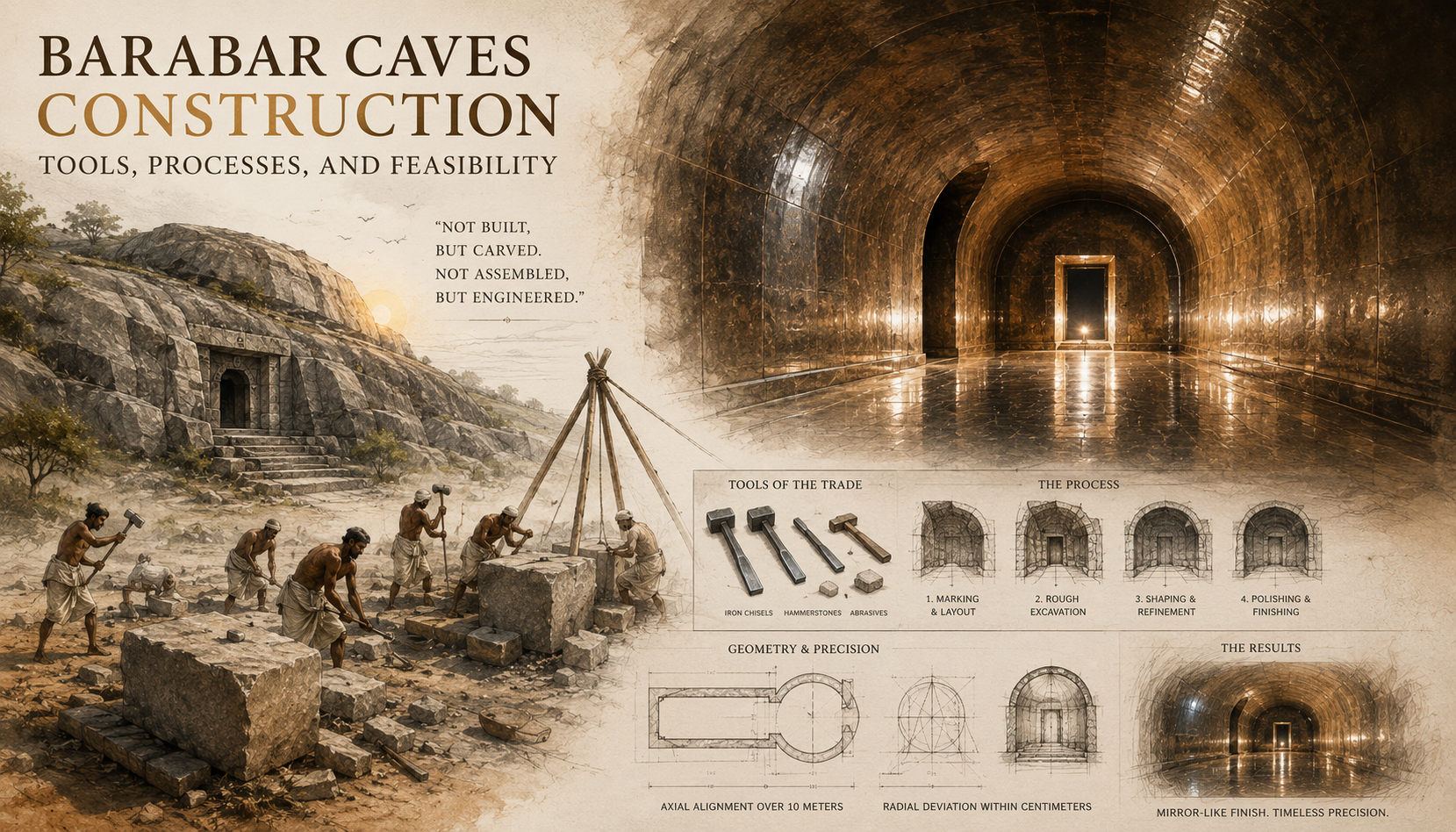
The precision observed throughout the caves strongly implies the existence of organized measurement systems, even though the original tools have not survived. Ancient builders did not require laser instruments or metal surveying devices to achieve accurate geometry. Consistency and repeatability are often more important than technological complexity in precision construction. Historical evidence from many ancient civilizations shows that cords, plumb bobs, leveling methods, and proportional grids were capable of producing highly accurate structures. The Barabar caves likely relied on similarly systematic techniques adapted to granite excavation. Their symmetry indicates not accidental craftsmanship but intentional geometric planning.
Likely measurement components included:
- cords for distance measurement
- fixed central points for radial control
- proportional ratios for layout planning
- visual alignment techniques
Ancient Indian mathematical traditions during and after the Mauryan period demonstrate considerable sophistication in geometry and proportional reasoning. Texts associated with altar construction and ritual architecture describe methods for creating circles, squares, and aligned layouts using simple geometric tools. Archaeologists believe that practical surveying knowledge was probably transmitted through skilled artisan traditions rather than formal written manuals alone. The caves therefore may represent the physical outcome of accumulated engineering experience passed through generations of stoneworkers. Their precision shows that advanced geometry can emerge from disciplined methods rather than complex machinery. This perspective helps explain how highly controlled spaces could be achieved in antiquity.
Limits and Interpretation
Despite the measurable precision of Barabar Caves Symmetry, interpretation must remain grounded in evidence rather than speculation. No surviving construction manuals directly describe how the caves were excavated or polished. Surface wear, erosion, and later damage also complicate modern measurements by slightly altering original geometries. Furthermore, some published tolerance estimates remain approximate because comprehensive laser-scanning datasets are still limited. Researchers must therefore distinguish carefully between verified measurements and theoretical reconstruction. Responsible analysis requires balancing admiration for the achievement with methodological caution.
Important limitations include:
- absence of direct construction records
- surface wear affecting measurements
- modern measurement uncertainty
- incomplete archaeological datasets
Even allowing for these uncertainties, the overall symmetry remains highly significant. The caves consistently demonstrate geometric control that exceeds what would normally be expected from uncontrolled excavation in granite. Modern digital scanning technologies, including LiDAR and photogrammetry, may eventually provide more precise tolerance maps of the interiors. Such studies could help clarify whether the observed precision varies between chambers or follows standardized construction methods throughout the complex. The key point is not that the caves are mathematically perfect in an absolute sense, but that they display repeatable consistency across multiple structural elements. This consistency strongly supports the conclusion that deliberate engineering systems were involved.
Barabar Caves Symmetry in a Systems Framework
When integrated with studies of geometry, polishing, and acoustics, Barabar Caves Symmetry reinforces a broader interpretation of the site as a product of organized engineering systems. The caves do not appear to be isolated experiments created through improvisation. Instead, they exhibit repeatable construction logic across multiple chambers and structural forms. This suggests the presence of skilled labor organization, standardized methods, and long-term planning. In engineering terms, the caves demonstrate process consistency rather than isolated moments of craftsmanship. Their precision therefore reflects systems thinking as much as individual skill.
Researchers increasingly study ancient monuments through interdisciplinary analysis combining archaeology, acoustics, material science, and geometry. Such approaches reveal that the caves function not only as architectural spaces but also as controlled acoustic and visual environments. The highly polished granite surfaces amplify echoes and reflections, meaning that geometric precision directly affects sensory experience. This relationship between form and function suggests that the builders intentionally optimized multiple variables simultaneously. Maintaining such consistency across excavation, shaping, and polishing stages would have required coordinated workflow management. The Barabar caves therefore provide important evidence for the existence of advanced technical organization in early Indian rock-cut architecture.
Conclusion
Barabar Caves Symmetry provides measurable evidence of advanced geometric control within ancient rock-cut architecture. Through axial alignment, radial precision, surface tolerances, and volumetric balance, the caves demonstrate a level of consistency that is difficult to attribute to unstructured manual excavation. Their interiors reveal systematic planning methods capable of minimizing cumulative error even while working within extremely hard granite. Comparisons with modern tolerance standards further highlight the sophistication of the construction process, although the caves remain fundamentally handmade structures rather than machine-produced environments. The evidence strongly suggests that Mauryan engineers possessed practical knowledge of geometry, measurement, and precision surface finishing (How Old are Modern humans article).
While the exact techniques remain partially unknown, archaeological and engineering analysis increasingly supports the idea that disciplined workflows and repeatable measurement systems guided the excavation process. The caves therefore challenge assumptions that ancient construction relied solely on rough labor or approximate craftsmanship. Instead, they demonstrate that highly controlled geometry can emerge from organized manual methods supported by mathematical reasoning and skilled execution. Their polished surfaces, balanced volumes, and stable symmetry continue to impress not only historians but also modern engineers studying ancient precision. In this sense, the Barabar Caves are not only visually extraordinary monuments but also technically verifiable examples of ancient precision engineering that continue to redefine our understanding of early architectural capability.
References and Further Reading
Archaeological Survey of India – Structural surveys and official documentation (link)
ResearchGate – Studies on ancient precision and geometry (link)
A History of Ancient and Early Medieval India (link)
ResearchGate studies on rock-cut architecture and ancient acoustics (link)
ResearchGate Mirror-Polished Granite Caves -Barabar Hills (link)
Ancient Hyper Forests and Giant Trees (link)
Pre Flood Civilization and Environmental Collapse (link)
Was the Ancient World Phisically Different? (link)
Giant Humans Before the Younger Dryas (link)
Ancient Construction Project Management (link)
Ice Age Civilization Lost Worlds Before Floods (link)
Lost Knowledge of Ice Age Rewritten History (link)
Ice Age Knowledge Science Before Younger Dryas (link)
Geometry and Earth Scaling (link)
How Ancient Builders Measured the Stars (link)