Barabar Caves Polishing Mystery
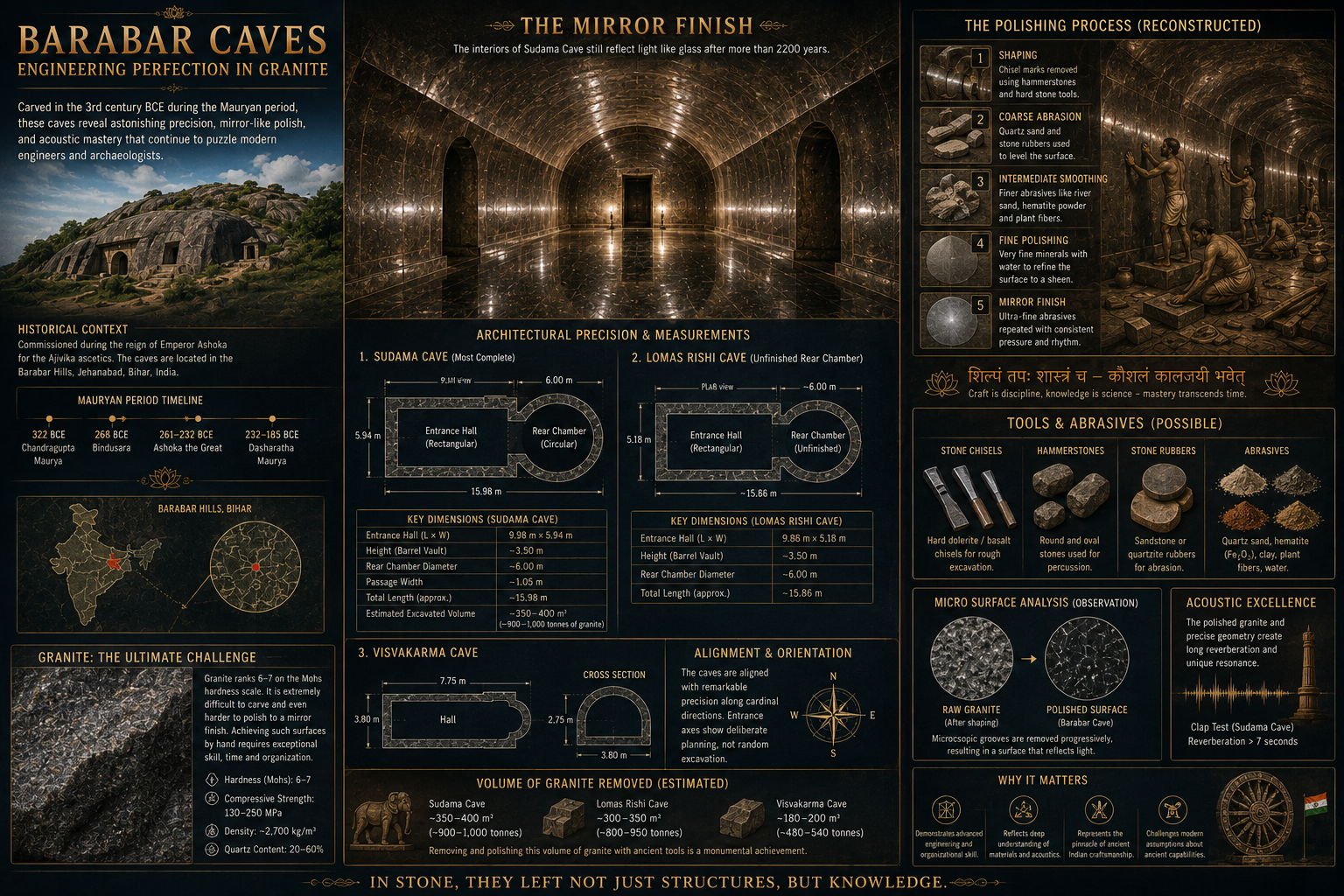
Barabar Caves Polishing represents one of the most extraordinary achievements in ancient engineering and stone finishing ever discovered. Barabar Caves Polishing transformed massive granite chambers in Barabar Caves into mirror-like reflective surfaces more than 2,200 years ago during the Mauryan period. The exceptional precision, uniformity, and optical smoothness visible throughout the caves make Barabar Caves Polishing one of the most technically sophisticated examples of ancient material processing in the world. Unlike decorative polishing found in statues or isolated architectural elements, Barabar Caves Polishing extends continuously across walls, ceilings, curved transitions, and enclosed granite chambers with astonishing consistency.
Techniques Behind the Mirror Finish
Barabar Caves Polishing represents one of the most extraordinary achievements in ancient stone engineering and material finishing ever discovered. Located in Barabar Caves, these granite chambers display a level of reflectivity so refined that the walls still resemble polished glass more than 2,200 years after their construction during the Mauryan period. The phenomenon of Barabar Caves Polishing is not limited to isolated decorative areas or ceremonial details; instead, the polishing extends continuously across walls, ceilings, curved transitions, and enclosed chambers with astonishing uniformity. This makes Barabar Caves Polishing one of the most technically sophisticated examples of ancient surface engineering ever identified (Barabar Caves Measurement article).
What makes Barabar Caves Polishing particularly remarkable is the extreme difficulty of the material itself. Granite is composed largely of quartz and feldspar, minerals with hardness values reaching 6 to 7 on the Mohs scale, making the stone exceptionally resistant to abrasion and finishing. Even modern granite polishing operations require diamond abrasives, industrial machinery, calibrated pressure systems, and multi-stage finishing cycles to achieve mirror-like reflectivity. Yet the surfaces inside the Barabar caves display an optical smoothness and consistency that continue to challenge assumptions about ancient engineering capabilities. The reflective finish appears across entire chambers measuring several meters in length and height, creating a polished environment that resembles machine-finished stone rather than manually worked granite from antiquity.
The engineering complexity of Barabar Caves Polishing increases dramatically because the interiors are not composed of simple flat surfaces. The caves contain curved ceilings, rounded transitions, enclosed geometries, and acoustically resonant chambers that would make uniform polishing extraordinarily difficult. Maintaining the same reflective quality across concave and convex granite surfaces would require precise control over abrasion angles, polishing pressure, and surface correction methods. Any inconsistency in polishing technique would produce visible distortions, dull zones, or uneven reflections across the stone. The fact that these defects are minimal strongly suggests that Barabar Caves Polishing relied on highly organized workflows, specialized labor systems, and advanced practical knowledge accumulated over generations.
From an engineering perspective, Barabar Caves Polishing demonstrates far more than artistic craftsmanship. The caves reveal evidence of systematic planning, sequential production methods, quality control procedures, and large-scale labor coordination operating within one of the most powerful empires of ancient India. Researchers estimate that the polishing process may have required thousands of labor hours per chamber, especially considering the hardness of granite and the total polished surface area involved. The extraordinary precision visible throughout the caves indicates that Barabar Caves Polishing was not an experimental technique, but rather a mature and highly refined technological tradition. More than two millennia later, the reflective granite interiors remain among the clearest examples of ancient mastery over hard stone engineering and architectural finishing.
Barabar Caves Polishing and the Challenge of Granite
Granite is among the most difficult natural materials to shape and polish, which is why the achievement at the Barabar complex remains technically astonishing. The stone is composed primarily of quartz, feldspar, and mica, minerals that resist abrasion and fracture unpredictably under impact. Modern granite finishing industries rely on industrial abrasives, diamond tooling, and water-cooled polishing systems to produce reflective surfaces. Even with contemporary machinery, achieving uniform mirror polish across hundreds of square meters requires multiple polishing stages, calibrated pressure control, and extensive labor. Accomplishing a comparable finish in antiquity using manual methods dramatically increases the complexity of the task (Barabar Caves Precision Beyond Explanation article).
To create a reflective granite surface, ancient workers would have needed to progressively reduce microscopic surface irregularities. The process likely began with rough shaping to eliminate excavation scars and hammer marks, followed by increasingly fine abrasion cycles designed to flatten peaks and smooth valleys at the microscopic level. Experimental archaeology demonstrates that reflective polish only emerges after repeated reduction of surface roughness to fractions of a millimeter. Any inconsistency in abrasive grain size, pressure application, or directional motion can create visible distortions. The fact that the Barabar walls maintain such visual continuity suggests extraordinary procedural discipline.
The enclosed nature of the caves further amplified the engineering challenge. Workers had limited lighting, restricted maneuverability, and confined ventilation while attempting to polish highly reflective granite surfaces. Curved ceilings would have forced craftsmen to maintain consistent polishing angles while standing on temporary platforms or scaffolding. Errors could not easily be corrected because excessive abrasion would permanently distort the geometry of the chamber. In practical terms, this means the polishing operation required not only endurance but also careful planning and sequential execution over extended periods of time.
Stages of the Barabar Caves Polishing Process
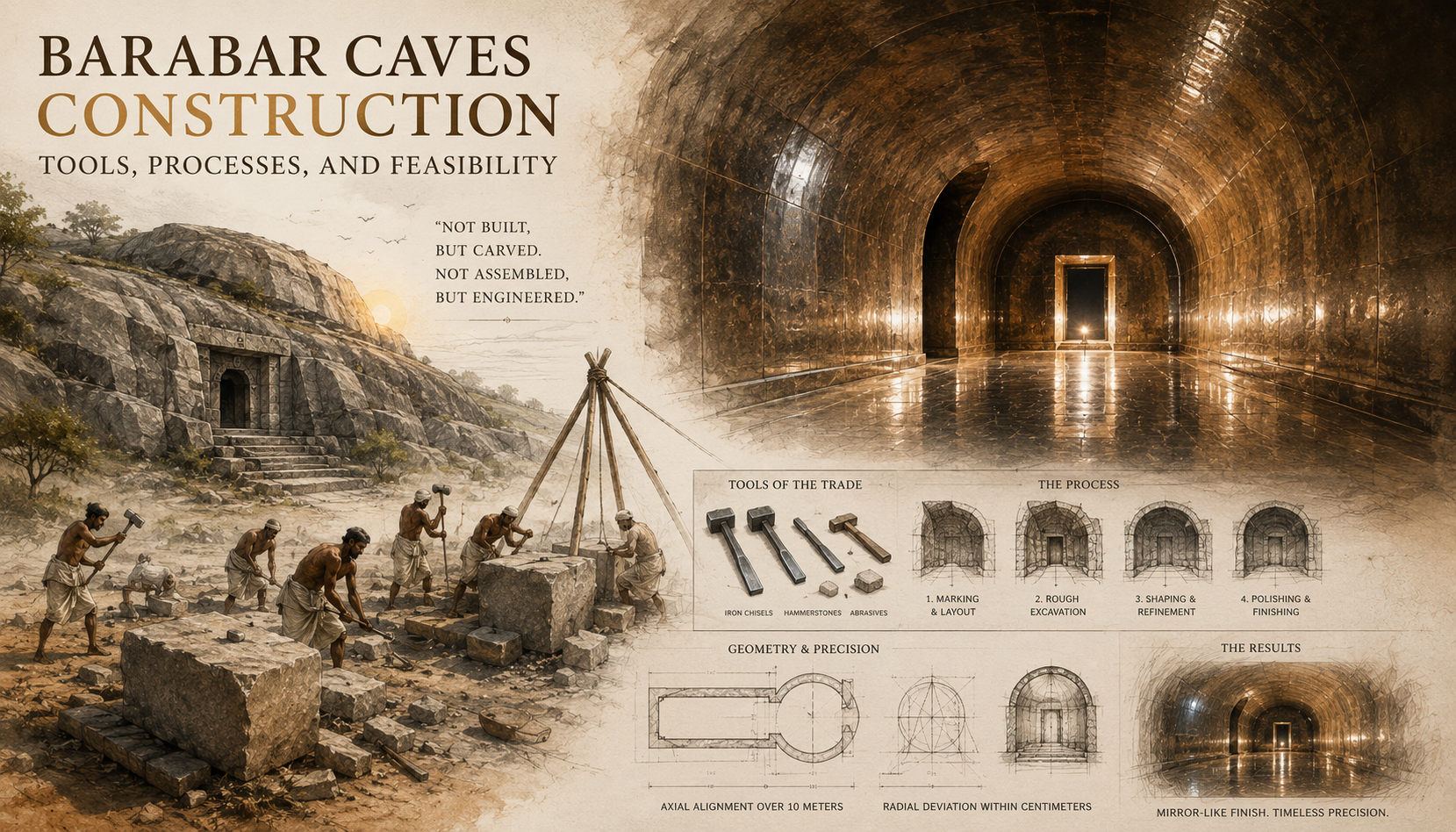
A technical reconstruction of Barabar Caves Polishing suggests a highly organized multi-stage workflow comparable in principle to modern stone-finishing systems. The first stage likely involved coarse excavation using iron chisels, hammerstones, and impact tools capable of breaking granite through repeated percussion. This phase would leave deep tool marks, fractures, and uneven contours across the rock surface. Before polishing could begin, workers had to stabilize and regularize the chamber geometry to prevent irregular reflections later in the process. Even minor deviations in curvature would become visually amplified once the surface became reflective (Acoustic Engineering Ancient Structures article).
The second stage probably involved coarse abrasion using quartz-rich sand, crushed granite, or other mineral abrasives. Ancient workers may have applied these abrasives with rubbing stones, hardwood blocks, leather pads, or composite friction tools. Coarse abrasion would gradually remove chisel scars while flattening the microscopic high points of the granite surface. Considering the hardness of quartz particles and the resistance of granite itself, this phase alone may have required thousands of repetitive motions per square meter. Water was likely added periodically to reduce friction heat, clear debris, and improve abrasive consistency.
Intermediate smoothing would then refine the surface using progressively finer mineral powders such as hematite dust, fine river sand, or pulverized stone. This phase reduced visible irregularities and produced a more uniform texture capable of reflecting diffuse light. At this stage, workers would need to maintain highly controlled directional movements to avoid creating swirl patterns or uneven sheen. The transition from rough matte granite to semi-reflective stone marks a critical threshold where surface errors become increasingly visible. Achieving continuity across adjoining walls and ceilings would therefore require constant inspection and correction.
The Barabar Caves Polishing and its final polishing stage represent the greatest technical mystery. Mirror-like reflectivity in granite demands extremely fine abrasion and prolonged surface burnishing, potentially involving countless repetitive polishing cycles. The polishing may have included water-assisted friction, fine mineral slurries, and repeated high-frequency rubbing motions maintained over months or years. The remarkable aspect is not merely the shine itself, but the fact that the finish remains consistent across entire chambers measuring hundreds of square meters. This indicates an advanced understanding of cumulative surface refinement long before the emergence of industrial polishing technology.
Labor, Time, and Organizational Scale
The scale of labor implied by Barabar Caves Polishing is immense and points toward a highly organized workforce rather than isolated artisans. A single polished chamber may contain between 200 and 400 square meters of finished granite surface when walls, ceilings, and transitional curves are included. Modern hand-polishing experiments on hard stone suggest that even one square meter of reflective granite can require dozens of labor hours depending on the desired finish quality. Extrapolated across an entire cave, the total labor investment likely extended into thousands—or even tens of thousands—of man-hours. Such effort implies state-supported engineering projects rather than small-scale religious construction.
The caves are generally associated with the reign of Ashoka and the Mauryan Empire, one of the largest political entities in ancient South Asia. At its height, the empire governed tens of millions of people across a territory exceeding 5 million square kilometers. This level of centralized administration would have enabled the coordination of specialized labor teams, supply chains, and long-term architectural planning. Workers may have been divided into excavation crews, abrasion specialists, finishing teams, and inspectors responsible for maintaining consistency. Such specialization dramatically increases efficiency and suggests a sophisticated construction hierarchy.
Time itself becomes a critical factor when evaluating the caves. Granite polishing is not a rapid process, particularly under manual conditions without mechanized assistance. Seasonal weather, lighting conditions, and abrasive supply logistics would all influence the pace of work. It is therefore plausible that a single chamber required several years of continuous labor from trained workers operating within carefully managed sequences. The extraordinary finish preserved today reflects not only technical ability, but also patience, institutional continuity, and long-duration project management.
Uniformity and Precision Control
One of the most remarkable aspects of Barabar Caves Polishing is the extraordinary uniformity maintained across large curved surfaces. Reflective finishes are unforgiving because they amplify even tiny deviations in geometry, pressure, or surface texture. Uneven abrasion can produce distortions, dull patches, ripple effects, or directional inconsistencies that become immediately visible under reflected light. Yet many sections of the caves display uninterrupted reflective continuity across walls and ceilings. This level of optical consistency strongly implies repeated inspection and controlled procedural methods (Stone Functional Material article).
Maintaining such uniformity without modern measuring instruments would have required practical systems of quality control. Ancient workers may have relied on tactile inspection, reflected light observation, or standardized polishing sequences to maintain consistency. Repetitive workflows could ensure that each section received similar abrasion intensity and directional finishing. Teams may have operated in coordinated patterns to avoid localized over-polishing or geometric distortion. The precision visible today suggests process standardization rather than improvised craftsmanship.
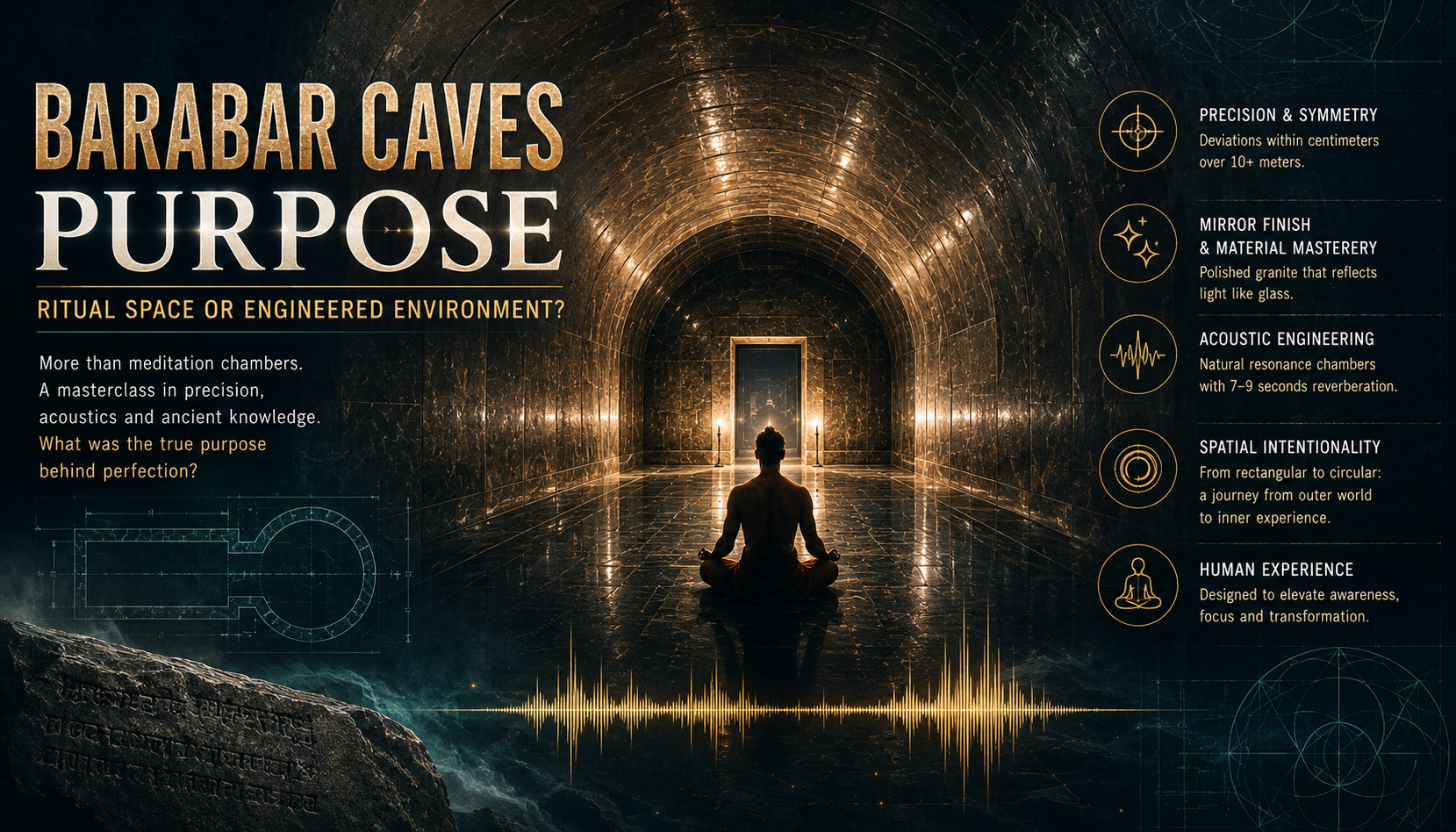
Curved geometry further complicates the engineering challenge. Flat surfaces can be checked using straight edges or visual references, but concave chambers distort spatial perception and make error detection far more difficult. Even slight asymmetries in polishing pressure can create visible optical discontinuities across curved granite surfaces. The fact that these chambers remain visually coherent indicates a highly refined practical understanding of surface behavior. In engineering terms, the caves demonstrate early mastery of large-scale error control in architectural finishing.
Comparison with Other Ancient Stone Polishing Traditions
The Barabar Caves are often linked to the broader phenomenon known as “Mauryan polish,” a finishing style also visible on imperial pillars, sculptures, and ceremonial stonework from the same historical period. However, the caves represent the most extreme application of this technology because the polish covers entire enclosed interiors rather than isolated decorative surfaces. Mauryan pillars, some exceeding 12 meters in height and weighing more than 40 tons, already demonstrate exceptional stoneworking capability. Yet polishing a freestanding object is fundamentally different from finishing the interior of a carved granite chamber. The caves therefore represent a distinct escalation in technical complexity.
Comparable achievements can be found in other ancient civilizations, though rarely at the same scale or reflectivity. Ancient Egyptian granite sarcophagi from sites such as Great Pyramid of Giza display remarkable internal smoothness and precision machining characteristics. In Peru, Inca masonry achieved extraordinary stone-fitting tolerances, though without mirror-like polish. Later Indian temple traditions produced highly refined stone carving, but few examples equal the optical reflectivity of the Barabar interiors. This places the caves in a unique category within the global history of ancient material processing (Yuga Cycles and Mythological Time Systems article).
What distinguishes Barabar most clearly is the combination of scale, curvature, and continuity. Many civilizations polished statues, columns, or ceremonial objects, but polishing entire granite chambers with such uniformity remains exceedingly rare. The caves therefore stand not merely as architectural monuments, but as evidence of advanced procedural systems capable of controlling difficult material transformations over large spatial environments. Their uniqueness continues to challenge conventional assumptions regarding the limits of ancient engineering capability.
The Limits of Conventional Explanations
The standard explanation for Barabar Caves Polishing involves manual abrasion using sand, mineral powders, water, and prolonged labor. From a purely physical standpoint, this explanation is valid because granite can indeed be polished through repeated abrasion. However, acknowledging theoretical possibility does not fully explain the extraordinary consistency and scale achieved within the caves. Experimental archaeology has successfully polished small granite objects, but scaling that process to entire chambers introduces exponentially greater complexity. The challenge lies not in whether polishing is possible, but in how such precision was systematically maintained.
Several technical questions remain difficult to answer in detail. How did workers maintain consistent curvature and reflectivity without modern reference systems? How were polishing sequences coordinated across large teams to prevent visible transitions? How were abrasive materials standardized over years of continuous work? These questions do not necessarily imply lost “advanced machines,” but they do suggest highly optimized workflows and practical knowledge far beyond simplistic depictions of ancient labor. The caves reveal a level of operational sophistication that is often underestimated (Older Dryas and Younger Dryas Climate Events articles).
Modern observers sometimes assume that ancient technology must have been primitive because it lacked industrial machinery. Yet many historical engineering systems achieved extraordinary results through organization, repetition, and accumulated craft knowledge. The Barabar Caves demonstrate that precision can emerge from disciplined process control even without electricity or mechanization. Rather than representing an impossible anomaly, the caves illustrate how advanced procedural systems can produce results that continue to impress modern engineers and researchers alike.
Lost Knowledge and Technical Continuity
Barabar Caves Polishing also raises the broader historical question of technological continuity and loss. Human civilizations frequently develop specialized techniques that later disappear due to political collapse, economic change, or the breakdown of skilled guild systems. The formula for Roman marine concrete remained poorly understood for centuries after the fall of the Roman Empire. Damascus steel production methods largely vanished despite the survival of the blades themselves. Similar patterns appear throughout architectural history, metallurgy, and materials science (Sacred Geometry and Megalithic Architecture article).
In this context, the Barabar polishing tradition may represent the peak of a highly specialized stone-finishing culture that gradually declined after the Mauryan period. Such techniques may never have been fully documented in written form and instead depended on apprenticeship, repetition, and direct transmission between skilled workers. If the institutional systems supporting these craftsmen disappeared, the techniques themselves could fade within only a few generations. The surviving caves would then become isolated remnants of a once broader technical tradition.
This possibility does not require speculative theories about forgotten civilizations or impossible technology. Instead, it highlights how fragile practical knowledge can be when separated from the social systems that sustain it. The caves demonstrate that ancient societies were capable of achieving astonishing technical sophistication through cumulative refinement over time. Their survival provides rare insight into what organized ancient engineering systems could accomplish when supported by centralized resources and highly trained labor.
Barabar Caves Polishing as an Integrated Engineering System
Rather than viewing polishing as a decorative afterthought, it is more accurate to understand Barabar Caves Polishing as part of an integrated engineering system. Every stage of construction influenced the final reflective outcome, from excavation geometry to abrasive selection and labor coordination. Poorly aligned excavation surfaces would dramatically increase polishing difficulty later in the workflow. Likewise, inconsistencies in chamber curvature could become visually magnified once reflectivity emerged. The final result therefore depended on careful integration between all phases of construction (Ancient Construction Project Management article1 & article2).
Material selection also played a critical role. Different granite compositions respond differently to abrasion depending on crystal size, mineral distribution, and fracture behavior. Ancient engineers may have intentionally selected sections of rock with favorable structural and polishing characteristics. The workflow itself likely followed highly standardized sequences to ensure repeatability across multiple chambers. Such organization suggests systemic planning rather than spontaneous experimentation.
This systems-oriented interpretation aligns with broader patterns observed throughout ancient engineering history. Monumental architecture rarely results from isolated genius alone; it emerges from coordinated labor, procedural consistency, and long-term institutional knowledge. The Barabar Caves therefore reveal not just technical skill, but the existence of a mature engineering culture capable of integrating material science, geometry, logistics, and workforce management into a unified production system. Their enduring polish stands as physical evidence of that achievement.
Conclusion
Barabar Caves remain one of the clearest demonstrations of ancient mastery over difficult materials and large-scale architectural finishing. The mirror-like granite interiors, preserved across curved chambers for more than two millennia, reveal extraordinary control over abrasion, geometry, and workflow coordination. Achieving such results in one of the hardest natural stones known to builders would challenge even modern craftsmen using advanced tools. The caves therefore deserve recognition not merely as religious monuments, but as engineering achievements of global significance.
The technical sophistication visible in the caves suggests a civilization capable of long-term planning, organized labor management, and highly refined procedural knowledge. While the fundamental physics of abrasion are understood today, the execution of these techniques at such scale and consistency remains deeply impressive. The caves challenge simplistic assumptions about ancient technology by demonstrating how disciplined systems and accumulated expertise can rival the precision of later industrial processes. Their existence reminds us that technological advancement is not always linear and that remarkable capabilities can emerge long before modern machinery.
Ultimately, Barabar Caves Polishing should be viewed not as an inexplicable mystery, but as evidence of what ancient engineering cultures could achieve through sustained refinement, organization, and technical discipline. The caves stand as a benchmark of material processing, architectural precision, and human persistence. More than 2,200 years after their creation, their reflective granite surfaces continue to provoke admiration, debate, and scientific curiosity. Few ancient structures communicate technical mastery as powerfully or as silently as these remarkable chambers carved into the granite hills of Bihar.
References and Further Reading
Barabar Caves of India – Documentary Video (link)
A History of Ancient and Early Medieval India (link)
The Wonder That Was India (link)
Ancient Indian Architecture More Advanced Thank You Thought (link)
Seed of Knowledge, Stone of Plenty (link)
Academia.edu – Archaeological Survey of India documentation on the Barabar Caves (link)
ResearchGate studies on rock-cut architecture and ancient acoustics (link)
ResearchGate Mirror-Polished Granite Caves -Barabar Hills (link)
Ancient Hyper Forests and Giant Trees (link)
Pre Flood Civilization and Environmental Collapse (link)
Was the Ancient World Phisically Different? (link)
Giant Humans Before the Younger Dryas (link)
Ancient Construction Project Management (link)
Ice Age Civilization Lost Worlds Before Floods (link)
Lost Knowledge of Ice Age Rewritten History (link)
Ice Age Knowledge Science Before Younger Dryas (link)
Geometry and Earth Scaling (link)
How Ancient Builders Measured the Stars (link)