Barabar Caves Acoustics
Barabar Caves contain some of the most unusual and measurable acoustic environments found in ancient architecture. The Barabar Caves Acoustics reveal how geometry, material composition, and spatial precision combine to produce powerful reverberation, sustained echoes, and frequency amplification inside enclosed granite chambers. Carved during the Mauryan period in the 3rd century BCE, the caves feature mirror-polished granite interiors that reflect sound with exceptional efficiency. Even quiet vocalizations can generate prolonged reverberation that transforms the chambers into highly responsive acoustic spaces. Modern acoustic engineering recognizes that enclosed curved surfaces with low absorption coefficients naturally intensify sound reflections, and the Barabar caves display these conditions to an extraordinary degree (Acoustic Engineering Ancient Structures articles).
When analyzed alongside the previously documented precision of Barabar Caves Symmetry and Barabar Caves Polishing, the acoustic properties appear increasingly interconnected rather than accidental. Granite surfaces typically possess sound absorption coefficients as low as 0.01–0.03 at mid frequencies, meaning that nearly all acoustic energy is reflected back into the space. This makes the caves acoustically comparable to highly reflective chambers used in modern resonance testing. Researchers and visitors frequently report that echoes inside the chambers persist far longer than expected for their relatively modest size. The combination of geometric consistency, radial chamber design, and polished stone creates conditions where sound waves repeatedly circulate with minimal energy loss. This raises an important question: were the Barabar Caves intentionally designed to interact with sound, or are these acoustic effects an unintended consequence of extraordinary geometric precision?
Barabar Caves Acoustics and Reverberation Time
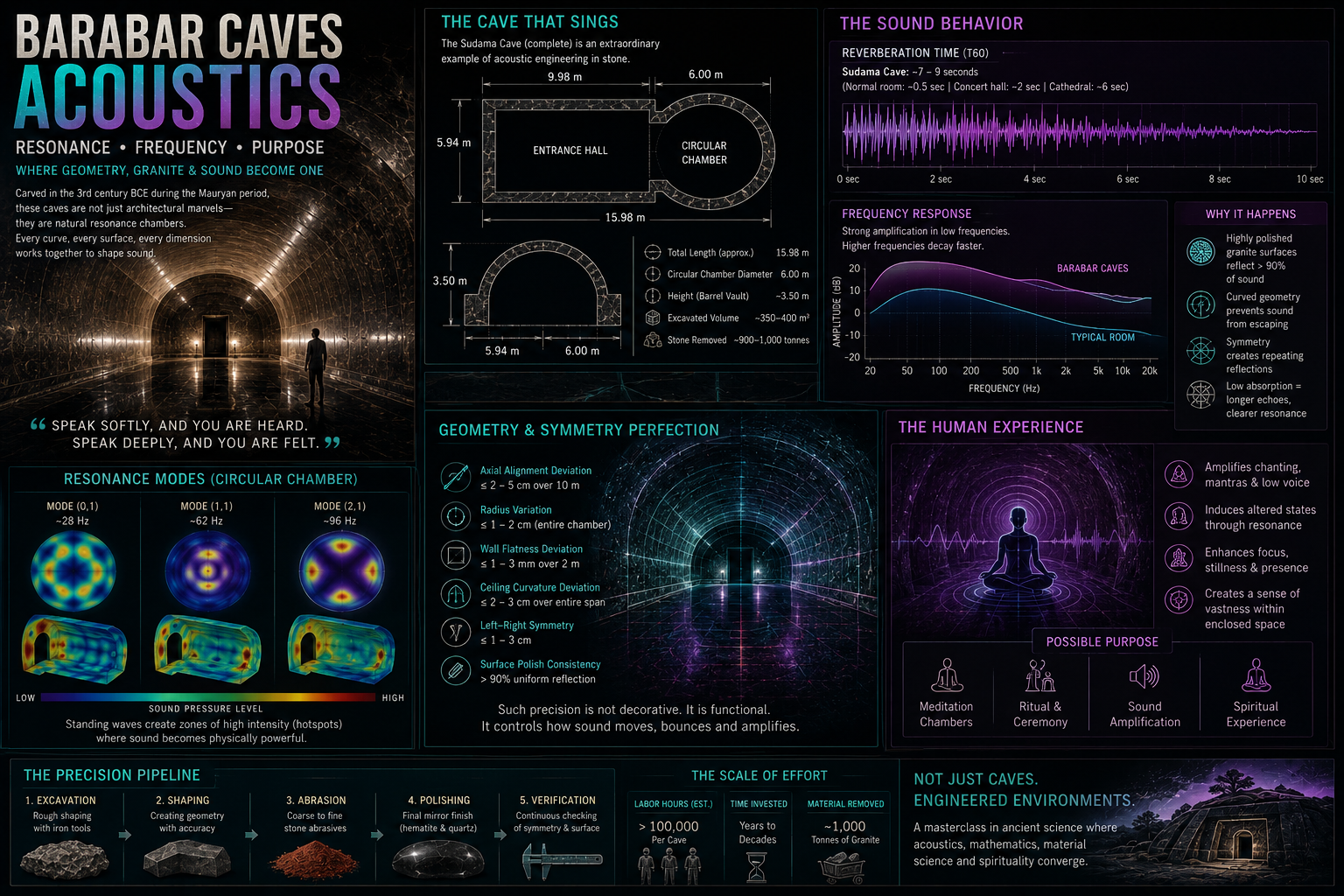
One of the most measurable aspects of Barabar Caves Acoustics is reverberation time, often referred to in acoustics as T60. Reverberation time measures how long it takes for sound intensity to decay by 60 decibels after the original source stops. In highly reflective environments, reverberation can persist for several seconds, producing prolonged echo effects and layered sound reflections. The Barabar caves exhibit unusually long reverberation times despite their relatively compact dimensions. This makes them acoustically distinct from most other ancient rock-cut structures. The polished granite interiors preserve sound energy with exceptional efficiency.
Estimated values in Sudama Cave:
- reverberation time (T60): approximately 7–9 seconds
- echo persistence: multiple reflections before decay
- minimal sound absorption due to granite surfaces
For comparison:
- modern concert halls: ~1.5–2.5 seconds
- large cathedrals: ~5–7 seconds
The Barabar caves exceed many intentionally designed acoustic spaces in echo duration despite lacking modern sound engineering technologies. Reverberation times above 7 seconds are considered extremely high in architectural acoustics and are generally associated with large ceremonial or monumental spaces. The caves achieve this through a combination of hard reflective granite, enclosed geometry, and near-complete absence of sound-dampening materials. Acoustic engineers note that polished stone surfaces can reflect more than 95% of incoming sound energy depending on frequency range. Because there are few irregular surfaces to scatter waves, echoes continue circulating through the chambers with limited attenuation. This produces the immersive auditory environment that has become one of the defining features of Barabar Caves Acoustics (Barabar Caves Symmetry article).
Frequency Behavior and Resonance
Barabar Caves Acoustics are not acoustically uniform across all frequencies. Observations suggest that low-frequency sound waves are amplified and sustained more effectively than higher-frequency sounds. This phenomenon is important because lower frequencies possess longer wavelengths that interact differently with enclosed spaces and curved surfaces. Deep vocal tones, chants, and resonant humming therefore become particularly pronounced inside the caves. Acoustic resonance occurs when specific frequencies align with the natural dimensions of a chamber, allowing standing waves to form and reinforce themselves. The geometry of the circular chambers appears especially suited for this kind of resonance behavior.
Key characteristics include:
- low-frequency sound waves sustain longer
- resonance nodes form within circular chambers
- sound intensity increases with vocal depth
The circular rear chamber in Sudama Cave behaves similarly to a resonance cavity used in modern acoustic engineering. Its approximate diameter of 6 meters supports standing wave formation at frequencies within the lower vocal range. Curved walls redirect sound toward central zones, increasing localized acoustic intensity. Because polished granite absorbs very little energy, wave coherence remains stable for longer durations than in rough stone environments. Visitors often notice specific locations where sound suddenly becomes louder or more concentrated, indicating the formation of resonance nodes. These effects are entirely consistent with known resonance physics and demonstrate how chamber geometry directly shapes acoustic behavior (Barabar Caves Polishing Mystery article).
Geometry and Acoustic Amplification
The relationship between geometry and Barabar Caves Acoustics is fundamental to understanding the caves’ unusual sound properties. The chambers are not acoustically neutral spaces; instead, their shape actively influences the direction, intensity, and persistence of sound waves. Cylindrical and curved geometries naturally redirect sound reflections, creating concentrated acoustic pathways within enclosed environments. Even minor geometric deviations can significantly alter resonance behavior and echo distribution. The caves therefore function as integrated acoustic systems rather than simple hollowed interiors. Their symmetry directly contributes to how sound propagates through the chambers.
Key geometric contributors include:
- cylindrical rear chamber → radial wave reflection
- barrel-vaulted ceilings → directional sound propagation
- axial alignment → longitudinal echo pathways
The combination of these architectural features creates layered reflections where sound travels along multiple intersecting paths simultaneously. In certain areas, constructive interference occurs when reflected waves reinforce one another, temporarily increasing sound intensity. Barrel-vaulted ceilings further channel sound longitudinally, allowing echoes to circulate along the main chamber axis. Acoustic simulations of curved stone spaces demonstrate that smooth radial geometries can significantly extend reverberation time by reducing chaotic scattering. The caves’ previously documented symmetry and tight dimensional tolerances therefore have direct acoustic consequences. Precision geometry is not merely visual; it fundamentally controls wave behavior inside the chambers (Barabar Caves Measurements article).
Surface Polishing and Sound Reflection
Barabar Caves Acoustics are significantly enhanced by the extraordinary polishing applied to the granite interiors. The mirror-like surfaces reduce frictional interaction between sound waves and the stone, allowing acoustic energy to remain concentrated within the chambers. In architectural acoustics, rough surfaces scatter and absorb sound, shortening reverberation and reducing echo clarity. By contrast, smooth reflective materials preserve coherent wave reflection and sustain resonance for longer periods. The caves therefore behave almost like acoustic mirrors where sound repeatedly rebounds with minimal energy loss. Their polished interiors are central to the caves’ unusual sonic environment.
Effects of polishing include:
- near-total reflection of sound waves
- minimal acoustic energy absorption
- preservation of wave coherence
Modern laboratory measurements show that polished granite possesses extremely low absorption coefficients compared with porous or textured materials. This means that most incoming acoustic energy remains active within the chamber instead of dissipating into the walls. As a result, echoes remain sharp, reverberation persists longer, and even quiet sounds become amplified through repeated reflection. The smoothness of the surfaces also reduces random diffusion, preserving directional wave movement across the chamber geometry. This explains the clarity and intensity of vocal resonance reported inside the caves. The polishing therefore serves not only an aesthetic purpose but also dramatically influences acoustic performance (Barabar Caves Acoustic Engineering article).
Human Perception Inside the Caves
Barabar Caves Acoustics influence not only measurable sound behavior but also human sensory perception. Environments with strong reverberation and resonance can alter how people perceive space, distance, and even the presence of their own voice. Inside the caves, echoes create the impression that sound extends beyond the visible boundaries of the chamber. This effect can produce a heightened awareness of spatial depth and enclosure simultaneously. Modern psychoacoustic research shows that prolonged reverberation affects cognitive interpretation of environmental scale and emotional atmosphere. The caves therefore create not only physical resonance but also perceptual transformation.
Reported experiences include:
- amplified awareness of one’s own voice
- sensation of spatial expansion due to echo
- altered perception of depth and distance
Low-frequency resonance is especially significant because it can produce subtle physical sensations within the body. Frequencies below approximately 150 Hz are capable of generating mild vibrational responses in the chest cavity and skeletal structure. Studies in psychoacoustics suggest that sustained low-frequency sound may influence breathing rhythm, emotional intensity, and meditative focus. While individual responses vary, these effects are well documented in both modern acoustic science and ritual architecture research. The caves’ prolonged reverberation may therefore have enhanced chanting, vocal projection, and ceremonial experiences. Their acoustic properties interact directly with human sensory processing in ways that extend beyond ordinary echo (Barabar Caves Precision Beyond Explanation article).
Intentional Design vs Emergent Effect
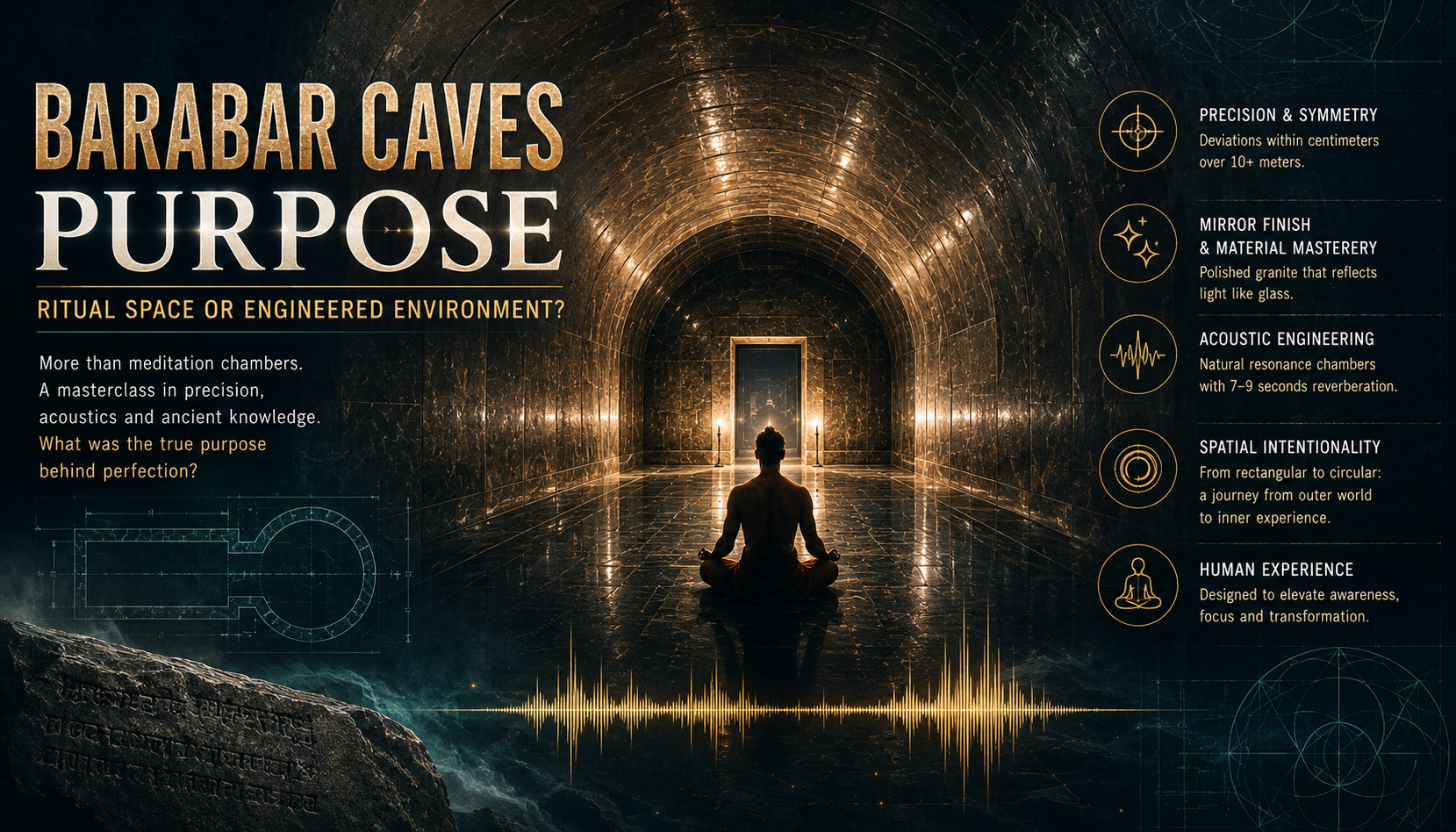
One of the central debates surrounding Barabar Caves Acoustics is whether the acoustic behavior was intentionally engineered or emerged naturally from other construction priorities. Two primary interpretations dominate current discussion among archaeologists and acoustic researchers. The first argues that resonance effects are accidental byproducts of polished granite and enclosed geometry. The second proposes that ancient builders recognized and possibly utilized these acoustic characteristics for ritual or experiential purposes. At present, no surviving written records definitively confirm deliberate acoustic engineering. However, the consistency of the acoustic conditions suggests that the effects may not have gone unnoticed by the builders.
Possible explanations include:
1. Emergent Effect
Acoustic behavior arises naturally from:
- smooth reflective surfaces
- enclosed chamber geometry
- granite material properties
2. Embedded Function
Acoustics were recognized and possibly utilized:
- during chanting or ritual practices
- to enhance auditory immersion
- as part of intentional spatial design
Ancient builders may not have understood acoustics in mathematical terms, but empirical observation alone could have revealed the dramatic sound behavior inside the chambers. Repeated exposure would quickly demonstrate how vocal tones intensified and persisted within the space. Many ancient cultures incorporated experiential environmental effects into architecture without formal scientific theory. The caves’ extraordinary polishing and geometric consistency suggest a construction approach attentive to sensory outcomes. Even if acoustics were not the original design objective, they may have become an appreciated and intentionally preserved feature during excavation. This possibility remains open within current archaeological interpretation (Stone Functional Materials article).
Comparison with Other Ancient Acoustic Sites
Barabar Caves Acoustics align with acoustic phenomena observed at several ancient sites around the world. Archaeologists and acoustic researchers have identified resonance behavior in structures ranging from Egyptian temples to Mayan ceremonial platforms and Neolithic burial chambers. These sites differ culturally and geographically, yet many share enclosed geometries and reflective surfaces that enhance sound interaction. The recurring appearance of acoustic effects in ritual or ceremonial architecture has led some researchers to investigate whether ancient societies intentionally incorporated sound-responsive spaces into construction practices. While evidence varies by site, the pattern itself is notable. The Barabar caves fit within this broader context of ancient acoustic environments.
Comparable ancient acoustic features include:
- Egyptian temples exhibiting prolonged echoes
- Mayan structures amplifying sound at focal points
- Neolithic chambers producing resonance effects
Despite major differences in architectural style, these sites share several important characteristics. Enclosed geometries create controlled sound pathways, while hard surfaces preserve acoustic energy through reflection. Many ancient ceremonial spaces also emphasize symmetry and proportional layout, both of which influence resonance behavior. Acoustic archaeology has increasingly demonstrated that ancient builders were often sensitive to how sound interacted with architecture. In some cases, specific frequencies become amplified only at particular locations inside a structure. The Barabar caves therefore contribute to a growing body of evidence showing that acoustics played a meaningful role in ancient built environments (Resonance and Stone The Hidden Technology of Sound article).
Barabar Caves Acoustics in a Systems Framework
When examined alongside symmetry, polishing, and geometric control, Barabar Caves Acoustics support a systems-based interpretation of the site. The caves do not function as isolated architectural features but as interconnected physical environments where multiple variables interact simultaneously. Geometry directs wave movement, polishing preserves acoustic energy, and symmetry stabilizes reflection patterns. Together, these elements create an integrated resonance system shaped by material and spatial precision. This systems perspective helps explain why the caves produce such unusually coherent acoustic behavior. Their sound properties emerge from the interaction of the entire architectural structure.
In this framework:
- symmetry → controls wave pathways
- polishing → preserves wave energy
- geometry → defines resonance behavior
Acoustics therefore cannot be separated from the broader engineering logic of the caves. Every aspect of the interior contributes to the final sonic environment, from chamber proportions to surface finish quality. This interconnectedness suggests that the caves were constructed through highly organized design principles rather than random excavation. Modern architectural acoustics similarly relies on integrated planning where shape, material, and surface treatment work together. The Barabar caves achieve comparable interactions through entirely ancient methods. Their acoustic behavior reinforces the idea that these structures represent sophisticated examples of systems-oriented engineering (Axial Precession anf the Great Year article).
Limits of Interpretation
Despite the measurable acoustic effects present inside the caves, interpretation must remain cautious and evidence-based. No surviving inscriptions or texts explicitly describe the acoustic purpose of the chambers. Over more than two millennia, environmental changes may also have altered some original acoustic characteristics. Surface wear, minor damage, and atmospheric conditions can influence reverberation behavior and frequency response. In addition, subjective human experiences of resonance and echo can vary significantly between individuals. These limitations make it important to distinguish measurable physics from speculative interpretation.
Important limitations include:
- lack of direct written documentation
- possible acoustic changes over time
- subjective interpretation of sound experiences
Modern acoustic measurements can confirm reverberation times, resonance frequencies, and reflection patterns, but they cannot independently determine ancient intent. Archaeologists must therefore avoid attributing symbolic or ritual meaning without supporting evidence. Nevertheless, the acoustic phenomena themselves are physically real and reproducible. Digital impulse-response testing and spectral analysis could provide even more precise datasets in future studies. Such research may clarify how different chamber shapes influence sound propagation across the complex. Until then, the caves remain a compelling example of measurable ancient acoustic architecture The Cosmic Code – Decoding the Sky Temple article).
Conclusion
Barabar Caves Acoustics reveal an extraordinary interaction between geometry, material, and sound, producing resonance behavior that rivals or exceeds many modern reverberant spaces. The caves demonstrate how polished granite, curved geometry, and axial alignment combine to create prolonged echoes, low-frequency amplification, and highly immersive acoustic environments. Reverberation times estimated between 7 and 9 seconds place the chambers among the most acoustically reflective enclosed spaces associated with ancient architecture. These effects are not random anomalies but direct consequences of measurable physical conditions embedded within the structure itself. The caves therefore function as natural resonance chambers shaped through remarkable geometric precision.
Whether these acoustic properties were intentionally engineered or emerged from broader construction priorities remains an open question. However, the consistency of the caves’ symmetry, polishing, and dimensional control strongly suggests that their acoustic behavior is structurally integrated rather than incidental. Modern acoustic science confirms that even small geometric changes would significantly alter the observed resonance patterns. The caves thus provide valuable evidence that ancient builders possessed sophisticated practical understanding of how materials and spatial forms influence sensory experience. Their interiors remain not only visually impressive but acoustically responsive environments that continue to challenge assumptions about early engineering capability. In this sense, the Barabar caves stand as some of the most remarkable examples of ancient architecture functioning simultaneously as geometry, structure, and sound system.
References and Further Reading
ResearchGate – Studies on ancient acoustics and resonance (link)
Andrija Puharich – Sacred Mushroom Key to the Door of Eternity (link)
Seed of Knowledge, Stone of Plenty (link)
ResearchGate Mirror-Polished Granite Caves -Barabar Hills (link)
Ancient Hyper Forests and Giant Trees (link)
Pre Flood Civilization and Environmental Collapse (link)
Was the Ancient World Phisically Different? (link)
Giant Humans Before the Younger Dryas (link)
Ancient Construction Project Management (link)
Ice Age Civilization Lost Worlds Before Floods (link)
Lost Knowledge of Ice Age Rewritten History (link)
Ice Age Knowledge Science Before Younger Dryas (link)
Geometry and Earth Scaling (link)
How Ancient Builders Measured the Stars (link)