
Göbekli Tepe and the Forgotten Dawn of Civilization
Human knowledge is often divided between what we experience in the present and what we reconstruct from the past. Yet, modern society tends to undervalue ancient history, treating it as distant and disconnected from contemporary reality. Anthropology and archaeology remind us that understanding humanity’s origins is essential to understanding who we are today. Few discoveries illustrate this better than Göbekli Tepe, a site so ancient and anomalous that it has forced scholars to reconsider the very foundations of civilization.
Discovered in southeastern Turkey, Göbekli Tepe represents the earliest known monumental architecture on Earth and may redefine the story of human development itself.
Discovery of an Anomaly
Göbekli Tepe was identified in 1994 by German archaeologist Klaus Schmidt, though excavations formally began in 1996. Radiocarbon dating places its construction between the 10th and 9th millennium BCE, making it over 11,000 years old. This chronology places Göbekli Tepe approximately 7,000 years older than both Stonehenge and the Great Pyramid of Giza.
At the time of its discovery, mainstream archaeology believed humans of this era lived exclusively as nomadic hunter-gatherers. Monumental stone construction, organized labor, and advanced symbolic expression were thought impossible without agriculture or complex social hierarchies. Göbekli Tepe shattered that assumption overnight.

Architecture Beyond Its Time
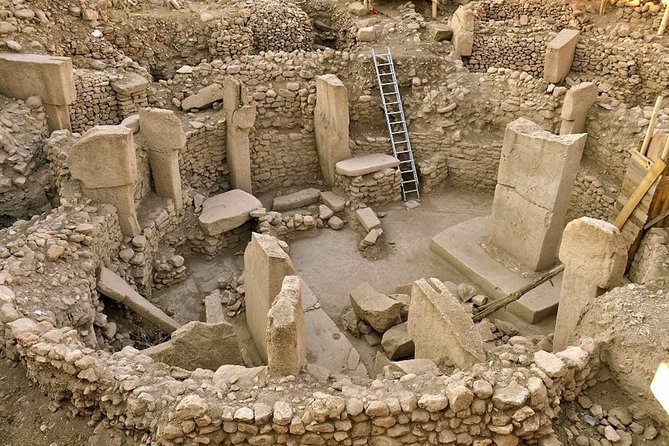
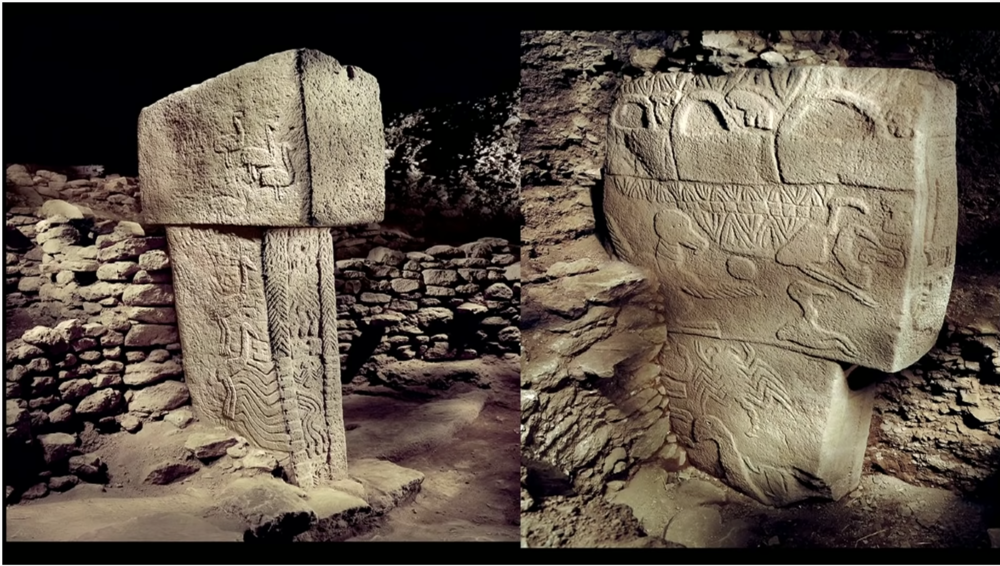
The site consists of massive T-shaped limestone pillars, some weighing up to 20 tons, arranged in circular enclosures. These pillars are carved with intricate reliefs depicting animals, abstract symbols, and mythological imagery. The precision of the stonework and the scale of construction imply a sophisticated understanding of geometry, engineering, and coordinated labor.
Although often compared unfavorably to the grandeur of the Egyptian pyramids, Göbekli Tepe’s true significance lies in its age, not its appearance. It represents an advanced architectural tradition emerging thousands of years earlier than previously believed possible.
As Klaus Schmidt himself stated, Göbekli Tepe “provides a chapter of humanity we did not know existed.”
A Center of Knowledge, Not a Settlement
One of the most striking aspects of Göbekli Tepe is that it was not a permanent settlement. There is little evidence of domestic life such as hearths or housing. Instead, the site appears to have functioned as a ceremonial or educational center, drawing groups from across the region.
Even more remarkable is the evidence of early agriculture and animal domestication found nearby. Domesticated wheat varieties trace their origins to this exact region of the Fertile Crescent. However, agriculture seems to have emerged after Göbekli Tepe’s construction, not before it.
This suggests that agriculture may have been taught or disseminated from the site, rather than being its prerequisite. In this view, Göbekli Tepe becomes a catalyst for civilization rather than its byproduct.

Sudden Innovation, Not Gradual Evolution
Traditional models describe agriculture as a slow evolutionary process. Göbekli Tepe contradicts this narrative. Instead of gradual experimentation, the archaeological record points to a sudden and widespread adoption of farming practices following the site’s active use.
Scholars have described Göbekli Tepe as a “center of innovation”, where knowledge, stories, and techniques were exchanged. For nearly 3,000 years, groups likely gathered there before returning to their territories, carrying transformative ideas with them.
Mythology and the Echoes of Du-Ku
Ancient Sumerian mythology speaks of Du-Ku, a sacred mountain described as the place where grain was first sown and animals were first domesticated. Du-Ku translates as “holy hill,” while Göbekli Tepe means “potbelly hill.” Notably, Göbekli Tepe is not a natural hill but an artificial mound, deliberately constructed before the stone enclosures were erected.
This pattern aligns with a global tradition of mound and pyramid building, from Cahokia in North America to the pyramids of Egypt, Mesoamerica, and China. Whether symbolic, cosmological, or practical, early civilizations repeatedly shaped the Earth into elevated sacred forms.
Intentional Burial and Preservation
Perhaps the most mysterious feature of Göbekli Tepe is that it was intentionally buried. The site was not abandoned and eroded over time; it was deliberately filled in. This intentional burial preserved the structures in extraordinary condition and prevented contamination from later cultures.
Only about 5 percent of the site has been excavated, yet its impact on archaeology has been profound.
Cataclysm, Memory, and Lost Civilizations
The timeline of Göbekli Tepe coincides with the Younger Dryas, a sudden return to Ice Age conditions around 12,800 years ago. Increasing geological evidence suggests this event may have been triggered by an extraterrestrial impact, resulting in massive flooding, climate disruption, and megafaunal extinctions.
Researchers such as Graham Hancock propose that an advanced prehistoric civilization may have existed prior to this cataclysm, transmitting knowledge to surviving populations afterward. In this framework, Göbekli Tepe represents not the birth of civilization, but its rebirth.
Plato’s account of Atlantis, allegedly destroyed around 9,600 BCE, aligns intriguingly with known climatic upheavals. While speculative, these correlations invite deeper investigation rather than dismissal.
But the question remains: How did Göbekli Tepe come to be?
For those who are fascinated by the unknown origins of human civilization, open to the idea that the current period may not be the uncontested pinnacle of human society, and simply humbled by the discovery of sites like Göbekli Tepe which pose more questions than they answer, the simplified assessment by mainstream archaeology that it was built by hunter gatherers is rather frustrating, for a number of reasons other the clear lack of evidence. The world of academia in general often deters researchers from contesting theories accepted as the truth. After all, it’s easier to publish a paper which supports the findings of the entity which funds you than it would be to provide differing hypotheses that could lead to drastically new understanding.
Graham Hancock is one of the few prominent figures who is attempting to piece together the story of mankind—a task that requires one to detach themselves from the dogma of our current academic landscape and not be afraid of saying something wrong. The most important work being done in science is always what’s on the cusp of what is known and what is not known, requiring trial and error and the exploration of out-of-the box ideas.
Much of Hancock’s work is on answering the questions around humanity’s earliest and most impressive civilizations. From the Pyramids of Egypt to the Peruvian city of Tiahuanaco, Hancock is fascinated by the near impossible feats that past societies have accomplished. He has taken it upon himself to answer the questions of how and why ancient civilizations did the things they did. His main thesis, and the reason he is ostracized by most of the academic community, is that there lived a highly advanced ancient civilization which somehow relayed information to the more widely studied ancient civilizations we know of today, such as the Greeks, Egyptians, and Incans. Hancock believes this theory can help explain the existence of highly advanced structures from Stonehenge to the Great Pyramids. Naturally, Göbekli Tepe is at the center of Hancock’s work, and his postulation is that this was not the birth of civilization, but rather a rebirth of civilization facilitated by the transfer of knowledge to neolithic hunter gatherers from members of this advanced society, most of whom were wiped out by a global cataclysm caused by an asteroid impact which took place around 12,000 years ago.
It sounds pretty out there. But when you look at the facts, evidence presents itself that helps legitimize this theory. We know that one of the most consequential events in the history of our planet was the asteroid impact that wiped out the dinosaurs 65 million years ago and caused the K-T boundary, a geological feature which can be seen across the world. Recently, thanks to the work done by Jim Kennett, Allen west, James Wittke, Richar Firestone, and Albert Goodyear in 2013, there is a growing body of evidence which points to an extraterrestrial impact 12,800 years ago that contributed to megafaunal extinctions—a hypothesis that is supported by mainstream geology as well. Their study found that 10 million tons of spherules were distributed across 50 million square kilometers. Spherules are very small pieces of a comet or asteroid which disperse across vast areas upon impact on a planet. This event laid down a layer of ash and soot across the planet, known as a black mat, and geologic surveys of this layer show the same spherules and other impact proxies as the K-T event from modern day Canada to Syria. The supposed impact has also been used to explain a sudden decrease in temperatures and return to the glacial conditions of the ice age, known as the Younger Dryas. While this is still a theory and not yet accepted as fact, it has been supported by many highly respected scholars in the field of geology. This along with the convincing physical evidence makes it a very enticing and popular hypothesis with major implications
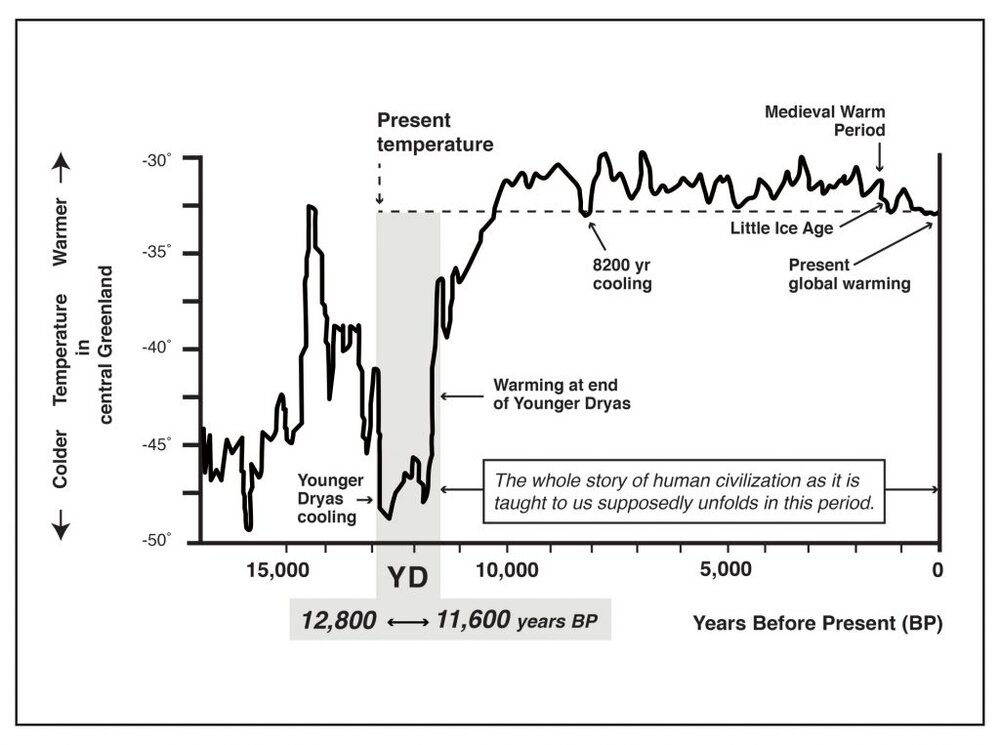
As seen in the graph, the onset of the Younger Dryas, likely caused by the impact of comet fragments 12,800 years ago, was accompanied by massive floods and global cooling. It is said to have made an impact on the North American Icecap, causing meltwater to enter the gulf stream, one of Earth’s main heating systems. Also observed is another instance of massive flooding, known as Meltwater Pulse 1B, which occurred 11,600 years ago—only this time the event coincided with a sudden rise in temperature. In the 1980s, astronomer Sir Fred Dyle said that the second incident was also a result of an extraterrestrial impact, this time in the ocean, which caused water vapor to fill the atmosphere and led to a greenhouse effect . While evidence for this hypothesis isn’t as strong as the initial impact, the fact is that there were two major catastrophic events associated with melting ice around this period.
What does this have to do with Göbekli Tepe and ancient civilizations? We’ve very recently found out that there was a major cataclysm 12,800 years ago – not quite as intense as the K-T event but a baby version of it if you will – only this time there were modern humans living on Earth. Had there been any sort of advanced civilization living at this point, namely in North America, they likely would have been wiped off the map.
One of the most widely known myths of humanity is the story of Atlantis, a highly advanced island-nation described by Plato in his works Timaeus and Critias. It is important to note that while we refer to many stories today as myths, at the time of their transcription, they were being recorded as documentation of real events. In the case of Atlantis, Plato had heard of the story from his grandfather, Solon. Solon traveled to Egypt in the year 600 BC and heard from priests at the Temple of Sais about Atlantis being destroyed by an earthquake and flood. When Solon asked the priests when Atlantis was destroyed, they said it happened 9,000 years prior.
This is where it gets really interesting: 9,000 years before 600 BC would be 9,600 BC. And 9,600 BC would be 11,600 years ago, precisely the date of Meltwater Pulse 1B, give or take a few decades.
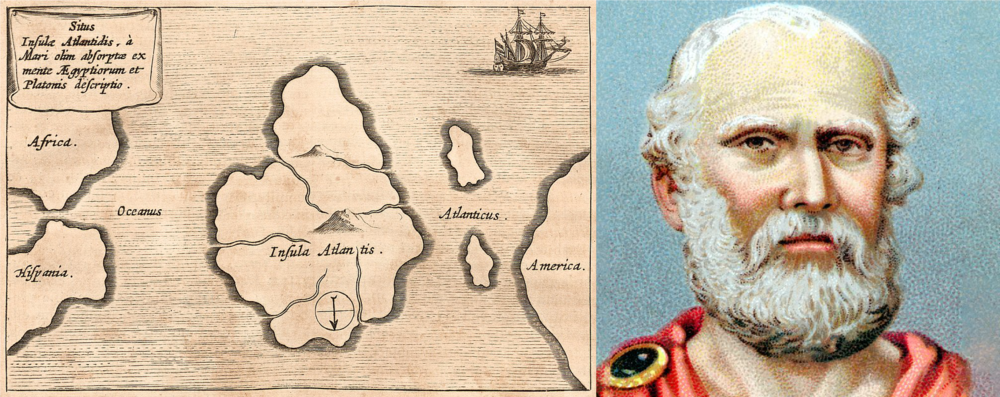
Could Atlantis have been a real place, and part of the highly advanced lost civilization which Graham Hancock has hypothesized? If so, could members of this civilization also be responsible for the construction of Göbekli Tepe, which was built between the 10th and 9th millennium BC – roughly 11,600 years ago?
Yes, it is possible.
This would allow us to make sense of the anomalous site of Göbekli Tepe and help explain the sudden appearance of advanced structures and agriculture, which we consider to be the start of human civilization—or a restart of civilization. Being open to this possibility would also help us make sense of the geometric precision and grandiosity of sites like the Great Pyramids of Egypt, Stonehenge, and the temple at Tiahuanaco. If there existed a highly advanced civilization in our ancient past, there would theoretically exist a central repository of knowledge which early civilizations drew from.
Given the current, compartmentalized state of global academia, the scholars doing work at the frontier of human knowledge must be intellectually cautious and stick to hard data and facts, rather than unsubstantiated theories. But then there are independent-thinkers like Graham Hancock, who are not bound by the dogma or professional pressures of any particular scientific field.
There are also platforms like World Wide Waves that aim to present thought-provoking content to raise our collective consciousness, and allow everyday free-thinking people to take in all the magnificence of the amazing reality we live in. It is up to us to think critically and look at the world around with bewilderment: It may be more fascinating and magical than the current systems allow us to comprehend.
Truth persists. Truth does not conform to the zeitgeist of any particular moment in time. We are limited by the dogma of our time in our ability to perceive the objective truth. Whatever happened at Göbekli Tepe happened. This particular event is as far back in our history as we can go, and the tiny sliver of truth that we know about this site is already the most consequential and paradigm shifting truth in the world of anthropology.
The Great Pyramids were built 4,500 years ago, and we have no idea how. Stonehenge stood 1,000 years before that, and we have no idea how. Göbekli Tepe was constructed 7,000 years before that, and we have no idea how. But someone did it. The how is out there, and I’m sure that if and when we uncover the secret, it will be far more mind-blowing and paradigm-shifting than the structures themselves.
Conclusion: The Question That Remains
Göbekli Tepe stands as a direct challenge to linear models of human progress. It reveals that monumental architecture, symbolic thought, and complex social organization existed at the very dawn of known history. Who built it, how they did so, and why they chose to bury it remain unanswered questions. But one fact is undeniable: Göbekli Tepe proves that humanity’s past is far more complex, interconnected, and mysterious than previously believed. Truth does not change with academic fashion. Göbekli Tepe happened — and its implications are only beginning to be understood.
Additional Reading & References
_____________________________________________________________________________________
- Faiz, Haque, The story and the consequence of Göbekli Tepe, www.worldwidewaves.co
- Megalithic Structures – link


3 Responses