Orion and the Great Pyramid: A Stellar Design?
The Great Pyramid Orion Belt alignment remains one of the most compelling and debated mysteries of ancient Egypt. Rising with astonishing precision from the Giza Plateau, the Great Pyramid of Khufu appears to reflect not only architectural genius but also a deep understanding of astronomy, sacred geometry, and cosmic symbolism. For centuries, scholars and researchers have questioned whether this monument was designed purely as a royal tomb or as part of a much broader celestial blueprint connecting Earth to the stars.
The Role of Astronomy in Ancient Egyptian Culture
Astronomy played a central role in ancient Egyptian culture, religion, and state organization. The Egyptians carefully observed the movements of the Sun, Moon, and stars to regulate agricultural cycles, religious festivals, and royal rituals. Celestial events such as solstices, equinoxes, and stellar risings were not abstract phenomena but sacred moments tied to divine order, known as Ma’at.
The Sun god Ra symbolized life, rebirth, and cosmic balance, while the stars were viewed as manifestations of divine power. Certain constellations, particularly Orion, held exceptional importance due to their association with Osiris, god of the afterlife and resurrection. This belief system laid the foundation for monumental architecture that did more than dominate the landscape, it mirrored the heavens.
The Great Pyramid Orion Belt Alignment Hypothesis
One of the most intriguing interpretations of the Giza Plateau is the Great Pyramid Orion Belt alignment, often discussed within the framework of the Orion Correlation Theory. This hypothesis suggests that the three main pyramids of Giza, Khufu, Khafre, and Menkaure, were positioned to reflect the three stars of Orion’s Belt: Alnitak, Alnilam, and Mintaka.
According to this view, the pyramids were not randomly placed nor solely aligned to cardinal directions, but deliberately arranged to recreate a celestial pattern sacred to Egyptian religion. The Nile River itself may have symbolized the Milky Way, reinforcing the idea of a terrestrial reflection of the heavens.
Astronomy, Osiris, and the Journey to the Afterlife
In Egyptian mythology, Orion was closely associated with Osiris, ruler of the underworld and judge of the dead. The deceased pharaoh was believed to transform into Osiris after death, ascending to the stars to live eternally among the gods. The Great Pyramid Orion Belt alignment may therefore represent a symbolic gateway, guiding the soul of the king toward rebirth in the celestial realm.
Ancient texts, including the Pyramid Texts, repeatedly reference the king’s ascent to the stars. This reinforces the interpretation that the pyramids functioned not only as funerary monuments but as cosmic resurrection devices, designed to harmonize earthly architecture with divine order.
Architectural Precision and Stellar Alignment
Researchers have long noted the extraordinary precision of the Great Pyramid’s construction. Its near-perfect cardinal alignment, massive stone blocks, and internal shafts suggest advanced planning and mathematical expertise. Some scholars, including Robert Bauval, have proposed that the shafts extending from the King’s and Queen’s Chambers were intentionally aligned with specific stars, including those of Orion and other significant constellations.
A quantitative astronomical analysis of the Orion Correlation Theory shows that while small discrepancies exist between pyramid placement and stellar positions, these variations fall well within the limits of naked-eye observation available to ancient astronomers. This strengthens the argument that any deviations do not invalidate the intentional nature of the alignment.
Scientific Debate and Skepticism
Despite its appeal, the Great Pyramid Orion Belt alignment remains controversial. Critics argue that the alignment may be coincidental or that alternative explanations, such as topography or construction logistics, better account for the pyramid layout. Others caution against projecting modern astronomical interpretations onto ancient cultures.
Nevertheless, the debate itself highlights an important shift in archaeological thinking: ancient civilizations may have possessed far more sophisticated knowledge than traditionally assumed. Sites like Göbekli Tepe have already forced scholars to reconsider established timelines of human development, lending credibility to the possibility that advanced astronomical planning existed earlier than expected.
A Monument Beyond Time
Whether viewed as symbolic, astronomical, or both, the Great Pyramid Orion Belt alignment continues to challenge simplistic interpretations of ancient Egypt. The Giza pyramids stand not merely as tombs of stone but as enduring expressions of humanity’s desire to understand its place in the cosmos.
Far from being relics of a “primitive” society, these monuments suggest a civilization deeply attuned to celestial cycles, spiritual continuity, and cosmic order. As research advances and new analytical tools emerge, the stars above Giza may yet reveal more secrets about the true purpose of the Great Pyramid.
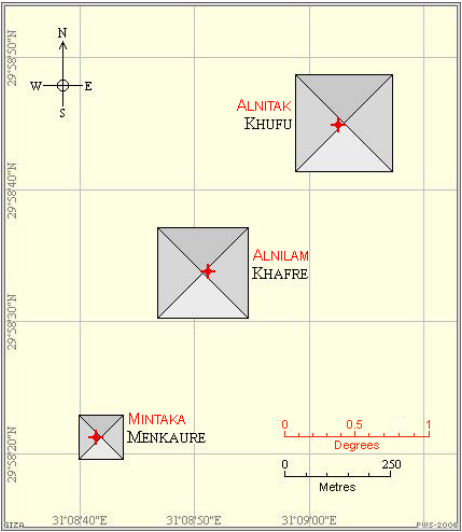
Figure 1 – Comparison between the positions of the Orion Belt stars (red dots) and those of the vertexes of the corresponding pyramids. The star map (scale in red) has been overlapped to the topographic map of the Giza necropolis (scale in black with the related coordinate grid in gray – after Wakefield Sault, 2008). The crosses represent the error bars on the stellar positions and indicate the minimum uncertainty, equal to 3’, due to the resolution power of the human eye under optimal observation conditions.
According to A quantitative astronomical analysis of the Orion Correlation Theory, this figure shows that a certain discrepancy exists between the actual position of the vertex of each pyramid and the position expected on the basis of the stellar correlation; such a difference is more pronounced in the case of the couple Khufu-Alnitak where it is equal to 3.1% of the angular distance between Alnitak and Alnilam; since the angular separation of the two stars is 1.356°, this corresponds to about 2.5’.
This value is less than the resolution power of the human eye (defined as the minimum angular distance between two sources necessary to see them as distinct objects); the latter in general falls between 5’ and 10’ (Silvestro, 1989), according to the characteristics of the observed sources, and, in the most favorable cases, can be as low as 3’ (Herrmann, 1975; Gribbin e Gribbin, 1996). Any measurement of stellar position (astrometry), performed with unaided eye, can never have an uncertainty less than the resolution power of the human eye, and in general the former is much greater than the latter. Therefore, the errors made by the pyramid builders in the positioning of these monuments, supposing they really wanted to represent the asterism of the Orion Belt, fall within the uncertainty range of the stellar positions known at that time. In other words, according to Bauval e Gilbert (1994), the positions of the main pyramids of the Giza plain correspond to those of the Orion Belt stars within the error margin of the astrometric measurements of that epoch. Were the builders of the Pyramids of Giza – Timekeepers of Ages – using a Masterplan Based on the Three Stars of The Belt of Orion?
Conclusion: Stone, Stars, and Forgotten Wisdom
The Great Pyramid of Giza continues to defy simple explanations. Its alignment with Orion’s Belt sits at the crossroads of astronomy, mythology, geometry, and theology. As ANCIENT360 has repeatedly shown, ancient civilizations were not merely builders of monuments—they were architects of meaning, shaping stone to mirror the heavens. The question remains open: Were the pyramids simply tombs, or were they designed as cosmic instruments—timeless markers of humanity’s forgotten relationship with the stars?