Meteorite Hits House Germany After Fireball Seen Across Europe
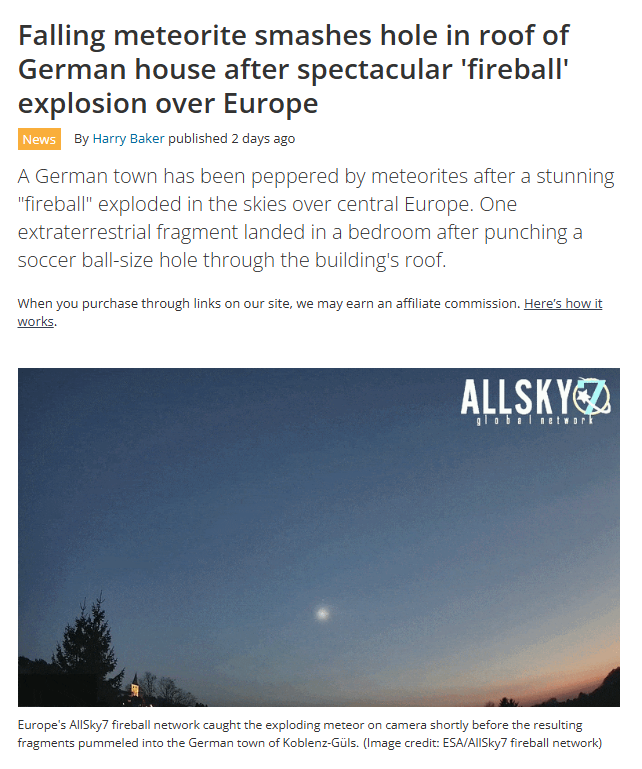
A rare cosmic event recently captured attention across Europe when a meteorite hits house Germany (Science Alert link) after a bright fireball streaked across the night sky. Witnesses in several countries reported seeing the spectacular meteor before fragments reached the ground. Fortunately, no one was injured, but the incident serves as a powerful reminder that Earth exists within a dynamic cosmic environment filled with moving celestial objects (Live Science link).
For readers of ANCIENT360, events like this highlight how the movements of asteroids, comets, and planets continue to interact with our world.
When a Meteorite Hits House Germany: The Fireball Over Europe
Witnesses across several European countries described seeing a brilliant fireball streak across the sky moments before the meteorite hits house Germany event occurred. Observers described a bright flash followed by a glowing trail as the object entered Earth’s atmosphere at tremendous speed.
When meteoroids enter the atmosphere, friction with the air heats the object to extremely high temperatures. This intense heating produces the bright streak of light commonly known as a meteor or “shooting star.” Most meteors burn up completely before reaching the ground. However, when a fragment survives the descent, it becomes what scientists call a meteorite (link).
In this case, at least one fragment survived its fiery journey and crashed through the roof of a home in Germany, creating a small hole and landing inside the house.
Earth’s Cosmic Environment and the Meteorite Hits House Germany Event
Although it is rare for a meteorite to strike a building, the meteorite hits house Germany incident reminds us that Earth constantly encounters debris traveling through the solar system. Earth encounters cosmic material every day.
Our planet travels through regions of space filled with dust, rock fragments, and small asteroids. Every year, thousands of tons of cosmic material enter Earth’s atmosphere.
Most of these particles are tiny and burn up high above the ground. Occasionally, however, larger fragments survive the descent and reach the surface.
These meteorite falls provide scientists with valuable information about the early solar system. Many meteorites are billions of years old and contain materials that formed during the birth of the Sun and planets.
In this sense, each meteorite that reaches Earth is a fragment of ancient cosmic history.
Cosmic Impacts That Have Changed Earth’s History
While the meteorite hits house Germany event caused only minor damage, larger cosmic impacts have played major roles in shaping Earth’s history. One debated example is the Younger Dryas Impact Hypothesis, which proposes that fragments of a comet or asteroid struck Earth around 12,800 years ago.
Scientists widely agree that a massive asteroid impact 66 million years ago contributed to the extinction of the dinosaurs. The impact released enormous energy, altering the climate and ecosystems across the planet.
Another intriguing scientific idea is the Younger Dryas Impact Hypothesis, which proposes that fragments of a comet or asteroid struck Earth around 12,800 years ago. According to this theory, the impacts may have triggered sudden climate changes that marked the end of the last glacial period and the beginning of the Holocene epoch, the relatively stable climate era in which human civilization developed.
Although this hypothesis remains debated, it highlights the possibility that cosmic events have influenced Earth’s climate and environmental history.
Why Ancient Civilizations Watched the Sky
Ancient cultures closely observed celestial movements including planets, comets, and meteor events. These observations formed the foundation of early astronomy and calendars. Many civilizations believed that unusual events in the sky carried important meaning about the relationship between Earth and the cosmos.
Long before modern astronomy, ancient civilizations closely observed the movements of celestial bodies. The Sun, Moon, and visible planets formed the foundation of early calendars, agricultural planning, and navigation systems. Comets, eclipses, and meteor events were also carefully recorded by ancient astronomers.
In many cultures, unusual celestial events were interpreted as signs that the heavens were interacting with the world below.
Today, science provides detailed explanations for these phenomena. Yet the sense of wonder experienced by ancient observers remains familiar to anyone who has watched a bright meteor cross the sky.
Meteors as Messages from the Early Solar System
Meteorites are not simply rocks from space. They are remnants of the processes that formed the solar system approximately 4.6 billion years ago.
Many originate from the asteroid belt between Mars and Jupiter, where countless rocky bodies orbit the Sun. Collisions between these bodies can send fragments drifting through space until their paths intersect with Earth’s orbit.
When these fragments enter our atmosphere, they produce the brilliant fireballs that sometimes appear in the night sky.
Each meteor event is therefore a brief intersection between Earth and a traveler that has been wandering through space for millions—or even billions—of years.
A Reminder to Look Up
The meteorite that struck a house in Germany serves as a striking reminder of the dynamic cosmic environment surrounding our planet.
Although such events are rare, they illustrate an important truth: Earth exists within an active solar system where celestial bodies constantly move along complex orbital paths.
For those interested in astronomy and cosmic awareness, moments like this encourage us to pay attention to the sky above us.
The movements of planets, asteroids, and comets continue to shape the environment of our solar system, just as they have throughout Earth’s long history.
Cosmic Awareness and the Mission of ANCIENT360
At ANCIENT360, we explore the deeper connections between humanity and the celestial environment that surrounds our planet.
From planetary cycles and solar activity to rare events like meteorite falls, the sky offers continuous reminders that Earth is part of a vast cosmic system.
Observing these events invites us to rediscover a perspective that ancient cultures once held naturally: the understanding that our world is deeply connected to the movements of the heavens.
And sometimes, those cosmic movements arrive with a flash of light across the sky—and a reminder delivered directly to Earth.