
Polyhedron in Sacred Geometry
The polyhedron in Sacred Geometry is one of the most fascinating structures in both mathematics and spirituality. In the simplest sense, a polyhedron is a three-dimensional solid made up of polygons joined at their edges. Its name comes from the Greek poly (many) and hedron (seat or face). Beyond its geometric meaning, the polyhedron carries a deep symbolic resonance in the study of sacred patterns, cosmic harmony, and the universal blueprint of creation.
The Geometric Foundation of Polyhedra
In classical geometry, a polyhedron is the 3D version of a polygon, extending into volume and space. Polyhedra are defined by their faces, edges, and vertices. A tetrahedron has four triangular faces, a hexahedron (cube) has six square faces, and a dodecahedron has twelve pentagonal faces.
Mathematicians distinguish between:
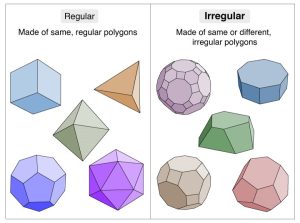 1. Regular Polyhedron – Also called Platonic Solids, with identical faces and perfect symmetry. It is a polyhedron with faces that are regular polygons congruent to each other. Regular polyhedrons are also known as ‘platonic solids’. Cubes, tetrahedrons, and octahedrons are common examples of regular polyhedrons.
2. Irregular Polyhedron – Solids whose faces vary in shape and size, like prisms and pyramids. It is a polyhedron with faces that are irregular polygons where all the components are not the same. Prisms and pyramids are common examples of irregular polyhedrons.
3. Convex Polyhedrons – very connecting line remains within the shape, symbolizing stability and wholeness. It is a polyhedron where a line segment joining any 2 points on its surface lies completely inside it. All regular polyhedra are convex.
4. Concave Polyhedron – With inward folds, they suggest mystery, transformation, and hidden space. It is a polyhedron where a line segment joining any 2 points on its surface can lie outside it.

This mathematical framework gave rise to deeper symbolic interpretations that shaped philosophy, mysticism, and even architecture.
Polyhedra and Sacred Geometry
The polyhedron in Sacred Geometry is more than a mathematical object—it is a sacred symbol of the cosmos. Ancient traditions saw these shapes as reflections of divine order. Plato associated the five Platonic Solids with the classical elements:
-
Tetrahedron – Fire
-
Cube (Hexahedron) – Earth
-
Octahedron – Air
-
Icosahedron – Water
-
Dodecahedron – Ether or the Heavens
Later, Archimedean Solids expanded this family, combining polygons into semi-regular forms that represent transformation, diversity, and the evolving complexity of life.
In mysticism, polyhedra are considered energetic templates—shapes that resonate with vibrational patterns found in nature, from crystals and molecules to planetary orbits. Their symmetry mirrors the universal truth that order underlies chaos.
Historical and Cultural Significance
-
Ancient Greece: Philosophers like Plato and Archimedes studied polyhedra as models of the cosmos.
-
Renaissance Europe: Artists and scholars such as Leonardo da Vinci illustrated polyhedra for works like Luca Pacioli’s De Divina Proportione, linking geometry with divine proportion and aesthetics.
-
Sacred Architecture: Polyhedral geometry influenced temples, cathedrals, mosques, and domes, believed to amplify harmony and spiritual connection.
These cultural applications show that polyhedra were not only abstract concepts, but living symbols shaping art, science, and spirituality.
Polyhedron in Nature and Energy Work
Polyhedra appear throughout nature:
-
Molecular structures reflect polyhedral symmetry.
-
Crystals and minerals often form geometric solids.
-
Viruses take icosahedral forms, hinting at geometry’s role in life itself.
-
Sacred art and mandalas echo polyhedral arrangements as symbols of balance and transformation.
In spiritual practice, meditating on polyhedral forms—such as visualizing a spinning cube or dodecahedron—can help align one’s consciousness with universal harmony. Some energy workers use polyhedra as tools for visualization, healing, and connecting with higher dimensions.
Conclusion: Polyhedra as the Blueprint of Creation
The polyhedron in Sacred Geometry unites science, art, and spirituality into one cosmic vision. From Platonic perfection to Archimedean variety, these shapes remind us that the universe itself is structured according to sacred patterns.
They are not merely abstract forms—they are keys to understanding the hidden architecture of reality. By studying polyhedra, we connect to the same universal intelligence that ancient civilizations revered, reminding us that behind every star, crystal, and lifeform lies geometry—and that geometry is sacred.
________________________________________________________________________
References
- The Geometry of Earth: Article 251: The Geometry of Earth – Part 1 – Earth Metrology & Platonic Solids – Cosmic Core
- The Meaning of Sacred Geometry: The Meaning of Sacred Geometry – Graham Hancock Official Website
- Weisstein, Eric W. “Archimedean Solid.” From MathWorld–A Wolfram Web Resource. https://mathworld.wolfram.com/ArchimedeanSolid.html
- Kosmografia: Lost History Kosmographia episode archive – unofficial : Randall Carlson : Free Download, Borrow, and Streaming : Internet Archive
- Sacred Geometry: Sacred Geometry Archives – Ancient360