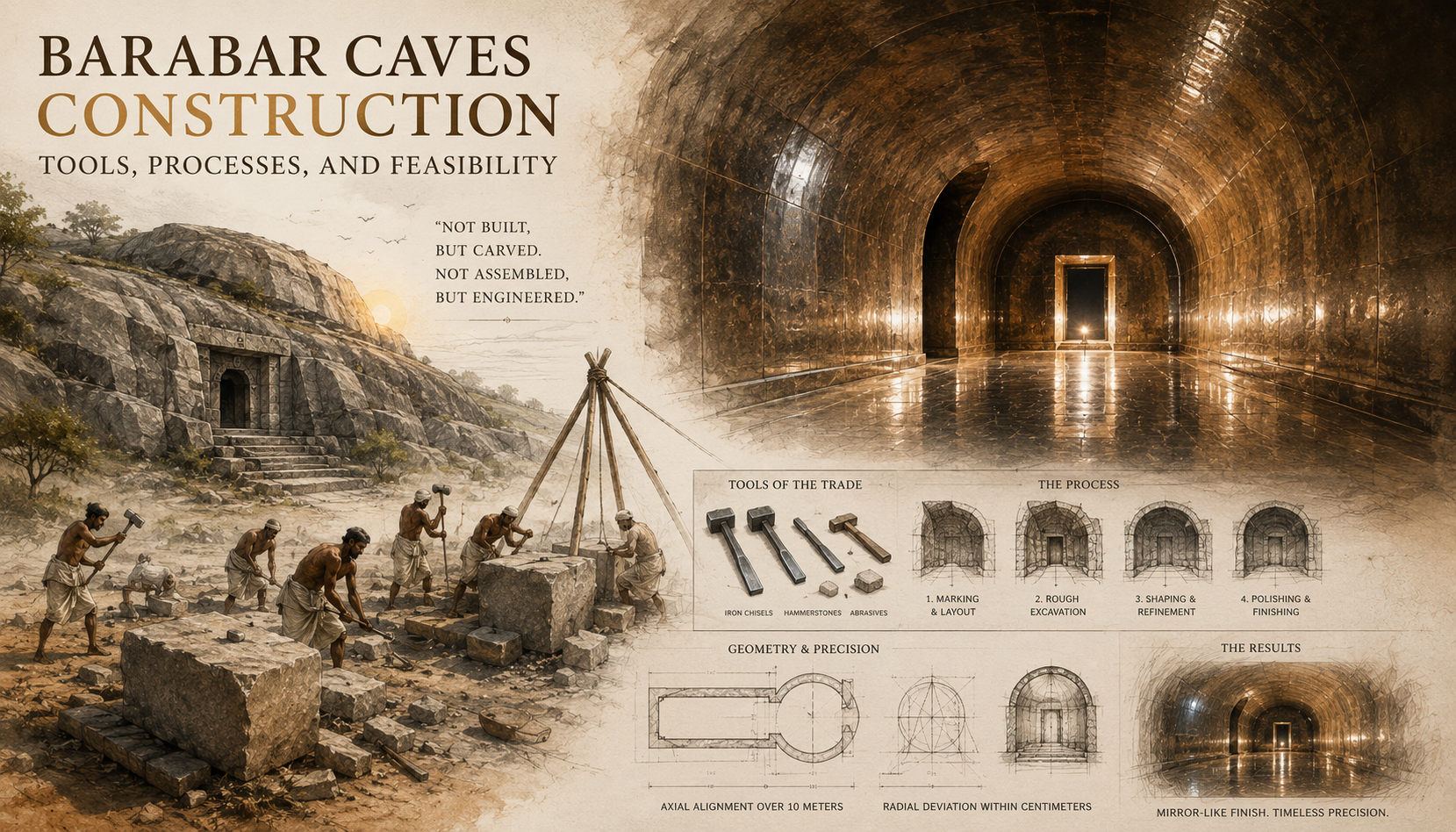
Rethinking the Origins of Engineering
The study of prehistoric construction systems forces a fundamental reassessment of how and when complex engineering capabilities emerged in human history, challenging the conventional narrative that places the origin of advanced construction firmly within the boundaries of early civilizations such as Egypt, Mesopotamia, or the Indus Valley (Ancient Construction Similarities: Global Parallels link). Across multiple continents, monumental structures appear in the archaeological record with a level of precision, scale, and durability that seems disproportionate to the technological context traditionally assigned to their builders, raising a critical question that continues to provoke both academic investigation and broader curiosity: were these systems the result of gradual development, or do they represent the continuation of knowledge inherited from earlier, less understood phases of human history?
When examining sites such as Göbekli Tepe, the megalithic complexes of Malta, the stone circles of Britain, and the precisely constructed cities of the Andes, a pattern begins to emerge that suggests the existence of structured methodologies rather than isolated acts of construction. These sites demonstrate not only the ability to move and shape large materials but also the capacity to organize labor, apply geometric planning, and integrate environmental and astronomical factors into the design process. Such capabilities imply the presence of underlying systems—frameworks that governed how construction was conceived, planned, and executed long before the emergence of written engineering principles.
This perspective gains additional complexity when considered alongside the Younger Dryas Impact Hypothesis (The Cataclysms that Reset Civilization link), which proposes that significant climatic disruptions around 12,000 years ago may have interrupted the continuity of human societies, potentially fragmenting or erasing knowledge systems that had developed during earlier periods. While this hypothesis remains a subject of active research and debate, it introduces a compelling lens through which to interpret the apparent gap between the sophistication of certain prehistoric constructions and the assumed simplicity of the societies that built them. If knowledge was indeed lost or disrupted, then what we observe today may represent only remnants of a more extensive and integrated system of engineering and construction (Ancient Construction Materials Lost Techniques link).
A Systems Perspective — Beyond Isolated Monuments
To fully understand prehistoric construction systems (Construction Systems and Megalithic Engineering link), it is necessary to move beyond the analysis of individual monuments and adopt a systems-based perspective, where each structure is viewed as the outcome of interconnected processes involving design, logistics, material science, and organizational coordination. This approach aligns with modern engineering thinking, where complex projects are understood not as singular achievements but as the result of multiple subsystems working in harmony toward a common objective.
Within this framework, construction is not merely the act of assembling materials but a coordinated sequence of activities that includes site selection, planning, resource acquisition, transportation, shaping, assembly, and long-term maintenance. Each of these phases introduces its own challenges and constraints, requiring solutions that are both context-specific and adaptable to changing conditions. The ability to manage these stages effectively suggests that prehistoric builders possessed a level of systemic thinking that allowed them to anticipate interactions between different components of the construction process (Prehistoric Construction Logistics Organizing the Impossible – link).
This systems perspective also highlights the imortance of integration, where the success of a construction project depends on the alignment of its components rather than the optimization of individual elements in isolation. For example, the selection of materials must be compatible with the available tools and transport methods, while the design of the structure must account for environmental factors such as terrain, climate, and seismic activity. The presence of such integration in prehistoric constructions indicates that these systems were not only functional but also optimized to a degree that reflects accumulated knowledge and experience (Science Before the Younger Dryas link).
Core Components of Prehistoric Construction Systems
To establish a clear analytical foundation, prehistoric construction systems can be understood as comprising several core components, each of which contributes to the overall functionality and success of the construction process. These components, while conceptually distinct, are deeply interconnected and must be considered as part of a unified system (Ancient Construction Geometry: Planning Before Measurements link).
Engineering and Design represent the conceptual phase, where the structure is defined in terms of its form, function, and alignment. This includes geometric planning, spatial organization, and the integration of symbolic or cosmological elements.
Materials and Processing involve the selection, extraction, and preparation of provision materials, requiring knowledge of geological properties and techniques for shaping and finishing.
Logistics and Transport address the movement of materials and tools, often over considerable distances, and the coordination of supply chains that ensure continuous progress.
Labor Organization encompasses the structuring of human effort, including specialization, supervision, and the provision of resources necessary to sustain the workforce.
Project Coordination integrates all these elements, managing time, resources, and risks to maintain coherence and ensure that the construction progresses according to plan.
The presence of these components across multiple prehistoric sites suggests that construction was approached as a comprehensive system rather than a series of ad hoc decisions, reinforcing the idea that early builders operated within structured frameworks that guided their activities.
Global Evidence — Recurring Systems Across Civilizations
One of the most compelling aspects of prehistoric construction systems is the recurrence of similar patterns across geographically distant regions, where different cultures appear to have developed comparable approaches to construction despite variations in environment, materials, and cultural context. This phenomenon raises important questions about the universality of certain solutions and the potential for knowledge transfer across regions and time periods.
In Egypt, the pyramids demonstrate large-scale coordination, precise alignment, and advanced material handling, while in the Andes, polygonal masonry reflects a deep understanding of structural stability and seismic resistance. In Europe, megalithic sites such as Stonehenge exhibit astronomical alignment and geometric planning, while in the Near East, early settlements show evidence of organized construction and resource management.
The repetition of these elements suggests that certain principles of construction may be inherent to the challenges faced by human societies, leading to similar solutions even in the absence of direct contact. However, the consistency and sophistication of these systems also leave open the possibility that knowledge was shared or inherited in ways that are not fully captured by the current archaeological record.
The Question of Lost Knowledge
The concept of lost knowledge plays a central role in the interpretation of prehistoric construction systems, offering a potential explanation for the apparent disparity between the capabilities demonstrated by ancient structures and the limited documentation of their development. Throughout history, knowledge systems have proven vulnerable to disruption, whether through environmental events, social collapse, or the destruction of cultural centers.
The idea that advanced construction techniques may have been lost is not without precedent, as historical examples demonstrate how quickly specialized knowledge can исчез when the conditions that sustain it are removed. If prehistoric societies experienced similar disruptions, whether due to climatic events such as the Younger Dryas or other factors, it is plausible that complex systems of construction knowledge were fragmented or lost, leaving behind only the physical evidence of their application.
This perspective does not require the assumption of unknown technologies but instead emphasizes the fragility of knowledge transmission and the possibility that what we observe today represents only a portion of what once existed. It encourages a more open approach to interpreting the evidence, one that balances skepticism with curiosity and recognizes the limitations of the current record.
Toward a New Understanding
The investigation of prehistoric construction systems ultimately points toward a broader reconsideration of human history, where the development of complex capabilities may not follow a simple linear progression but instead reflects a dynamic interplay of innovation, loss, and rediscovery. By examining the systems that underlie ancient constructions, we gain insight into the cognitive and organizational capacities of early societies, revealing a level of sophistication that challenges conventional assumptions (Lost Knowledge Before Ice Age – Rewriting History link).
As research continues to advance through technologies such as satellite imaging, material analysis, and computational modeling, new evidence may further illuminate the nature of these systems, providing a more detailed understanding of how they functioned and how they evolved over time. Until then, the study of prehistoric construction systems remains an open field, inviting continued exploration and critical inquiry into one of the most fascinating aspects of human achievement.
References and Further Reading
National Geographic — Ancient Engineering and Labor Systems
Journal of Archaeological Science — Construction Logistics Studies (link)
Archaeological Institute of America — Field Reports
Kerzner, Harold — Project Management: A Systems Approach (link)
Fletcher, Banister — A History of Architecture (link)
World Atlas — Ancient Architecture Materials (link)
Encyclopaedia Britannica — Geometry in Architecture (link)
National Geographic — Ancient Engineering and Alignments (link)