Patterns Across Continents
The study of ancient construction similarities reveals a compelling and often overlooked dimension of human history, one that challenges the conventional assumption that ancient civilizations developed in isolation, progressing independently according to local conditions and limited exchanges. When examined in detail, monumental structures across geographically distant regions—ranging from the pyramids of Egypt to the stone cities of the Andes, the temples of Southeast Asia, and the urban grids of the Indus Valley—display recurring architectural patterns, engineering strategies, and geometric principles that suggest a deeper level of connection or convergence (Ancient Construction Materials Lost Techniques link).
These similarities are not limited to superficial features but extend into the underlying logic of construction systems, including material selection, structural design, alignment, and spatial organization. The repetition of such patterns raises critical questions about the mechanisms through which knowledge may have been shared, adapted, or independently rediscovered. Are these parallels the result of universal problem-solving approaches inherent to human cognition, or do they point toward a more complex network of knowledge transmission that predates the historical records currently available?
Egypt and the Andes: Precision Without Contact?
One of the most frequently cited examples of ancient construction similarities lies in the comparison between the stonework of ancient Egypt and that of the Andean civilizations, particularly in Peru. In both regions, we observe an extraordinary level of precision in stone cutting and fitting, with large blocks shaped and assembled in ways that ensure stability, durability, and resistance to environmental stress (Ancient Construction Geometry Planning Before Measurements link).
In Egypt, the construction of pyramids and temples demonstrates a mastery of large-scale planning and alignment, with structures oriented to cardinal directions and built using carefully selected materials. In the Andes, sites such as Sacsayhuamán and Machu Picchu exhibit polygonal masonry techniques, where stones are intricately shaped to fit together without mortar, creating walls that have withstood seismic activity for centuries (Ancient Logistcs Organizing the Impossible link).
The apparent absence of direct contact between these regions during the periods in question makes these similarities particularly intriguing. While differences in style and context are evident, the convergence in technical solutions—such as precise stone fitting and large-scale organization—suggests either parallel innovation driven by similar constraints or the possibility of shared knowledge at a much earlier stage of human development.

Mesoamerica and Mesopotamia: Monumental Planning
Another layer of ancient construction similarities emerges when comparing the monumental architecture of Mesoamerica with that of Mesopotamia, where large stepped structures—pyramids and ziggurats—serve as focal points for religious and social activity. Despite differences in materials and cultural context, both regions developed architectural forms that emphasize elevation, symmetry, and hierarchical spatial organization (Ancient Construction Megalithic Engineering link).
These structures required not only engineering capability but also a conceptual framework that integrates symbolism with functionality. The elevated platforms may have served practical purposes, such as visibility and protection, while also representing cosmological concepts, linking the earthly realm with the divine. The recurrence of such forms across distant regions suggests that certain architectural solutions may be particularly effective in addressing both practical and symbolic needs, leading to their independent emergence in multiple contexts.
However, the similarities in layout, scale, and purpose also invite consideration of broader patterns of knowledge exchange, whether through indirect contact, shared ancestral traditions, or convergent development shaped by common human experiences (Geometry of Ancient Structures Earth Scaling and Cosmic Code link).
The Indus Valley and Global Urban Planning
The cities of the Indus Valley Civilization, such as Mohenjo-Daro and Harappa, provide a striking example of ancient construction similarities in the realm of urban planning, where grid-based layouts, standardized building materials, and advanced drainage systems reflect a level of organization that appears remarkably sophisticated for its time. Streets are aligned according to a consistent plan, buildings follow standardized dimensions, and water management systems are integrated throughout the world (Sacred Geometry as Universal Language link).
When compared to other ancient urban centers, including those in Mesopotamia and later classical civilizations, we observe recurring principles of organization: the use of grids, the separation of functional zones, and the integration of infrastructure into the overall design. These similarities suggest that certain approaches to urban planning may represent optimal solutions to common challenges, such as population density, resource distribution, and sanitation (Sacred Numbers in Megalithic Structures link).
At the same time, the level of standardization observed in the Indus Valley raises questions about the mechanisms through which such systems were developed and maintained, particularly in the absence of clearly identified central structures. This further emphasizes the role of construction systems as expressions of broader social and organizational frameworks.
Southeast Asia and Monumental Integration
In Southeast Asia, sites such as Angkor Wat demonstrate another dimension of ancient construction similarities, where large-scale architecture is integrated with the surrounding landscape in ways that reflect both practical and symbolic considerations. The alignment of structures with celestial events, the use of water management systems, and the incorporation of natural features into the design all point to a holistic approach to construction that extends beyond individual buildings.
This integration is not unique to Southeast Asia; similar patterns can be observed in other regions, where construction systems are designed to interact with the environment rather than exist independently of it. The recurrence of such approaches suggests that ancient builders recognized the importance of aligning human-made structures with natural systems, creating environments that are both functional and sustainable.
Convergence or Connection: Interpreting the Evidence
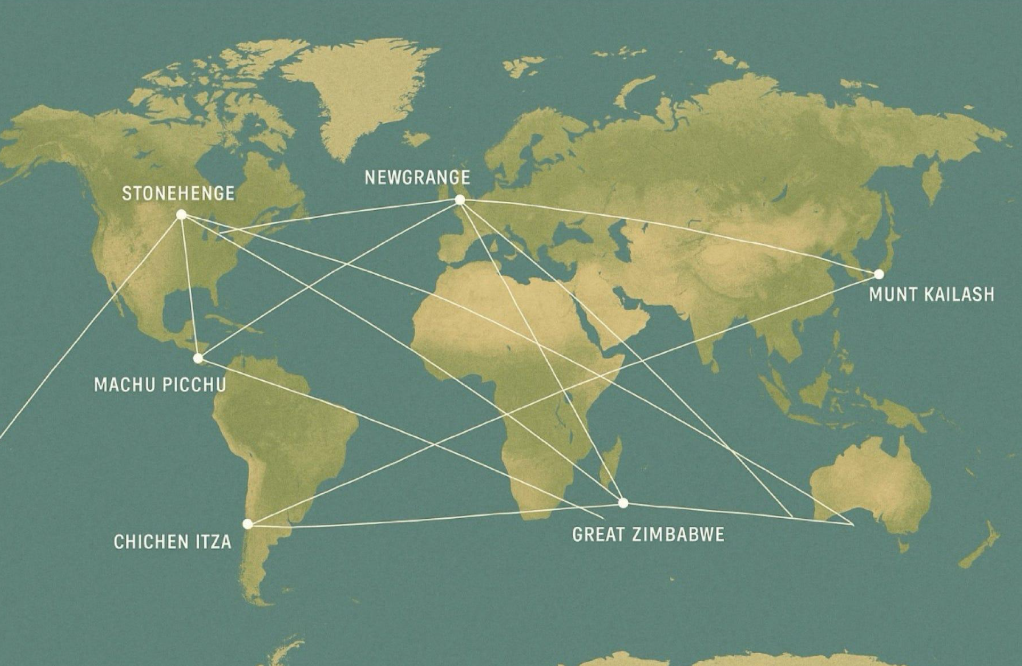
The central question raised by ancient construction similarities is whether these patterns represent independent convergence or evidence of connection. Convergent evolution, in which similar solutions arise independently in response to similar challenges, is a well-established concept in both natural and cultural systems. From this perspective, the similarities observed in ancient construction may reflect the universal constraints of physics, materials, and human cognition.
However, the possibility of connection cannot be entirely dismissed. The existence of trade routes, migration patterns, and cultural exchanges in later periods suggests that knowledge transfer is a plausible mechanism for the spread of ideas. If such exchanges occurred earlier than currently documented, they could provide a framework for understanding the distribution of construction techniques across regions.
It is also possible that both processes—convergence and connection—played a role, with certain ideas emerging independently while others were transmitted through networks that are only partially visible in the archaeological record. This hybrid model allows for a more nuanced interpretation of the evidence, acknowledging the complexity of human history without relying on overly simplistic explanations.
The Role of Lost Knowledge
Within the broader discussion of ancient construction similarities, the concept of lost knowledge introduces an additional layer of complexity, suggesting that some techniques or principles may have been more widely known in the past but were later forgotten or fragmented due to environmental, social, or cultural disruptions. This perspective aligns with the idea that the archaeological record represents only a partial snapshot of human activity, with significant gaps that may obscure earlier developments.
While such hypotheses must be approached with caution, they provide a useful framework for exploring anomalies and inconsistencies in the data, encouraging further investigation rather than premature conclusions. The possibility that certain aspects of ancient construction systems have been lost highlights the importance of preserving and studying existing structures, as they may contain clues to techniques and knowledge that are no longer fully understood.
Conclusion: A Shared Language of Building
The study of ancient construction similarities reveals a pattern of recurring solutions, principles, and structures that transcend geographical and cultural boundaries, suggesting that ancient builders operated within a shared language of construction, whether through independent discovery or interconnected knowledge systems. These parallels challenge the notion of isolated development, pointing instead toward a more complex and interconnected history of human innovation.
By examining these similarities in detail, we gain a deeper understanding of the capabilities and ingenuity of ancient societies, as well as the potential mechanisms through which knowledge was created, shared, and preserved. Whether the result of convergence, connection, or a combination of both, the evidence underscores the sophistication of prehistoric construction systems and invites continued exploration into the origins and evolution of human engineering.
References and Further Reading
Encyclopaedia Britannica — Ancient Architecture (link)
National Geographic — Megalithic Structures Around the World
JSTOR — Comparative Architecture Studies
UNESCO — World Heritage Construction Sites
Fletcher, Banister — A History of Architecture (link)
World Atlas — Ancient Architecture Materials (link)
Encyclopaedia Britannica — Geometry in Architecture (link)
National Geographic — Ancient Engineering and Alignments (link)