The Hidden Architecture Behind Monumental Builds
The study of ancient monuments often gravitates toward visible achievements—towering stones, geometric precision, and enduring structures that defy time. Yet beneath these physical outcomes lies an equally critical dimension that is far less visible but arguably more complex: prehistoric construction logistics (Megalithic Enineering System – link). If engineering determines what can be built, logistics determines whether it can be built at all. It is the invisible architecture that transforms intention into execution, coordinating people, materials, time, and environment into a coherent system capable of sustaining large-scale projects (Lost Knowledge of the Ice Age Rewriting History – link).
When examining sites such as the pyramids of Giza, the terraces of Machu Picchu, or the massive stone platforms of Baalbek, one quickly realizes that the true challenge was not simply lifting stones but orchestrating thousands of interdependent actions over extended periods (Lost Worlds Before the Flood – link). These projects required not only physical effort but also planning frameworks that could manage uncertainty, allocate resources efficiently, and maintain continuity across seasons and possibly generations. In this sense, prehistoric construction logistics represents an early form of operational intelligence—one that functioned without written manuals, digital tools, or formalized management theory, yet achieved results that continue to challenge modern understanding.
Labor Organization — Structuring Human Effort at Scale
At the core of prehistoric construction logistics lies the organization of labor, a factor that transforms raw manpower into coordinated productivity. The assumption that ancient projects relied solely on large numbers of unskilled workers fails to account for the diversity of tasks involved. Construction at scale requires specialization: quarry workers, transport teams, stone shapers, alignment experts, supervisors, and support personnel responsible for food, shelter, and tool maintenance. This division of labor implies not only technical differentiation but also a hierarchy of roles, where knowledge and responsibility are distributed according to skill and experience (Science Before the Younger Dryas – link).
Archaeological evidence from sites like Deir el-Medina in Egypt suggests that workers were organized into structured communities with defined roles and schedules. While this site is later than many prehistoric constructions, it provides a glimpse into how labor systems may have functioned in earlier periods. The presence of standardized work gangs, rotational shifts, and even forms of compensation indicates that construction logistics extended beyond immediate physical tasks into broader social organization. Such systems would have been essential for maintaining productivity over long durations, preventing burnout, and ensuring that critical knowledge was retained within the workforce (Lost Knowledge Before Written History – link).
The scale of labor required for certain projects further reinforces the need for structured organization. Estimates for the construction of the Great Pyramid suggest a workforce in the tens of thousands, though not necessarily all working simultaneously. Coordinating such numbers without centralized planning would likely result in inefficiency and conflict, suggesting instead the presence of proto-management frameworks capable of assigning tasks, monitoring progress, and adapting to changing conditions.
Resource Management — Sustaining the Flow of Materials
No construction system can function without a reliable flow of materials, and prehistoric construction logistics demonstrates a sophisticated approach to resource management that extends far beyond simple acquisition. Stone, timber, water, and auxiliary materials had to be sourced, transported, and stored in ways that aligned with the construction timeline. Any disruption in this flow—whether due to environmental factors, depletion of local resources, or logistical bottlenecks—could halt progress and compromise the entire project (Ancient Mapping the Sky – link).
The selection of materials itself reflects logistical awareness. In many cases, builders appear to have balanced the trade-offs between quality and accessibility, choosing sources that minimized transport complexity while still meeting structural requirements. However, there are notable exceptions, such as the transport of bluestones to Stonehenge or the movement of large granite blocks within Egypt, which suggest that logistical systems were capable of handling long-distance supply chains when necessary (Geometry of Ancient Structures – link).
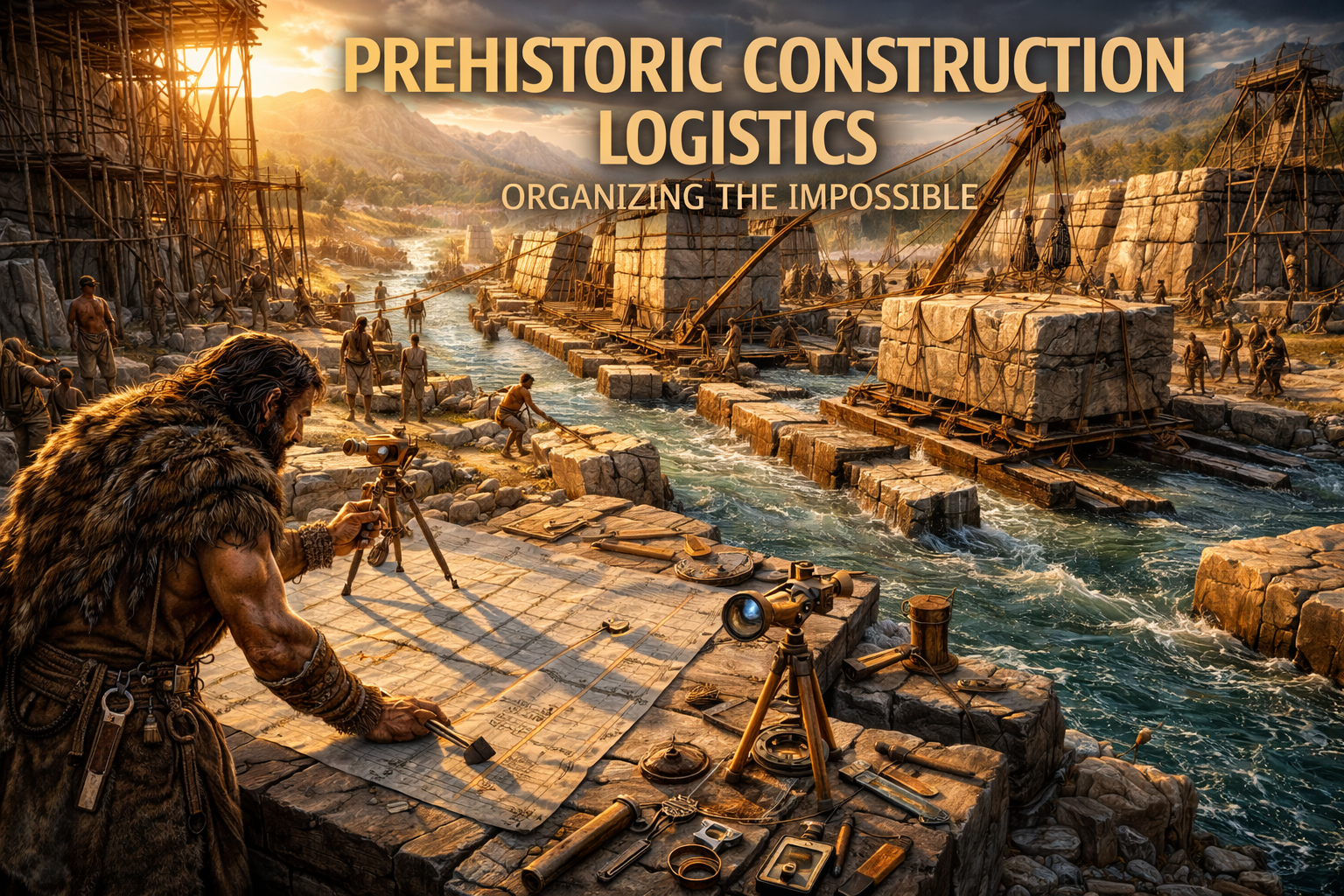
Water management also plays a critical role in this context. Rivers and seasonal floods may have been used not only as natural transport routes but also as integral components of construction logistics. The Nile, for example, provided a predictable and efficient means of moving heavy materials, effectively reducing the energy required for transport. This integration of natural systems into logistical planning highlights an adaptive approach that leverages environmental dynamics rather than attempting to overcome them entirely.
Time and Scheduling — Building Across Seasons and Generations
Time represents one of the most complex variables in prehistoric construction logistics. Unlike modern projects, which rely on precise scheduling tools and continuous timelines, ancient builders operated within environmental cycles that imposed constraints on when certain activities could occur. Seasonal changes affected everything from material availability to labor capacity, requiring construction systems to adapt their schedules accordingly (Geometry of the Pyramids and Earth – link).
Agricultural societies, for instance, would have had to balance construction efforts with farming activities, allocating labor during periods when agricultural demands were lower. This introduces the concept of seasonal scheduling, where different phases of construction are aligned with specific times of the year. Quarrying might occur during dry seasons, transport during periods of favorable terrain conditions, and assembly during times when sufficient labor is available (Ancient Engineering Tolerance – link).
The duration of some projects raises the possibility that construction extended beyond a single generation. In such cases, prehistoric construction logistics would need to incorporate mechanisms for continuity, ensuring that knowledge, plans, and objectives were preserved over time. This could involve oral transmission, symbolic representations, or physical markers embedded within the construction itself. The ability to maintain coherence across generations suggests a level of planning that transcends immediate goals, aligning with long-term visions that may have held cultural, religious, or social significance (Ancient Resonant Chambers Stone and Sound Technology – link).
Coordination Without Writing — Memory as Infrastructure
One of the most intriguing aspects of prehistoric construction logistics is the apparent ability to coordinate complex activities without reliance on written records. While some later civilizations developed writing systems that facilitated planning and communication, many prehistoric societies operated within oral traditions. This raises the question of how logistical information—such as measurements, sequences, and responsibilities—was stored and transmitted (Harmonics of Stones, Resonance Energy, Human Body – link).
Memory, in this context, becomes a form of infrastructure. Knowledge may have been encoded in rituals, songs, or repeated practices that reinforced procedural understanding. Skilled individuals likely played a critical role as knowledge holders, guiding less experienced workers and ensuring that techniques were applied correctly. This form of knowledge transmission is inherently resilient in some ways, as it is embedded within the community, but also vulnerable to disruption if key individuals are lost (Resonance and Stones, Hidden Technology of Sound – link).
The absence of written documentation does not imply a lack of structure; rather, it suggests that structure was maintained through alternative means. The consistency observed in construction outcomes indicates that these methods were effective, allowing complex logistical systems to function reliably over extended periods (Forgotten Engineers Builders Beyond Time – Article1 and Article2).
Risk Management — Anticipating Failure and Adapting
Every large-scale construction project carries inherent risks, and prehistoric construction logistics appears to have incorporated strategies for managing uncertainty. These risks could include structural failure, material defects, environmental disruptions, or logistical breakdowns. The presence of abandoned projects or partially completed structures provides evidence that not all endeavors succeeded, highlighting the importance of adaptability within the system (Lost Ancient Science From Sky to Stone – link).
Risk management in this context likely involved both proactive and reactive measures. Proactive strategies might include selecting stable construction sites, testing materials before use, and building redundancies into structural designs. Reactive strategies would involve adjusting plans in response to unforeseen challenges, such as changing environmental conditions or resource shortages.
The ability to adapt is a defining characteristic of any effective logistical system. In prehistoric construction, this adaptability would have been essential for maintaining progress in the face of uncertainty, ensuring that projects could continue even when conditions deviated from expectations.
Environmental Integration — Working With the Landscape
Prehistoric construction logistics demonstrates a deep integration with the natural environment, reflecting an approach that leverages existing conditions rather than attempting to impose entirely artificial systems. Terrain, climate, and natural resources all play a role in shaping logistical strategies, influencing decisions about site selection, material sourcing, and construction methods.
For example, the use of terraces in mountainous regions not only supports agriculture but also stabilizes the landscape for construction, reducing erosion and improving structural integrity. Similarly, the alignment of structures with natural features—such as rivers, पर्वत ranges, or solar paths—suggests that environmental factors were considered as part of the overall design and logistical framework.
This integration extends to energy efficiency as well. By utilizing natural forces, such as gravity or water flow, prehistoric builders could reduce the amount of human effort required for certain tasks. This reflects a form of optimization that aligns with modern principles of sustainable design, highlighting the sophistication of these systems despite their technological limitations.
Toward Proto-Project Management
When viewed through a contemporary lens, prehistoric construction logistics exhibits characteristics that align closely with modern project management principles. While it would be anachronistic to suggest that ancient builders employed formal methodologies, the underlying concepts—task allocation, resource management, scheduling, risk mitigation, and coordination—are clearly present.
This raises the possibility that prehistoric societies developed proto-project management systems, grounded in practical experience rather than formal theory. These systems would have evolved through iteration, with successful approaches being retained and refined over time. The absence of written frameworks does not diminish their effectiveness; instead, it highlights the adaptability and ingenuity of early human communities.
From this perspective, ancient construction projects can be seen not only as engineering achievements but also as organizational accomplishments, demonstrating the capacity to manage complexity at a scale that remains impressive even by modern standards.
Conclusion: The Invisible System That Made It Possible
Prehistoric construction logistics reveals a dimension of ancient human activity that is both subtle and profound. It shifts the focus from what was built to how it was made possible, uncovering the systems that coordinated labor, managed resources, and navigated the constraints of time and environment. These systems, though largely invisible in the archaeological record, are essential for understanding the true scope of prehistoric achievement.
Rather than viewing ancient construction as a series of isolated feats, we begin to see it as the product of integrated logistical frameworks capable of sustaining complex operations over extended periods. This perspective not only enriches our understanding of the past but also challenges assumptions about the origins of organizational intelligence. If prehistoric societies were able to develop such systems, then the roots of project management and logistical thinking may extend far deeper into human history than traditionally recognized.
References and Further Reading
National Geographic — Ancient Engineering and Construction (link)
Archaeological Institute of America — Field Reports
Journal of Archaeological Science — Logistics and Labor Studies (link)
Göbekli Tepe Research Project Publications
Scarre, Chris — The Human Past: World Prehistory and the Development of Human Societies (link)