The Harmonics of Stone — Resonance, Energy, and the Human Body
Across the ancient world, builders demonstrated a mysterious mastery of sound, vibration, and human physiology. In sites from Egypt to Malta, from Peru to Turkey, megalithic structures seem designed not only for ritual but for resonance—as if stone itself held instructions for tuning consciousness. This is the frontier where archaeology meets bio-energetics, revealing how the harmonics of stone may have interacted with the body, the mind, and a greater cosmic field.
The more we uncover, the more one truth becomes clear: ancient engineers designed environments that did more than stand. They resonated. And through resonance, they shaped experience.
𓂀 Stone as a Living Medium
Following from Article #5 (“Architects of Light”), we now move from illumination to resonance—another layer of ancient technology embedded in sacred architecture.
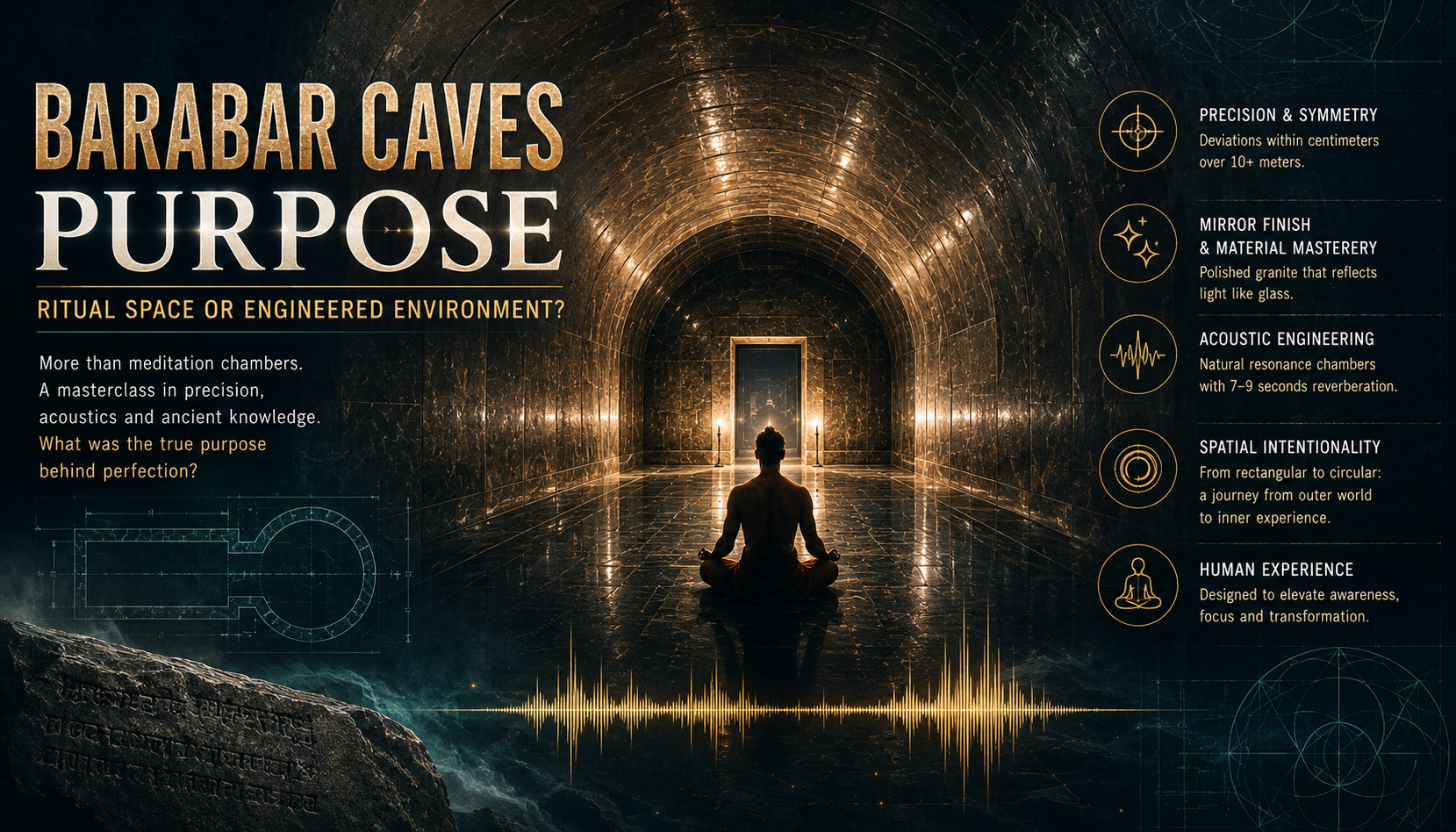
Stone is not inert. Modern materials science confirms that many ancient building materials—granite, basalt, limestone, and quartz-rich composites—are highly piezoelectric or resonance-sensitive. When struck, chanted into, or exposed to low-frequency waves, they vibrate, emit electrical charge, or produce subtle acoustics.
Ancient engineers seemed to know this intuitively. They chose stone not only for durability, but for frequency response:
-
Granite → high quartz content, excellent for resonance
-
Basalt → deep, bass-rich vibrational properties
-
Limestone → soft reflection, harmonious acoustics
-
Sandstone → natural amplitude amplifier
These materials suggest intentionality. Sacred structures were tuned like instruments.
How Stone Resonance Interacts With the Human Body
Every human being is a biochemical and electromagnetic system. The body vibrates at distinct frequencies—heartbeat, breath, neural oscillations, cranial rhythms, and cellular fields. Scientists now recognize that sound can alter brain states, hormone levels, and emotional processing.
Low-frequency acoustics (20–120 Hz), in particular, influence:
-
Theta wave production (linked to trance and intuition)
-
Vagal tone (linked to calm and resilience)
-
Somatic resonance (felt in bones and organs)
-
Perception of time and space
When ancient builders created chambers with standing-wave patterns, domed ceilings with echo pockets, or corridors tuned to specific tones, they created bio-resonant environments.
This is not speculation. It is measurable—and increasingly documented.
Case Studies: Temples that Sing Back
1. The Hypogeum of Ħal Saflieni (Malta)
A subterranean temple that amplifies sound at 111 Hz, a frequency associated with trance states.
Modern tests reveal that chanting here induces measurable changes in the prefrontal cortex.
2. The King’s Chamber (Giza)
Acoustic engineers found that the granite chamber resonates at several harmonic frequencies that align with the Schumann Resonance, Earth’s natural electromagnetic pulse.
3. Chavín de Huántar (Peru)
A labyrinth of ducts and galleries designed to transmit infra-sound. The “Singing Stone” at its heart vibrates like a tuning fork.
4. Göbekli Tepe (Turkey)
T-shaped pillars arranged in circular enclosures create acoustic feedback when drums or voices are used during ritual.
These discoveries reveal temples not as static sanctuaries but interactive frequency architectures.

Did Resonant Architecture Alter Awareness?
The idea that ancient builders engineered consciousness may seem bold, yet it aligns with multiple lines of evidence:
-
Mythology often connects temples with altered states, visions, or heavenly contact.
-
Initiation rituals took place in chambers with profound acoustics.
-
Ancient texts describe “hearing the gods” or experiencing divine vibration.
-
Neuroscience supports the role of rhythm, sound, and resonance in mystical experiences.
Ancient engineers may have intentionally created environments that:
-
quieted the analytical mind,
-
activated intuitive perception,
-
synchronized group consciousness,
-
or induced visionary experiences.
This was architecture as technology—a means of tuning human awareness.
Frequency, Memory, and Stone
One of the most intriguing aspects of the harmonics of stone is its ability to store and release vibrational patterns.
Recent studies in acoustics and crystal memory propose that:
-
Quartz-rich stone can encode vibrational “imprints.”
-
Repeated rituals may reinforce resonance patterns in temple walls.
-
Visitors entering the chamber re-activate stored frequencies.
If true, sacred sites may act like acoustic hard drives—repositories of cultural memory and energetic imprinting.
This concept aligns with Indigenous traditions which describe sacred places as “alive,” “aware,” or “remembering.” Modern physics, too, suggests that vibration underlies both matter and memory.
Were These Structures Part of a Larger Energetic Grid?
Patterns emerge when resonant sites are mapped globally:
-
Many lie on geological fault lines capable of generating natural frequencies.
-
Others form alignments or geodesic patterns resembling an energy grid.
-
Temples often combine astronomical orientation with acoustic engineering.
This implies a unified scientific worldview:
Light (optics) + Sound (resonance) + Water (fluid dynamics) + Geometry (harmonics)
= a holistic technology.
The harmonics of stone may have been one component of a broader energetic science—one now barely understood.
Questions That Lead Us Forward
As we unearth the vibrational secrets of ancient temples, a deeper inquiry emerges:
-
Did ancient cultures possess a science of consciousness integration?
-
How much knowledge was lost in cataclysms like the Younger Dryas?
-
Were resonant structures used for healing, initiation, or even communication?
-
And if stone harmonics shaped human consciousness once—could they again?
Each discovery pushes us to rethink the past not as primitive, but as layered, complex, and profoundly intelligent.
Additional readings