Resonance and Stone: The Hidden Technology of Sound
The forgotten engineers may have mastered more than geometry and precision. They seemed to understand something deeper — that sound was not only vibration, but a tool of creation. Across ancient sites, from Egypt to South America, clues suggest that resonance and stone worked together in ways modern science is only beginning to rediscover.
These engineers treated architecture as a living instrument. Walls hummed with frequency, chambers amplified tone, and the stones themselves became resonators. This was not mythic magic; it was applied physics in sacred form.
Vibration as a Force of Movement
Legends from around the world describe stones that moved as if weightless. Tibetan monks reportedly used horns and chanting to levitate rocks. In Egypt, texts reference the “voice that raised the stones.”
Recent experiments by acoustic physicists demonstrate that sound waves can indeed lift or move small particles — a process known as acoustic levitation. The same principle might have been scaled up by the ancients, amplifying resonance through material and geometry.
Moreover, certain types of rock — granite, basalt, and limestone — contain quartz and crystalline structures capable of responding to vibration. When struck, they emit measurable frequencies. Ancient builders likely selected stones not only for strength but also for resonance, designing structures that could literally “sing.”
Architectural Tuning and Cymatic Design
Cymatics, the science of visible sound, shows how vibration organizes matter into geometric patterns. When sand or water vibrates at certain frequencies, it forms intricate shapes — circles, hexagons, and spirals.
Temples such as Karnak in Egypt or Chavín de Huántar in Peru reveal chambers that mirror these patterns. Some rooms amplify low frequencies at 110 Hz — a tone known to affect human consciousness. Coincidence? Or deliberate design?
The Hypogeum of Ħal Saflieni in Malta**, built over 5,000 years ago, resonates perfectly at this same frequency. Researchers found that sound waves at this pitch trigger altered states of awareness. The ancients may have used resonance to tune the human mind — aligning consciousness with architecture.

The Science of Sonic Engineering
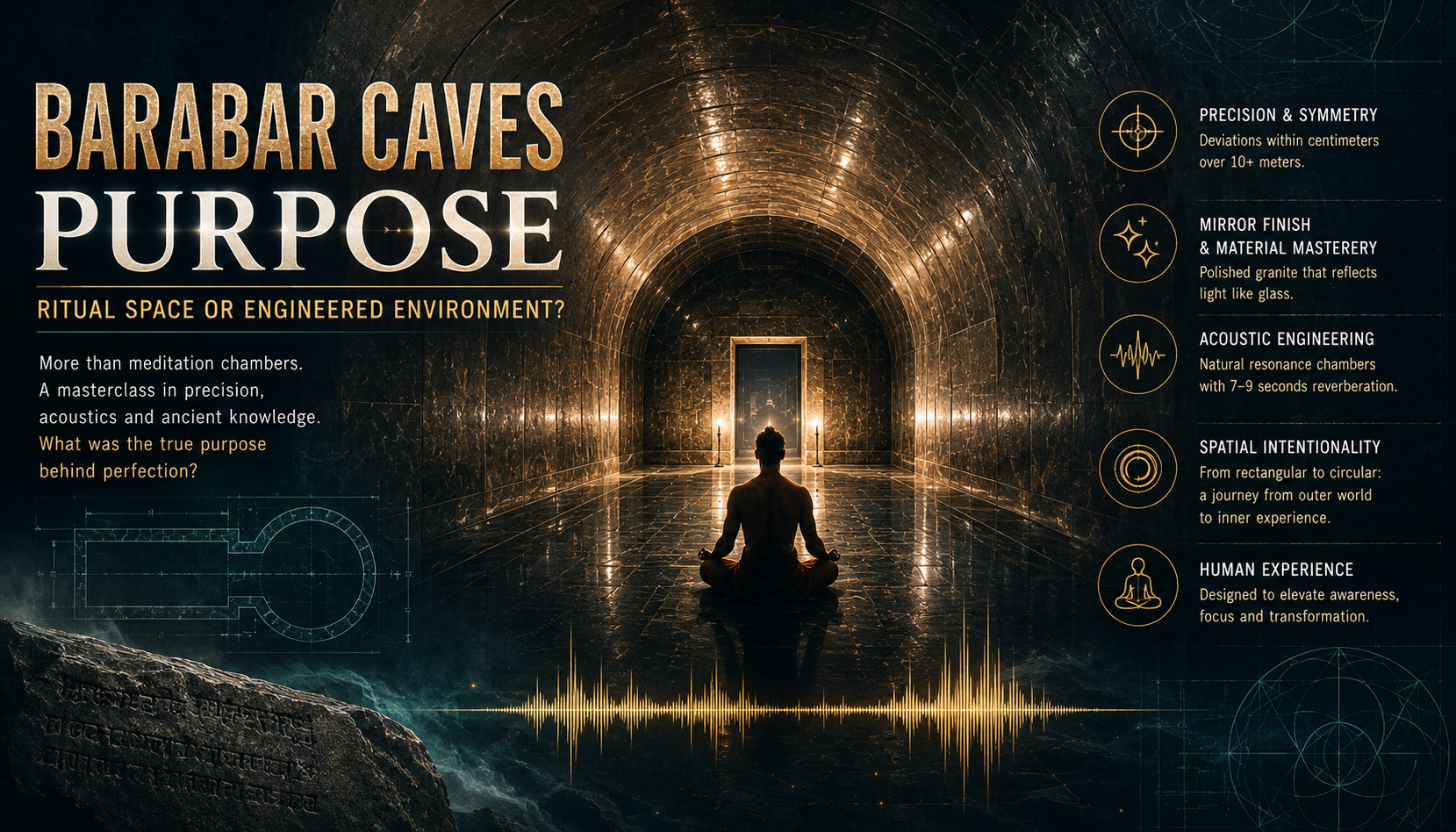
To understand how resonance and stone interact, consider how sound behaves inside a chamber. When waves reflect, they create standing frequencies that amplify energy. Ancient builders used curved ceilings, smooth walls, and polished surfaces to control this effect.
Unlike modern structures designed for utility, theirs prioritized acoustics and energetic flow. Every curve of the Great Pyramid’s Grand Gallery, every niche at Abu Simbel, may have served an acoustic function.
Researchers like Tom Danley and Paul Devereux have analyzed these sites using modern tools, finding evidence of resonant harmonics intentionally embedded into their designs. The ancient world was not silent; it was orchestrated.
Resonance, Healing, and Energy Transfer
Resonance may have extended beyond architecture. In India, Vedic texts describe “mantras” that build energy fields. Egyptian priests chanted specific tones to activate temple energies. Indigenous cultures worldwide used drums, flutes, and chants to synchronize brainwaves.
These practices all share a core belief: that sound transforms matter and consciousness. Modern science supports this — certain frequencies can alter cellular structures, stimulate growth, or even repair tissue through vibration therapy.
Could megalithic monuments have functioned as healing chambers, tuned to the frequencies of the Earth? The consistent alignment of ancient sites along geomagnetic lines suggests they were placed to channel natural resonance, amplifying both terrestrial and cosmic energy.
Echoes in Modern Science
Contemporary research into piezoelectricity, sonoluminescence, and resonant frequency fields is beginning to echo ancient wisdom. Crystals under pressure emit light. Sound waves can collapse microbubbles that generate plasma.
The ancients might not have had modern instruments, yet they demonstrated an intuitive grasp of energy transduction — converting sound into movement, movement into form, and form into consciousness.
When viewed through this lens, resonance and stone become keys to understanding how ancient civilizations interacted with the Earth as a living, vibrating organism. An example is given by the Chladni Patterns and Figures.

The Forgotten Frequency
It is easy to dismiss myths of singing stones or levitating blocks as fantasy. Yet, when myths appear across distant cultures with shared acoustic motifs, their persistence suggests something deeper.
Perhaps the forgotten engineers encoded an entire science of resonance — not lost, merely waiting to be heard again. Each temple, pyramid, and stone circle might still hum faintly with that forgotten frequency, calling us to remember that sound built the world before words named it.
Suggested Links