Cultural Memory Cataclysms Flood Myths
Cultural Memory Cataclysms provide a framework for examining how ancient societies may have preserved the memory of large-scale disasters through myths, legends, and symbolic narratives. The concept of Cultural Memory Cataclysms becomes particularly relevant when considering the recurrence of flood stories and destruction cycles across geographically distant cultures. Rather than isolated inventions, these narratives may reflect a shared human experience shaped by environmental instability (Milankovitch Cycles link). When placed alongside events such as the Older Dryas and the Younger Dryas or regional flooding episodes, Cultural Memory Cataclysms raise an important question: are these stories purely symbolic, or do they represent fragmented memories of real events experienced by early human populations?
Cultural Memory Cataclysms and Global Flood Myths
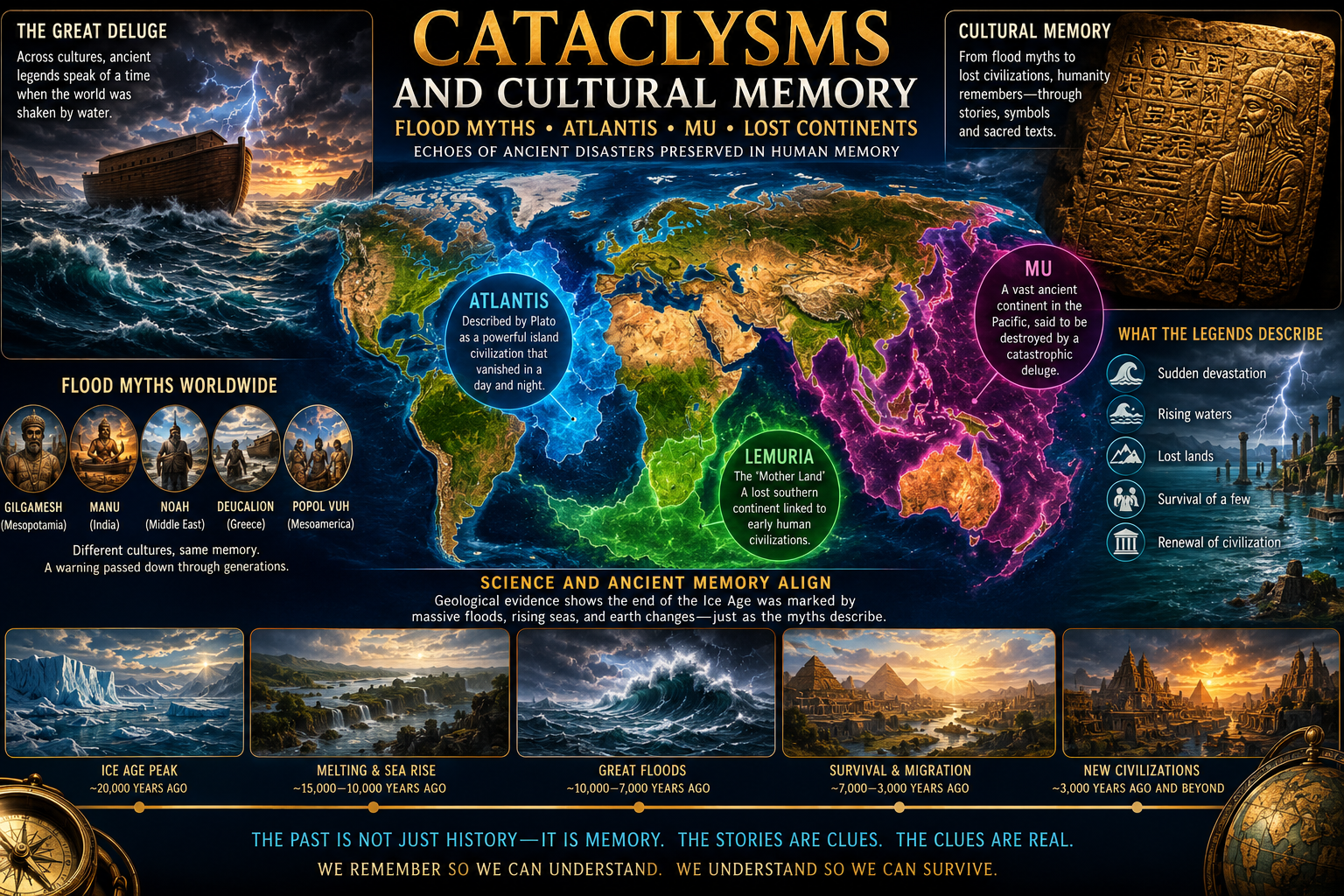
Cultural Memory Cataclysms are most visible in the widespread presence of flood myths across ancient civilizations. From Mesopotamia to South Asia and the Americas, narratives describe rising waters, destruction of land, and the survival of a small group that preserves knowledge or lineage. These similarities are difficult to ignore. While each culture frames the story differently, the recurring elements suggest a pattern:
- sudden inundation
- loss of land or civilization
- survival through preparation or chance
From an analytical perspective, Cultural Memory Cataclysms may represent a form of long-term information storage. In the absence of written records, oral traditions could encode significant environmental events, preserving them across generations in symbolic forms (Axial Precession and the Great Year link).
This does not confirm that all flood myths describe a single global event. However, it supports the possibility that repeated regional flooding events contributed to a shared narrative structure.
Atlantis and Cultural Memory Cataclysms
The story of Atlantis, first described by Plato, is often interpreted as a philosophical allegory. Yet within the framework of Cultural Memory Cataclysms, it can also be examined as a narrative reflecting sudden destruction (Climate History of the Last 40.000 Years link).
Atlantis is described as an advanced society that disappeared in a single catastrophic event. While there is no direct archaeological evidence confirming its existence, the structure of the story aligns with broader patterns:
- a developed society
- a sudden environmental collapse
- complete or near-complete loss
Rather than treating Atlantis as literal history, it may be more useful to consider it as a cultural expression of vulnerability to large-scale disasters. The persistence of this narrative suggests that such themes resonated deeply within ancient societies.
Mu and Recurring Patterns in Cultural Memory Cataclysms
Similar to Atlantis, the concept of Mu appears in various interpretations as a lost land or civilization submerged by catastrophic events. Although not part of mainstream archaeology, Mu represents another example of how Cultural Memory Cataclysms manifest in different cultural contexts (Younger Dryas Event and Abrupt Climate Reversal link). What matters here is not the literal validation of Mu as a historical location, but the repetition of the underlying idea:
- land lost to water
- civilization disrupted or erased
- memory preserved through narrative
When multiple cultures independently produce similar themes, it becomes reasonable to ask whether these narratives reflect recurring experiences rather than isolated imagination (Older Dryas Event: Climate Instability link).
Environmental Events and Cultural Memory Cataclysms
Scientific evidence confirms that the end of the last Ice Age was marked by rising sea levels, regional flooding, and abrupt climate changes. Events such as the Black Sea flooding or glacial meltwater pulses would have directly impacted human populations.
Within this context, Cultural Memory Cataclysms can be interpreted as responses to real environmental pressures. Sudden changes in coastlines, loss of habitable land, and forced migration would have left strong impressions on communities.
Over time, these experiences may have been transformed into stories—simplified, symbolic, and adapted to cultural frameworks. The original event becomes less important than the pattern it represents (Black Sea Deluge Rapid Sea-Level Rise Event link).
Transmission of Cultural Memory Cataclysms
One of the key challenges in interpreting Cultural Memory Cataclysms is understanding how information survives across long periods. Oral traditions, ritual practices, and symbolic systems all provide potential mechanisms for transmission. These methods do not preserve precise details. Instead, they retain core elements:
- destruction
- survival
- renewal
This selective preservation suggests that Cultural Memory Cataclysms function less as historical records and more as frameworks for understanding recurring danger. They encode lessons about instability, adaptation, and continuity (Ancient Solar and Lunar Calendars link).
Rethinking Myth and History
Cultural Memory Cataclysms challenge the strict separation between myth and history. While myths are not scientific records, they may contain traces of real experiences, filtered through cultural interpretation.
The difficulty lies in interpretation. Without direct evidence, it is not possible to assign specific events to specific narratives. However, dismissing these stories entirely may overlook their potential value as indicators of past environmental stress.
A balanced approach recognizes that Cultural Memory Cataclysms are neither literal accounts nor purely fictional constructs. They exist in a space where observation, memory, and symbolism intersect (Yuga Cycles and Mythological Time Systems link).
Conclusion
Cultural Memory Cataclysms provide a compelling framework for understanding the persistence of flood myths and lost civilization narratives across cultures. By examining these stories alongside scientific evidence of past environmental change, it becomes possible to explore the idea that ancient societies experienced and remembered repeated disruptions. While no single narrative can be confirmed as a direct record of a specific event, the consistency of themes suggests that these stories may reflect real patterns of human experience. Rather than offering definitive answers, Cultural Memory Cataclysms encourage a broader investigation into how humanity has remembered, interpreted, and transmitted the challenges of a changing world (Geometry of Ancient Structures Earth Scaling and Cosmic Code link).
References and Further Reading
Timaeus (link)
Critias (link)
National Geographic Society – Flood myths and ancient civilizations (link)
ResearchGate – Comparative mythology and environmental memory studies
Richard B. Alley, The Two-Mile Time Machine (link)
Wallace S. Broecker, The Great Ocean Conveyor (link)
ResearchGate – Studies on Dansgaard–Oeschger events and paleoclimate variability
Ancient Energy Systems: Myth or Technology? (link)
Ancient Hyper Forests and Giant Trees (link)
Pre Flood Civilization and Environmental Collapse (link)
Was the Ancient World Phisically Different? (link)
Giant Humans Before the Younger Dryas (link)
Ancient Construction Project Management (link)
Ice Age Civilization Lost Worlds Before Floods (link)
Lost Knowledge of Ice Age Rewritten History (link)
Ice Age Knowledge Science Before Younger Dryas (link)