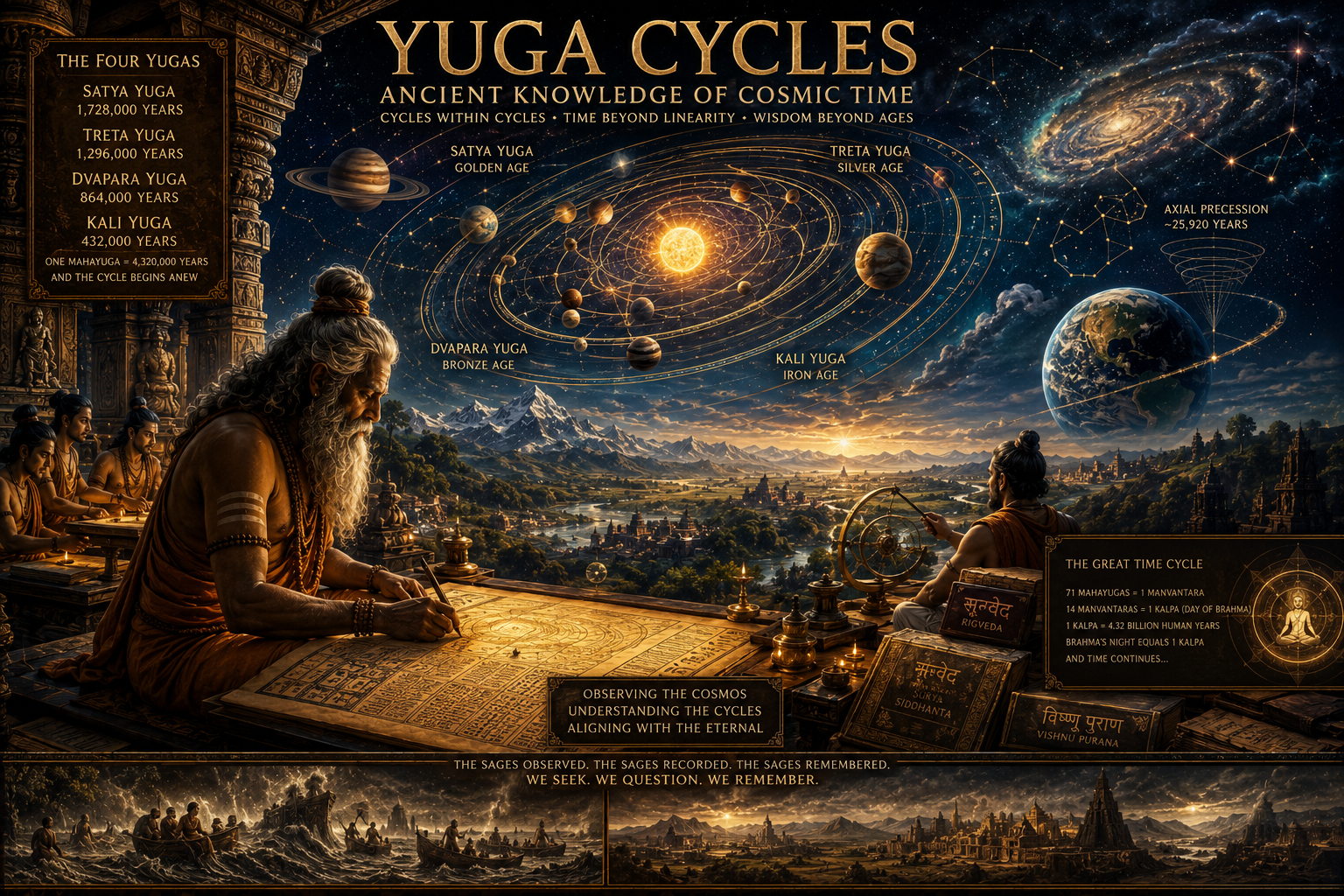
Yuga Cycles and Mythological Time Systems
Yuga Cycles describe one of the most structured and extensive models of cyclical time found in ancient traditions, presenting history not as a linear progression but as a repeating sequence of ages marked by transformation and decline. As in the Milankovitch Cycles (link), the concept of Yuga Cycles emerges from ancient Indian cosmology, where vast periods of time are divided into four phases, each reflecting different conditions of human civilization and natural order. When viewed alongside scientific models of long-term climate variability and astronomical cycles, Yuga Cycles raise an important question: could these systems represent symbolic interpretations of real environmental patterns experienced by early human populations?
Yuga Cycles as a Model of Cyclical Time
In traditional frameworks, Yuga Cycles consist of four repeating ages:
- Satya Yuga (1,728,000 years — a period of balance and stability)
- Treta Yuga (1,296,000 years)
- Dvapara Yuga (864,000 years)
- Kali Yuga (432,000 years — a period often associated with decline)
The total of these four ages forms a full Mahayuga of 4,320,000 years. Notably, the durations follow a clear numerical pattern: each age decreases by a factor of 432,000, creating a proportional sequence of 4 : 3 : 2 : 1. This structured scaling suggests intentional design, where time is not arbitrary but ordered according to a repeating mathematical relationship (Ancient Precession and the Great Year link).
The number 432 itself has attracted attention in discussions of Numerology and so-called sacred numbers. For example, 432,000 × 10 equals 4,320,000 (a full cycle), and multiples of 432 appear in various traditional systems, sometimes linked—symbolically rather than scientifically—to astronomical cycles or harmonic ratios. When reduced numerologically (4 + 3 + 2 = 9), the number connects to 9, often considered a number of completion or totality in many symbolic traditions.
From a more interpretive perspective, the consistent recurrence of these numerical patterns raises the possibility that the system encodes more than mythological storytelling—perhaps reflecting an attempt to model cyclical processes in nature through number. While there is no empirical evidence that these figures originate from advanced prehistoric civilizations, the precision and repetition of values like 432,000 encourage an open-minded examination of whether ancient knowledge systems embedded observational or symbolic insights into such frameworks. In that sense, the Yuga system can be explored both as a cosmological narrative and as a numerical structure that invites deeper reflection on how past cultures understood time, cycles, and order.
Yuga Cycles and Astronomical Correlations
Some researchers have explored possible connections between Yuga cycles and astronomical phenomena, particularly long-term cycles such as Axial Precession. This slow movement alters the orientation of Earth over roughly 25,920 years (often rounded to ~26,000), creating a gradual shift in the position of stars relative to the equinoxes—subtle within a lifetime but measurable across generations. In contrast, a full Yuga cycle (Mahayuga) spans 4,320,000 years, a number that is approximately 167.7 times longer than the precessional cycle, highlighting a striking difference in scale but not necessarily in conceptual structure.
Rather than implying a direct astronomical equivalence, this contrast in scale can be read as an example of how ancient systems may have extrapolated from observable cycles into far larger conceptual frameworks. The same mindset that recognizes slow celestial drift could, over time, extend those patterns into grander timelines that express continuity across vast epochs. In this view, the Yuga system does not attempt to measure a single physical cycle, but to generalize the principle that motion, change, and recurrence operate at multiple levels of reality.
From a broader interpretive angle, such scaling may reflect an effort to encode long-term awareness into durable cultural forms, allowing knowledge to persist even when precise measurements could not. The transformation of astronomical observation into narrative chronology suggests a synthesis of empirical awareness and symbolic structuring. While there is no scientific evidence that Yuga cycles correspond directly to known cosmic periods, their layered proportions and immense durations leave open the possibility that they preserve abstracted insights about recurring patterns in the sky.
Climate Cycles and Symbolic Parallels
When considered alongside paleoclimate data, Yuga Cycles present another layer of interpretation. The Climate History of the Last 40,000 Years shows that Earth has undergone repeated shifts between stable and unstable phases, including abrupt cooling and warming events (Climate History of the last 40.000 Years link).
Although the timescales differ, the pattern of fluctuation—periods of relative stability followed by disruption—echoes the structure found in Yuga Cycles. This parallel raises the possibility that such systems may reflect long-term environmental memory, expressed through symbolic language rather than quantitative measurement.
It is important to maintain caution here. The connection between Yuga Cycles and climate patterns is not direct or proven. However, the resemblance in cyclical structure invites further investigation rather than dismissal.
Human Continuity and Long-Term Memory
If modern humans have existed for hundreds of thousands of years, then multiple large-scale environmental cycles would have occurred during that time. This introduces the question of how knowledge—especially knowledge of recurring patterns—could be preserved across generations.
Yuga Cycles may represent one method of preservation. By embedding observations within narrative frameworks, early societies could transmit information without relying on written records. Over time, these narratives may have evolved, blending observation with symbolism (Older Dryas Event: Climate Instability link).
This perspective suggests that mythological systems are not necessarily separate from empirical reality but may represent alternative ways of encoding it. The challenge lies in distinguishing symbolic expression from underlying patterns (Younger Dryas and Abrupt Climate Reversal link).
Yuga Cycles and the Question of Lost Knowledge
One of the more provocative implications of Yuga Cycles is their suggestion that civilizations rise and decline repeatedly. This idea aligns with the possibility that knowledge may be lost and rediscovered over time.
From a conventional archaeological perspective, complex civilization is typically associated with the Holocene period. However, if cycles of disruption occurred before this era—as suggested by events such as the Younger Dryas—then earlier developments may have been interrupted or erased.
Yuga Cycles do not provide direct evidence of such civilizations, but they offer a framework in which repeated emergence and collapse are expected. This does not confirm alternative historical models, but it encourages a broader examination of discontinuities in the record (Black Sea Deluge: Sea-Level Raise Events link).
Interpreting Yuga Cycles Without Overreach
It is essential to approach Yuga Cycles with balance. They should not be treated as literal scientific models, nor should they be dismissed as purely mythological constructs. Instead, they can be understood as structured systems that reflect how ancient cultures interpreted time, change, and continuity.
By comparing these systems with modern scientific frameworks, it becomes possible to identify areas of overlap and divergence. This approach allows for exploration without forcing conclusions, maintaining both analytical rigor and openness to new interpretations.
Conclusion
Yuga cycles provide a complex and enduring model of cyclical time, one that resonates with both natural patterns and human experience. While their exact origin and meaning remain subjects of debate, their structured durations and repeating sequence invite comparison with long-term processes such as climatic shifts and celestial cycles studied in Axial Precession. When placed within the broader context of human antiquity and environmental change, they raise important questions about memory, continuity, and the possibility that knowledge—whether observational, symbolic, or philosophical—can persist across vast spans of time.
Rather than offering definitive answers, these cycles open a framework for inquiry that bridges mythology, observation, and interpretation. They encourage a perspective in which ancient narratives are not immediately reduced to fiction, but also not elevated uncritically to the status of scientific fact. In this balanced space, Yuga cycles can be appreciated as intellectual artifacts—products of sustained reflection on time, nature, and existence—while still inviting ongoing investigation into whether they preserve fragments of deeper insight.
References and Further Reading
The Rigveda (link)
Surya Siddhanta (link)
Subhash Kak, The Astronomical Code of the Rigveda
ResearchGate – Studies on archaeoastronomy and cyclical time
NASA.GOV Milankovitch Cycles (link)
Richard B. Alley, The Two-Mile Time Machine (link)
Wallace S. Broecker, The Great Ocean Conveyor (link)
ResearchGate – Studies on Dansgaard–Oeschger events and paleoclimate variability
Ancient Energy Systems: Myth or Technology? (link)
Ancient Hyper Forests and Giant Trees (link)
Pre Flood Civilization and Environmental Collapse (link)
Was the Ancient World Phisically Different? (link)
Giant Humans Before the Younger Dryas (link)
Ancient Construction Project Management (link)
Ice Age Civilization Lost Worlds Before Floods (link)
Lost Knowledge of Ice Age Rewritten History (link)
Ice Age Knowledge Science Before Younger Dryas (link)