A Fragmented Past Beneath the Waters
As time distances us from the origins of ancient civilizations, the physical traces of early human societies become increasingly elusive. Archaeology, by its very nature, is an incomplete discipline. It relies on what has survived erosion, tectonic shifts, climate change, and rising seas. Countless settlements, pathways, and cultural landscapes have been erased not by conquest or collapse, but by the slow and indifferent forces of nature.
This reality poses a profound challenge. Archaeologists reconstruct history from fragments—stone tools, foundations, skeletal remains—while entire chapters of human experience may lie forever beyond reach. Nowhere is this more evident than beneath the world’s oceans, where vast areas of once-inhabited land have disappeared below the surface.
When traces of ancient human activity are discovered underwater, they offer more than isolated finds. They provide glimpses into forgotten worlds, reshaping assumptions about where early societies lived, how they adapted, and what they were capable of achieving.
The Discovery of Submerged Landscapes
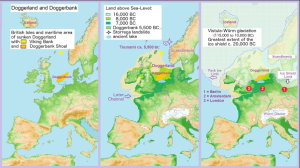
One of the most transformative discoveries in recent decades has been Doggerland, a prehistoric landmass that once connected Britain to mainland Europe. During the Mesolithic period, this low-lying plain supported forests, rivers, and thriving human populations. Archaeological evidence recovered from the North Sea—stone tools, animal remains, and human artifacts—confirms that Doggerland was inhabited until rising sea levels and a massive tsunami, likely triggered by the Storegga Slide around 6200 BCE, submerged it permanently.
Doggerland was not a mythic lost city but a lived landscape, erased by geological processes. Its discovery forced a reevaluation of early European settlement patterns and highlighted how dynamic Earth’s surface has always been.
Similar revelations have emerged elsewhere. Off the coast of Australia, submerged sites suggest extensive human presence dating back tens of thousands of years, when sea levels were significantly lower. These findings challenge linear narratives of migration and isolation, pointing instead to adaptability and environmental awareness among early populations.
Earth’s Hidden Continents and Forgotten Territories
Beyond regional land bridges, entire continental fragments now lie beneath the ocean. Zealandia, sometimes referred to as Earth’s eighth continent, once covered nearly two million square miles. Today, over 90 percent of it is submerged, with only New Zealand and New Caledonia visible above sea level. While not a “lost civilization” in the mythological sense, Zealandia demonstrates how profoundly Earth’s surface has changed since humans first began to organize into complex societies.
In South America, research in the Amazon basin has overturned long-standing assumptions about the region’s past. What was once thought to be an untouched wilderness is now known to have supported dense populations, with thousands of ancient mounds, engineered soils, and settlement networks. Similar reassessments are occurring in the Sahara, where satellite imagery has revealed traces of rivers, lakes, and human habitation beneath desert sands.
These discoveries suggest that ancient societies were far more widespread—and environmentally integrated—than previously believed.
Between Myth and Archaeology
The enduring story of Atlantis, described by Plato, continues to capture popular imagination. While no direct evidence confirms the existence of a technologically advanced, globe-spanning lost civilization, archaeology has shown that Plato’s broader premise—that lands and cultures can vanish beneath the sea—is not only plausible but historically documented.
Underwater archaeology has uncovered Roman ports, statues, and entire coastal cities now submerged due to sea-level rise. These sites lack the dramatic symbolism of Atlantis, yet they underscore a critical point: civilizations do not always collapse spectacularly; sometimes they are simply overtaken by water.
The question, then, is not whether submerged settlements existed, but how many remain undiscovered—and what they might reveal about ancient human capabilities.
Forgotten Engineers of a Changing Earth
Amazon and the Sahara are what unites these submerged landscapes is not mystery alone, but evidence of planning, adaptation, and engineering. The forgotten engineers of prehistory did not build in static environments. They understood rivers that shifted course, coastlines that advanced and retreated, and ecosystems that demanded flexibility.
Stone tools recovered from underwater contexts, remnants of dwellings, and modified landscapes point to deliberate design choices made in response to environmental conditions. These were not passive victims of nature, but active participants within it.
The loss of these landscapes has skewed archaeological narratives toward inland and elevated sites, creating an incomplete picture of early human development. Coastal and lowland societies—likely among the most innovative due to resource abundance—are underrepresented simply because their settlements were submerged.
A Planet in Motion
Seen through this lens, Earth itself becomes a dynamic actor in human history. Sea-level rise following the last Ice Age was not an isolated event but part of a broader planetary transformation. As glaciers melted, shorelines shifted, and habitable zones migrated, humans adapted—or moved.
Understanding submerged civilizations is therefore not about romanticizing lost worlds, but about recognizing that civilization has always been shaped by planetary forces. The archaeological record is not silent; it is incomplete, waiting for new methods and perspectives to recover what has been hidden.
Rewriting the Human Story
The study of submerged landscapes invites a more nuanced understanding of the past. It challenges rigid timelines and simplistic models of progress, reminding us that innovation, cooperation, and environmental awareness emerged under diverse conditions.
Doggerland, submerged Australian sites, Zealandia’s vanished plains, and the engineered landscapes of the Amazon all point to the same conclusion: early human societies were more adaptable, interconnected, and capable than traditional narratives suggest.
These lost territories do not belong to myth alone. They are part of humanity’s shared heritage, concealed beneath water and time. As underwater archaeology advances, the forgotten engineers of these submerged worlds may yet redefine how we understand the origins and resilience of civilization.